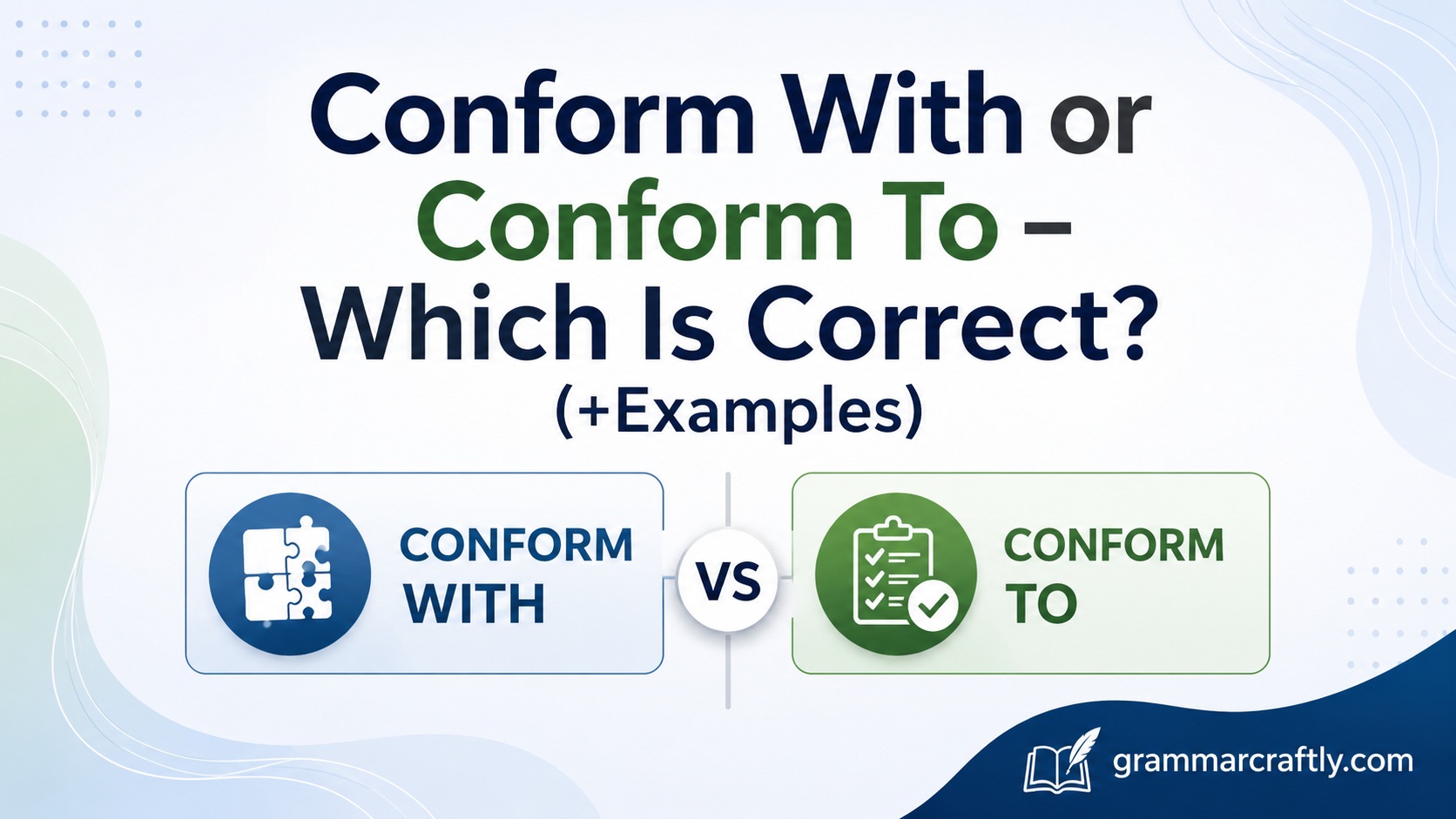
Conform With or Conform To – Which Is Correct? (+Examples) often confuses learners because both phrases seem similar in daily English use.
Many learners struggle to understand whether conform, conform to, or conform with is correct because the phrases appear almost identical in meaning and usage. Still, these subtle differences can change the intended message in both casual and formal communication. While teaching grammar, I noticed that even native speakers often intuitively recognize the distinction but cannot fully articulate why these prepositions have distinct grammatical functions. Using them incorrectly may create confusion, uncertainty, or awkward conversation, especially in professional writing. To use these constructions accurately, writers must focus on context, tone, and overall sentence structure. In most situations, conform expresses obedience, compliance, or adherence to rules, standards, or authority, whereas conform with suits harmonising elements, mutual agreement, alignment, and compatibility in casual settings. This basic understanding improves writing, increases clarity, supports precision, and creates a more confident tone.
I usually explain this topic through friendly examples, breaking ideas into simple parts instead of relying on large tables, diagrams, or heavy context-based explanations. With step-by-step practice, writers build confidence, improve communication, and handle both simple sentences and complex sentences more naturally. By paying attention to word choices, construction, and surrounding language, writing becomes more polished and produces an accurate outcome. The rule is not arbitrary because it reflects fundamental differences that many English speakers notice when these forms are misused due to their apparent interchangeability in casual conversation. In formal language, grammar often matters because the way each phrase applies changes the reader’s understanding of meaning. Conform usually suggests fitting, harmonizing, and shared understanding, while conform to connects more with an authoritative standard, a hierarchical relationship, or official requirements involving directional movement toward a fixed standard.
What Does “Conform” Really Mean in Modern English?
At its core, the verb conform means to match, follow, or behave according to something.
But that “something” changes everything.
English doesn’t treat all connections the same way. Instead, it uses different prepositions like to and with to signal relationships.
Think of it like this:
- Sometimes you move toward a rule
- Other times you match alongside facts or ideas
That small difference creates the entire confusion.
Here’s a simple breakdown:
- Conform = Adjust behavior or form
- To / With = Shows the type of relationship
A quick real-life example
- You conform to school rules because you follow them.
- You conform with scientific results because they match.
Same verb. Different logic.
That’s where most learners get stuck, but you won’t after this.
The Mental Model: Conform To vs Conform With Explained Simply
Let’s make this visual and intuitive.
Imagine two different directions in your mind:
Conform TO → Movement toward a rule, system, or structure
Conform WITH → Alignment or matching with something already existing
Now picture it like this:
- Conform To = You follow a path
- Conform With = You walk beside something that already exists
The easiest way to remember it
- TO = Direction
- WITH = Agreement
That’s it. If you only remember one idea from this article, keep that.
A metaphor that makes it stick
Think of a dance floor:
- When you conform to rules, you follow the instructor’s steps.
- When you conform with the music, your movement matches the rhythm naturally.
One is instruction-based. The other is harmony-based.
Conform To: Rules, Systems, and Structures
Now let’s go deeper into conformity, the more common of the two.
You use conformity when something must follow a rule, law, standard, or expectation.
Core idea
👉 You are adapting yourself to something external
Where you’ll see “Conform To” most often
- Laws and regulations
- School and academic rules
- Safety standards
- Company policies
- Technical requirements
Examples that feel real
- Employees must conform to workplace safety guidelines.
- Students conform to exam rules during testing.
- Products conform to international quality standards.
Simple breakdown table
| Situation | Why “Conform To” Works |
| Traffic laws | You follow enforced rules |
| Dress codes | You adjust behavior |
| Building codes | You meet fixed standards |
A practical case study
A software company once failed a compliance audit because its product didn’t conform to international data standards. They didn’t disagree with the rules. They simply didn’t match them.
After restructuring their system, they updated the software to conform to ISO requirements.
That’s conformity in action, not theory.
Conform With: Agreement, Evidence, and Harmony
Now let’s switch gears.
Conform with shows alignment, not obedience.
You use it when two things match logically or conceptually.
Core idea
👉 You are comparing or aligning two things
Where “Conform With” appears
- Scientific research
- Data analysis
- Beliefs or ideas
- Experimental results
- Observations and evidence
Examples that make it clear
- The findings conform with previous studies.
- Her explanation conforms with the available evidence.
- The results conform with expectations from the model.
Simple breakdown table
| Situation | Why “Conform With” Works |
| Research data | Comparing consistency |
| Scientific results | Checking agreement |
| Theories | Matching ideas |
A real-world analogy
Think of puzzle pieces.
- If they fit together perfectly, they conform with each other.
- No one is forcing them. They simply match.
That’s the key difference.
Why Learners Get Confused Between Conform To vs Conform With
Let’s be honest. English doesn’t always behave logically.
Here’s why this confusion happens:
Cognitive overload
Your brain tries to memorize full phrases instead of patterns.
Translation interference
Many languages don’t use prepositions the same way English does.
Similar meaning overlap
Both phrases relate to “matching” something, so they feel interchangeable.
Lack of context learning
Most learners see rules in isolation instead of real usage.
Real-Life Scenarios That Make Everything Click
Let’s ground this in everyday life.
At school
- You conform to classroom rules.
- Your answers conform with grading criteria when they match expectations.
At work
- Employees conform to company policies.
- Reports conform with financial data from previous quarters.
In society
- People conform to laws.
- Social behavior often conforms with cultural expectations.
In technology
- Devices conform to technical standards.
- System outputs conform with input models.
Quick Comparison Table: Conform To vs Conform With
| Feature | Conform To | Conform With |
| Meaning | Follow rules or systems | Match or align with something |
| Type of relationship | Directional | Comparative |
| Usage focus | Rules, laws, standards | Data, ideas, evidence |
| Tone | Obligatory | Analytical |
| Example | Conform to law | Conform with data |
This table alone can solve most confusion instantly.
Common Mistakes (And How to Fix Them Instantly)
Even advanced learners mix these up.
Let’s clean it up.
Mistake: Using “conform with” for rules
❌ Incorrect: Employees must conform with company rules.
✔ Correct: Employees must conform to company rules.
Mistake: Using “conform to” for data matching
❌ Incorrect: The results conform to previous research.
✔ Correct: The results conform with previous research.
Mistake: Dropping the preposition
❌ Incorrect: He must conform the standards.
✔ Correct: He must conform to the standards.
Mistake correction table
| Wrong Usage | Correct Usage |
| conform with rules | conform to rules |
| conform to data | conform with data |
| conform standards | conform to standards |
Memory Hacks That Make It Stick Forever
Let’s make this unforgettable.
Hack 1: Direction trick
- TO = Toward a rule
- You move toward something fixed
Hack 2: Side-by-side trick
- WITH = Walking beside something
- You compare or align
Hack 3: Visual shortcut
Imagine:
- A road = conform to
- Two parallel lines = conform with
Hack 4: Emotional anchor
- Rules feel strict → to
- Data feels neutral → with
Advanced Insight: Why English Uses Different Prepositions
English didn’t randomly assign “to” and “with.”
It evolved from older Germanic and Latin structures where prepositions showed relationships clearly.
Over time:
- “To” became directional
- “With” became associative
That’s why English says:
- Go to school
- Meet with someone
- Conform to rules
- Conform with evidence
It’s all about relationship mapping.
Fast Decision Rule (Use This in Real Writing)
When you’re stuck, ask yourself:
Step 1: Am I following a rule?
→ Yes → Use conform to
Step 2: Am I comparing or matching ideas?
→ Yes → Use conform with
That’s your 2-second decision system.
No overthinking needed.
Expert Writing Tips for Natural Usage
Want your English to sound natural, not textbook-heavy?
Try this:
Tip 1: Don’t overuse “conform”
Native speakers often replace it with:
- Follow
- Meet
- Match
- Align with
Tip 2: Keep sentences clean
- Short sentences feel clearer.
- Long sentences often hide mistakes.
Tip 3: Think in meaning, not rules
Ask yourself: What relationship am I describing?
That matters more than memorizing grammar charts.
Read More: Is It Grammatically Correct to Say “Dear All”?
Mini Case Study: How Writers Improve Clarity
A student once wrote:
“The report must conform with school regulations.”
A teacher corrected it:
“The report must conform to school regulations.”
Why?
Because regulations are rules you follow, not data you compare.
That small change improved clarity and correctness instantly.
FAQs About Conform To vs Conform With
What is the main difference between conform to and conform with?
You use conform to for rules and conform with for matching or agreement.
Which one is more common?
Conform appears more often in daily English because rules and systems are common.
Can they ever be interchangeable?
No. They depend on context. Swapping them changes meaning or sounds unnatural.
Why do learners confuse them?
Because both relate to “matching” something, but the relationship type differs.
What’s the easiest way to remember them?
Think:
- To = Toward a rule
- With = Alongside facts
Final Thoughts on Conform To vs Conform With
Once you stop treating grammar as memorization and start seeing it as relationships, everything becomes easier.
Here’s the truth:
- Conform to controls behavior
- Conform with checks alignment
One feels like instruction. The other feels like a comparison.
And once that clicks, you won’t just remember the difference you’ll use it naturally without thinking.
That’s the real goal.