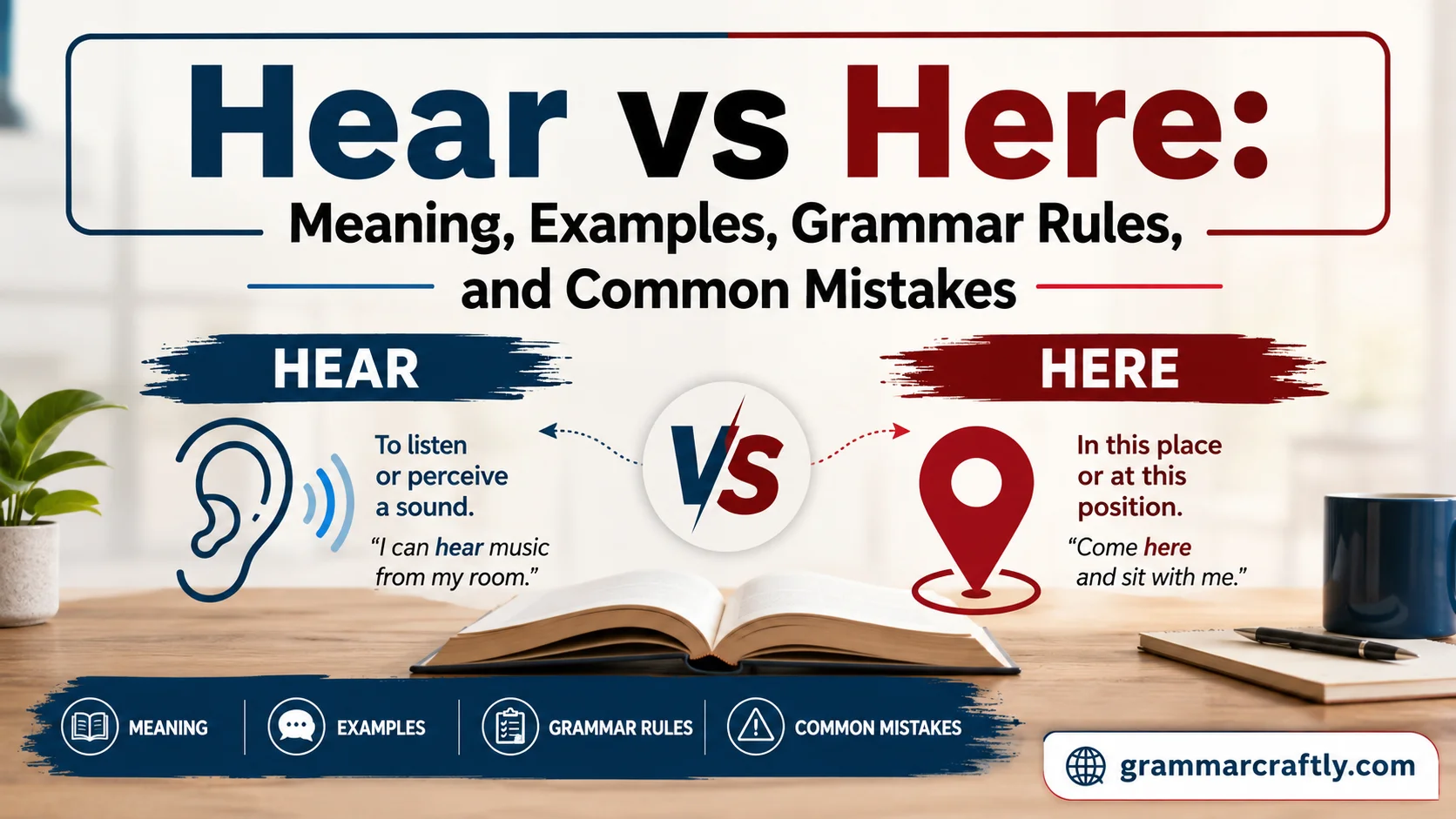
Hear vs Here: Meaning, Examples, Grammar Rules, and Common Mistakes makes English word choices simple, clear, and easy to understand today.
The hear vs here question remains a common confusion in English for English learners, learners, native speakers, and every speaker. These word pairs are perfect homophones that share the same pronunciation and sound identical when spoken, but they have different meanings, definitions, and a clear difference in usage. Hear relates to sound and listening, while here refers to location, place, position, and presence. Learning their relation improves language learning, language skills, communication, communication skills, and understanding of spoken language and written language.
This guide explains grammar, grammar rules, examples, word choice, word usage, proper usage, and the distinction between these terms. In writing, written communication, and professional writing, a simple typo can change the meaning of sentence or an entire sentence. Writers may accidentally mix or mix up the words in emails, essays, casual messages, social media posts, and professional documents. The good news is that memory tricks, practical exercises, and proofreading will help you remember them effortlessly, spot mistakes instantly, and rarely make a confusing homophone error again. By the end, you will know how to use these words correctly, grammatically, and with clear meaning—so let’s dive in and understand them exactly and completely.
Hear vs Here: Quick Answer
If you’re in a hurry, remember this:
| Word | Meaning | Example |
| Hear | To perceive sound through your ears | I can hear the birds singing. |
| Here | In this place or location | Please come here. |
A simple trick helps many people remember the difference:
- Hear contains the word ear.
- You use your ears to hear sounds.
- Here refers to a place or position.
That single memory trick solves most confusion.
Understanding Homophones in English
Before diving deeper into hear vs here, it helps to understand why these words are often confused.
What Are Homophones?
Homophones are words that sound identical when spoken but have different meanings and spellings.
Examples include:
| Homophone Pair | Meaning Difference |
| Their / There | Possession vs location |
| To / Too | Direction vs also |
| Your / You’re | Possession vs contraction |
| Hear / Here | Sound vs location |
When people speak, listeners rely on context to determine which word they mean.
When writing, however, the correct spelling becomes essential.
Why Homophones Cause Mistakes
Most people learn language by hearing it first. As a result, the brain often focuses on pronunciation instead of spelling.
For example:
“I can hear you.”
and
“I am here.”
sound very similar because the key words are pronounced exactly the same.
During fast typing, many writers accidentally choose the wrong version.
What Does “Hear” Mean?
The word hear is a verb.
It means to perceive sound through your ears.
Definition of Hear
Hear refers to becoming aware of sound.
You don’t always choose to hear something. Sound simply reaches your ears.
For example:
- I hear music from the next room.
- Can you hear the thunder?
- We heard a strange noise outside.
In each sentence, the person receives sound through hearing.
Hear vs Listen
Many learners confuse hear and listen.
Although related, they are not identical.
| Hear | Listen |
| Happens naturally | Requires attention |
| Passive action | Active action |
| You may not intend it | You intentionally do it |
Examples:
- I hear traffic outside.
- I listen to my favorite podcast every morning.
You can hear something without trying.
You listen when you deliberately focus on sound.
Common Uses of Hear
People use hear in many everyday situations:
Hearing Sounds
- I hear footsteps upstairs.
- She heard the door close.
- We heard birds at sunrise.
Receiving News
- Did you hear the announcement?
- I heard that the company is expanding.
- We heard about the event yesterday.
Understanding Information
- I hear what you’re saying.
- Let me hear your opinion.
- The judge heard both sides of the case.
Examples of Hear in Sentences
Here are additional examples:
- I can hear rain hitting the roof.
- We heard laughter from across the hall.
- Did you hear the alarm?
- She heard her name being called.
- Everyone heard the exciting news.
What Does “Here” Mean?
Unlike hear, here is not a verb.
It usually functions as an adverb.
Definition of Here
Here refers to a specific place, position, or location.
Examples:
- Come here.
- We are here.
- Put the package here.
The word identifies where something is.
Common Uses of Here
Referring to Location
- Sit here beside me.
- The restaurant is here.
- Leave your bag here.
Indicating Presence
- Is everyone here?
- I’m here now.
- She’s here for the meeting.
Drawing Attention
- Here is your receipt.
- Here comes the bus.
- Here are the results.
Examples of Here in Sentences
- The keys are here on the table.
- Please wait here.
- We arrived here yesterday.
- Here is the information you requested.
- Everyone is here except John.
Hear vs Here: The Key Difference Explained
The biggest difference between hear vs here comes down to meaning.
| Feature | Hear | Here |
| Part of Speech | Verb | Adverb |
| Main Meaning | Perceive sound | Location or position |
| Related To | Ears and hearing | Places and presence |
| Example | I hear music. | I am here. |
Think About the Context
Ask yourself a simple question:
Am I talking about sound or location?
If you’re discussing sound, use hear.
If you’re discussing a place, use here.
Examples:
- I can hear the ocean.
- We are standing here by the ocean.
One sentence involves sound.
The other involves location.
Why People Confuse Hear and Here
Many native English speakers still make this mistake.
They Sound Identically
Both words are pronounced:
/hɪr/
Because the pronunciation is identical, your ears cannot distinguish them.
Only the spelling reveals the difference.
Fast Typing Creates Errors
When people type quickly, they often rely on sound rather than meaning.
For example:
Incorrect:
Can you here me?
Correct:
Can you hear me?
The mistake occurs because the writer typed the word that sounded right instead of the word that was grammatically correct.
Autocorrect Doesn’t Always Help
Since both words are real English words, spell checkers often miss the error.
That’s why proofreading matters.
Hear vs Here in Everyday Life
Let’s examine how these words appear in real situations.
At Work
Correct:
- Did you hear the client feedback?
- Please come here for the meeting.
Incorrect:
- Did you here the client feedback?
- Please come hear for the meeting.
At School
Correct:
- I can hear the teacher clearly.
- Sit here in the front row.
During Travel
Correct:
- We heard the train arriving.
- We are here at the station.
On Social Media
Correct:
- Did you hear the latest news?
- Here is my new photo.
Common Phrases Using Hear
English speakers frequently use hear in expressions.
Hear Me Out
Meaning: Listen before making a decision.
Example:
Hear me out before you say no.
Hear From Someone
Meaning: Receive communication.
Example:
I hope to hear from you soon.
Hear a Rumor
Meaning: Learn unofficial information.
Example:
I heard a rumor about the merger.
Hear the Truth
Meaning: Learn accurate information.
Example:
It’s time to hear the truth.
Hear Voices
Meaning: Perceive voices.
Example:
He thought he could hear voices outside.
Common Phrases Using Here
The word here appears in many common expressions.
Here You Go
Meaning: Giving something to someone.
Example:
Here you go. Your coffee is ready.
Here and There
Meaning: In various places.
Example:
We found wildflowers here and there.
Here We Go
Meaning: Something is beginning.
Example:
Here we go. The race is about to start.
Here Comes
Meaning: Someone or something is approaching.
Example:
Here comes the school bus.
Here to Stay
Meaning: Permanent.
Example:
Remote work is here to stay.
Read More: Attend or Tend? The Ultimate Guide to Meaning, Usage, Grammar Rules,,
Hear vs Here Examples Side by Side
Seeing both words together helps reinforce the difference.
| Hear Example | Here Example |
| I hear music. | I am here today. |
| Can you hear me? | Please come here. |
| We heard the news. | The package is here. |
| She can hear birds. | Everyone is here now. |
| Did you hear that? | Put your bag here. |
Notice how hear always connects to sound.
Meanwhile, here always connects to place or presence.
Common Grammar Mistakes With Hear and Here
Mistake: Using Here Instead of Hear
Incorrect:
I can’t here you.
Correct:
I can’t hear you.
Mistake: Using Hear Instead of Here
Incorrect:
Your seat is hear.
Correct:
Your seat is here.
Mistake in Professional Emails
Incorrect:
I look forward to here from you.
Correct:
I look forward to hear from you.
Actually, even better:
I look forward to hearing from you.
This example shows how grammar and word choice work together.
Hear vs Here vs Listen
Many people search for the difference between hear, here, and listen.
Here’s a simple breakdown.
| Word | Meaning |
| Hear | Perceive sound |
| Listen | Pay attention to sound |
| Here | Location or position |
Examples:
- I hear music.
- I listen to music.
- I am here listening to music.
Each word serves a different purpose.
Hear vs Here vs There
Another common confusion involves here and there.
Here
Refers to a place close to the speaker.
Example:
Come here.
There
Refers to a place farther away.
Example:
Put it over there.
Comparison:
| Word | Meaning |
| Here | Near the speaker |
| There | Away from the speaker |
Examples:
- Come here right now.
- Leave it there.
The History and Origins of Hear and Here
Language becomes easier to understand when you know where words come from.
Origin of Hear
The word hear comes from Old English hieran.
Its meaning centered on listening and perceiving sound.
For centuries, the meaning has remained remarkably consistent.
Origin of Here
The word here comes from Old English her.
It referred to a place near the speaker.
Again, the meaning has changed very little over time.
Despite their similar sounds, these words developed along completely different paths.
Memory Tricks That Actually Work
Students often remember words better through associations.
The Ear Trick
Look closely:
H-ear
The word contains ear.
You hear with your ears.
Simple and effective.
The Place Trick
Imagine pointing at the ground.
You say:
Right here.
That physical location helps connect the meaning.
Color Coding Method
Some teachers use visual learning:
- Hear = sound waves
- Here = map location
The brain remembers visual patterns surprisingly well.
A Real-World Case Study
The Email Mistake That Changed the Message
A job applicant once sent an email saying:
I look forward to here from you.
The hiring manager understood the intended meaning. However, the mistake created a less professional impression.
The correct sentence was:
I look forward to hearing from you.
One small spelling error changed the professionalism of the message.
This example shows why mastering hear vs here matters in business communication.
Hear vs Here in Professional Writing
Professional documents demand accuracy.
Business Emails
Correct:
- Did you hear from the client?
- Please come here for a quick discussion.
Reports
Correct:
- We heard positive feedback from customers.
- Here are the quarterly results.
Academic Writing
Correct:
- Participants could hear the audio recording.
- Here is the data collected during the study.
These distinctions help maintain clarity and credibility.
Quick Reference Cheat Sheet
| If You Mean… | Use |
| Sound | Hear |
| Listening | Hear |
| Receiving news | Hear |
| A location | Here |
| Presence | Here |
| A place nearby | Here |
When in doubt:
Sound = Hear
Place = Here
Practice Exercise
Choose the correct word.
Questions
- Can you _____ me now?
- Please sit _____.
- I _____ the thunder.
- Everyone is _____ today.
- Did you _____ the announcement?
Answers
- Hear
- Here
- Hear
- Here
- Hear
FAQs
What is the difference between hear and here?
Hear means to listen to or receive sound through your ears, while here refers to a place or location. Although they sound the same, they have different meanings and uses in English grammar.
Why do people confuse hear and here?
People confuse these words because they are homophones. They have the same pronunciation but different spellings and meanings. Even native speakers occasionally mix them up when writing quickly.
Is hear vs here a grammar mistake or a spelling mistake?
It can be both. Using hear instead of here, or vice versa, is usually a spelling mistake, but it also affects grammar and sentence meaning because the wrong word changes the context of what you’re trying to say.
How can I remember when to use hear and here?
A simple memory trick is to connect hear with your ears because both words contain “ear.” Think of here as pointing to a place or your present location. Regular practice will make their usage easier to remember.
Can hear and here be used in professional writing?
Yes. Both words are commonly used in emails, essays, reports, and other professional documents. Using the correct word helps make your writing clear, accurate, and grammatically correct.
Conclusion
Understanding Hear vs Here: Meaning, Examples, Grammar Rules, and Common Mistakes is easier once you know what each word represents. Hear relates to sound and listening, while here points to location or presence. Since they are perfect homophones, they can easily create confusion, but learning their meanings, spellings, and grammar rules will help you avoid common mistakes. With careful proofreading and regular practice, you’ll be able to use both words naturally and confidently in everyday and professional communication.