Fiancé vs Fiancée: Understanding the Difference explains how fiancé and fiancée reflect gender in English and French usage for clear learning.
I still remember how Ravi happily announced his engagement on social media after he proposed to his girlfriend, but a minor slip in his posts created funny confusions. He accidentally refers to his male partner as fiancée instead of fiancé, proving these are not replaceable terms because their meanings truly matter. They help people differentiate the correct term in the English language, especially for non-native speakers in India where this kind of confusion is quite commonplace. With proper understanding, simple guidance, and less hesitation, learners can easily distinguish the words, pronounce them correctly, and avoid doubts during an engagement announcement or proposal. In the following sections, language experts often unpack the meaning, provide usage examples, share relatable examples, and offer vital tips to help readers remember the small but important spelling difference between the masculine form and the feminine ending. During my early studies, I became curious about how English and French blend through these small engagement terms. Over time, I noticed many speakers pause while choosing the correct form, especially because modern English usually avoids gendered endings.
That curiosity pushed me to dig deeper into the words, their French origins, Latin origins, and linguistic roots linked to fidare. These borrowed terms were carefully shaped by history, leaving traces of a long language journey across many languages and traditions. A friend once asked me about the correct spelling, and the memory came rushing back that the extra E denotes feminine noun forms. That tiny detail became a meaningful story about tradition, cultural tradition, and how languages derive meaning from another language. This learning process improves clarity, contextual understanding, communication, pronunciation, and overall language learning by explaining roots, endings, forms, gendered forms, semantic relation, semantic difference, contextual relevance, grammatical difference, usage distinction, and the full language structure behind the feminine and masculine versions of the noun.
Fiancé vs Fiancée Meaning: What Each Word Actually Means
Let’s start with the core distinction.
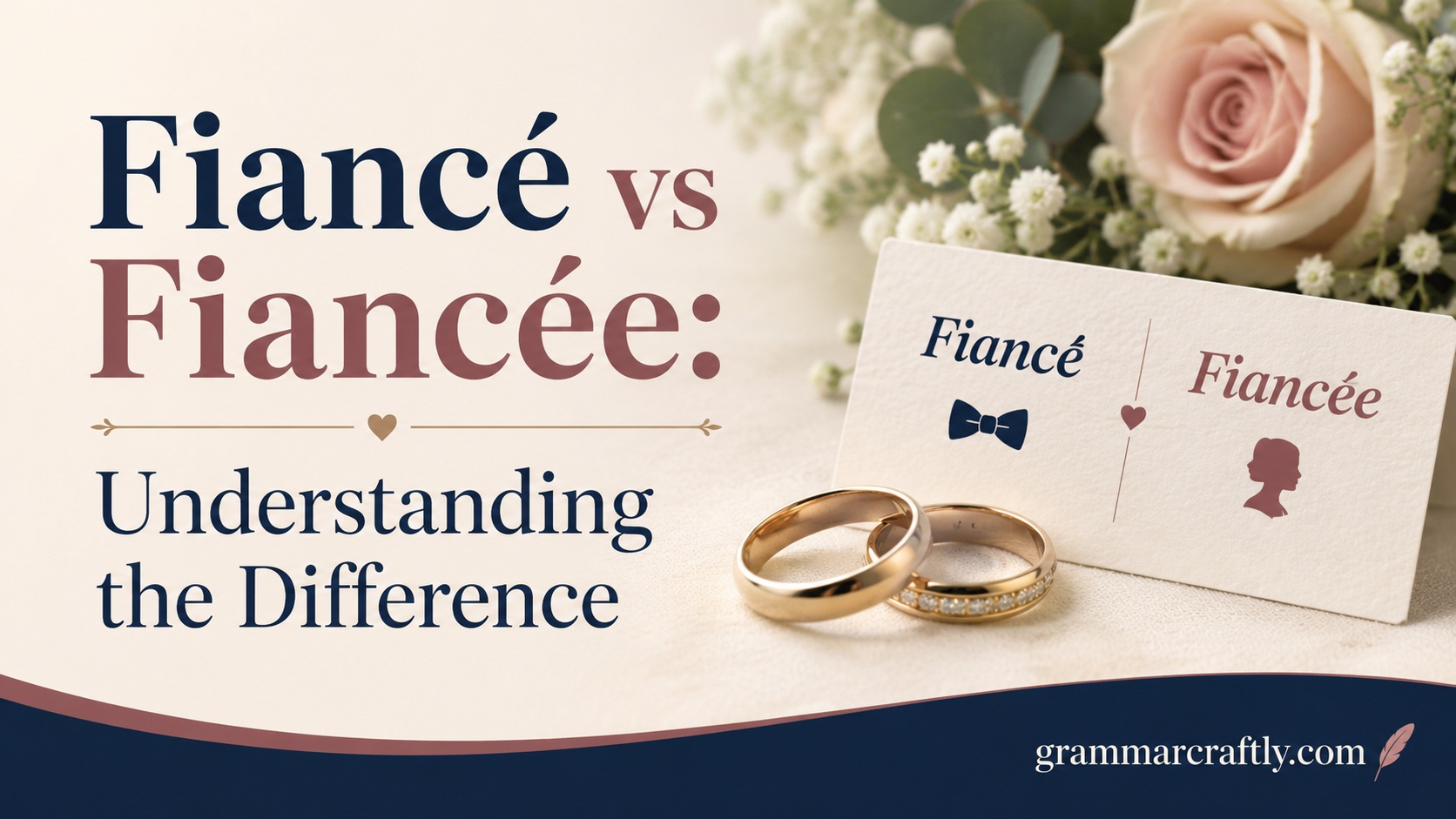
Fiancé means an engaged man.
Fiancée means an engaged woman.
That is the rule in standard English usage. The spelling difference is tiny, but the gender difference matters.
Here is the easiest way to remember it:
- Fiancé ends with -é
- Fiancée ends with -ée
That extra e at the end of fiancée signals the feminine form in French. English borrowed both words from French and kept that gender distinction.
Quick meaning breakdown
| Word | Meaning | Gender | Common Use |
| Fiancé | Engaged man | Masculine | “My fiancé and I are getting married next spring.” |
| Fiancée | Engaged woman | Feminine | “Her fiancée is planning the proposal ceremony.” |
A small spelling change can carry a real meaning shift. That is why accuracy matters, especially in formal writing.
Fiancé vs Fiancée Pronunciation: How to Say Them Naturally
Many people worry about spelling first. Pronunciation matters too.
In modern English, both words are usually pronounced very similarly:
- Fiancé: fee-ahn-SAY
- Fiancée: fee-ahn-SAY
Yes, they sound almost the same. That is one reason people confuse them. In casual speech, many speakers do not clearly distinguish the final sound. Still, the written form keeps the gender difference visible.
A simple pronunciation tip
Think of the final -é as an “ay” sound.
Then notice the second word has one more letter at the end.
That extra letter is the clue.
A useful shortcut:
- Fiancé = one less “e”
- Fiancée = one more “e”
That one extra letter is not decoration. It changes the word.
Fiancé vs Fiancée History: Where the Words Came From
The story behind these words is surprisingly elegant. Both come from French, which itself drew heavily from older Latin roots and centuries of grammatical development.
In French, many words change form depending on gender. That is normal there. English, on the other hand, usually does not mark gender in nouns this way. So when English borrowed fiancé and fiancée, it imported the French gender distinction along with the words themselves.
The linguistic journey in plain English
- Latin influenced Old French
- Old French developed gendered endings
- Modern French kept those forms
- English borrowed both words
- English speakers preserved the spelling difference, even though English itself does not usually need it
This is one of those moments where English says, “I’ll take the words, but not the whole system.”
That is also why these terms feel slightly formal or refined to many English speakers. They arrived through French, and French loanwords often carried a sense of style, class, or sophistication in English-speaking society.
Why English kept the gendered spellings
English could have flattened both forms into one. It did not. Why?
A few reasons stand out:
- The borrowed spellings were already established in written use
- The gender distinction helped clarify meaning
- French phrasing had prestige in higher social circles
- English often preserves borrowed forms when they feel culturally useful
Language does not always choose simplicity. Sometimes it chooses habit.
Fiancé vs Fiancée in Modern English Usage
Today, fiancé vs fiancée still means the same thing it did before: engaged man versus engaged woman. But modern usage looks a little different from older formal writing.
In everyday life, people often shorten, simplify, or avoid the terms entirely. You will see things like:
- my partner
- my future spouse
- my soon-to-be husband
- my soon-to-be wife
- my significant other
These alternatives show how language changes with culture. In many settings, people care less about the traditional French terms and more about clear, inclusive communication.
When people still use fiancé and fiancée
You will most often see the words in:
- wedding announcements
- engagement cards
- formal invitations
- newspaper or magazine stories
- legal documents
- family introductions
- polished social media captions
They still work beautifully in those contexts. In fact, they can sound elegant and precise when used correctly.
When people often skip them
People often avoid the words in:
- casual texting
- fast-paced social media posts
- gender-neutral communication
- professional settings where relationship labels are unnecessary
- inclusive writing that avoids assumptions about gender
That is not a sign that the words are wrong. It just means the context has changed.
Fiancé vs Fiancée Examples in Real Life
Nothing makes a grammar point clearer than real examples.
Correct use of fiancé
- “My fiancé and I booked the venue last week.”
- “Her fiancé works in finance.”
- “He introduced me to his fiancé at dinner.”
Correct use of fiancée
- “My fiancée and I are planning a spring wedding.”
- “His fiancée designed the invitations.”
- “She called her fiancée right after the proposal.”
Incorrect use
- “My fiancée and I are getting married.”
This is correct only if the speaker is referring to a woman. - “His fiancé arrived early.”
This is correct only if the fiancé is a man.
A helpful rule
If you know the person’s gender and want to be precise, use the traditional word.
If you do not need that level of precision, a gender-neutral term may be better.
Fiancé vs Fiancée in Formal Writing, Invitations, and Legal Documents
This is where the details really matter.
Wedding invitations
On wedding invites, the wording often aims for elegance and tradition. That makes fiancé and fiancée a natural fit.
Examples:
- “Celebrating the engagement of John and his fiancée, Maria”
- “Anna and her fiancé, Daniel, invite you to join them…”
These forms feel polished and familiar. They also make the relationship clear at a glance.
Legal and immigration documents
In legal paperwork, precision matters more than style. Some forms may ask for relationship status, spouse-to-be status, or engagement details. When documents are formal, using the correct term can help avoid confusion.
For example:
- If the applicant is a man, use fiancé
- If the applicant is a woman, use fiancée
That said, official forms may now prefer broader categories like “partner” or “intended spouse.” This shift reflects modern administrative language, which often tries to be more inclusive and less assumption-based.
Professional writing
In business writing, you usually do not need to mention engagement terms unless the topic is personal or event-related. When you do, keep the tone clear and tasteful.
Example:
- “The speaker will be accompanied by her fiancée.”
That works. It sounds polished and natural.
Social media posts
Social media is more relaxed. People may use whichever wording feels authentic or stylish.
Examples:
- “Forever starts now with my fiancé ❤️”
- “She said yes, and now my fiancée and I are over the moon.”
Here, the tone matters just as much as the grammar.
Fiancé vs Fiancée and Gender-Neutral Alternatives
Language has changed fast in recent years. Many people now prefer wording that does not assume gender.
Common gender-neutral alternatives
- partner
- significant other
- better half
- future spouse
- intended spouse
- soon-to-be spouse
These options work well when:
- you want to stay neutral
- you do not know the person’s gender identity
- you are writing for a broad audience
- you want a more modern or inclusive tone
Where gender-neutral terms work best
| Context | Best Choice | Why It Works |
| Casual conversation | Partner | Simple and clear |
| Inclusive writing | Significant other | Avoids gender assumptions |
| Legal or official forms | Future spouse | More precise for paperwork |
| Social media | Partner or fiancée/fiancé | Depends on tone |
| Professional bios | Partner | Neutral and respectful |
The smart rule
Use fiancé or fiancée when gender-specific language fits the situation.
Use neutral alternatives when clarity, inclusivity, or simplicity matters more.
That balance keeps your writing modern without losing precision.
Fiancé vs Fiancée in Everyday Speech: Do People Still Care?
Yes, but usually only when the difference matters.
A lot of people use the terms correctly without thinking about the rules. Others avoid them altogether. Both habits are common.
That means the words still matter, but not in every setting.
Think of them like formal shoes. They are perfect for a wedding or a polished event. They are unnecessary for a walk in the park.
Everyday language trend
People today often favor:
- simplicity
- speed
- inclusion
- natural speech
So while fiancé vs fiancée remains correct and useful, many speakers reach for shorter, easier words in daily life.
That does not make the traditional terms obsolete. It just means the language has expanded.
Fiancé vs Fiancée Common Mistakes to Avoid
Even confident writers slip up with these words.
Mistake: using the wrong gendered form
This is the most obvious error. It happens when people assume one spelling fits everyone.
Fix: Match the term to the person’s gender if you are using the traditional forms.
Mistake: dropping the accent in formal writing
You will often see fiance instead of fiancé. That happens because accent marks are easy to forget on keyboards and phones.
Technically, the accent matters in the standard spelling. In casual digital writing, many people skip it. In formal writing, keep it.
Mistake: using the words interchangeably
They are not interchangeable.
They point to different genders.
Mistake: forcing the term when a neutral one would sound better
Sometimes partner or future spouse sounds more natural. If the gendered term adds nothing useful, skip it.
Mistake: overthinking pronunciation
The pronunciations are close enough that perfect distinction is not usually necessary in everyday speech. Focus on clarity, not performance.
Fiancé vs Fiancée Quick Comparison Table
Here is a clean side-by-side view.
| Feature | Fiancé | Fiancée |
| Gender | Male | Female |
| Meaning | Engaged man | Engaged woman |
| Origin | French | French |
| Accent mark | One é | Two e-style ending in French spelling tradition |
| Common pronunciation | fee-ahn-SAY | fee-ahn-SAY |
| Best used in | Formal and traditional contexts | Formal and traditional contexts |
| Neutral alternative | Partner | Partner |
This table solves the core question in seconds. It is simple, but powerful.
Fiancé vs Fiancée Memory Tricks That Actually Work
If spelling slips your mind, use one of these tricks.
The extra e trick
- Fiancée has an extra e
- Think of the extra e as standing for “extra feminine”
That is a handy visual cue.
The “man vs woman” shortcut
- Fiancé = man
- Fiancée = woman
Link the final letter count to gender if that helps.
The sentence test
Use the word in a sentence and check whether it matches the person.
- “Her fiancé” sounds right if the person is male
- “Her fiancée” sounds right if the person is female
The context trick
If you do not know the gender or do not need to mention it, use partner instead. That avoids mistakes entirely.
Fiancé vs Fiancée Case Studies: Real-World Usage
A few practical examples make the difference feel even clearer.
Case study: wedding announcement
A couple is announcing their engagement in a newspaper.
- Correct wording: “Emily and her fiancé, Mark, are pleased to announce their engagement.”
Why it works: It is formal, traditional, and precise.
Case study: social media post
A user posts a photo after proposing.
- Correct wording: “I can’t wait to marry my fiancée.”
Why it works: It sounds warm and personal.
Case study: professional profile
Someone updates their bio and wants to mention their relationship in a subtle way.
- Better wording: “Lives with his partner in Chicago.”
Why it works: It is neutral, clean, and professional.
Case study: legal form
A visa application asks for relationship status.
- Best wording: Use the exact term requested on the form, or use future spouse if the form allows it.
Why it works: Legal forms care about accuracy more than style.
These examples show the real lesson: the right word depends on the setting, not just the dictionary definition.
Fiancé vs Fiancée and the Shift Toward Inclusive Language
Modern language is changing fast. People are more aware of identity, tone, and assumptions than they used to be.
That affects relationship words too.
Why inclusive language matters
Inclusive language helps you:
- avoid unnecessary assumptions
- respect different identities
- sound thoughtful and current
- communicate clearly with broad audiences
How that changes usage
Instead of always reaching for fiancé or fiancée, many writers now choose words that fit the situation better.
For example:
- “My partner and I are engaged.”
- “Their future spouse will join them at the event.”
- “The couple announced their engagement.”
These options often feel smoother and more flexible.
That said, traditional terms still have a place. They remain correct, recognizable, and elegant when used with intent.
Fiancé vs Fiancée: A Simple Decision Guide
Still unsure which word to use? Use this quick guide.
Choose fiancé when
- the engaged person is male
- you want traditional wording
- the context is formal or elegant
Choose fiancée when
- the engaged person is female
- you want traditional wording
- the sentence needs a precise feminine form
Choose partner or future spouse when
- gender does not matter
- the audience is broad
- you want inclusive language
- the setting is casual or modern
That is the whole game. Clear. Fast. Useful.
Fiancé vs Fiancée in One Sentence
If you need the shortest possible answer:
Fiancé is an engaged man, and fiancée is an engaged woman.
That single line solves the grammar problem.
Everything else helps you use it well.
Read More: In the Same Day or On the Same Day? Correct Usage
Why This Difference Still Matters
Some people think the distinction is old-fashioned. That is only partly true. Yes, the words come from French tradition. Yes, many people now use neutral alternatives. But the traditional forms still matter for several reasons.
They matter because:
- they preserve precise meaning
- they appear in formal writing
- they remain common in social and wedding contexts
- they help writers sound polished
- they reflect a useful piece of language history
In other words, this is not just trivia. It is practical knowledge.
Language works best when it gives you options. Knowing fiancé vs fiancée means you can choose the right word for the moment instead of guessing.
Final Thoughts on Fiancé vs Fiancée
The difference between fiancé and fiancée is small in print but meaningful in use.
- Fiancé = engaged man
- Fiancée = engaged woman
Both words come from French. Both still appear in formal and social writing. Both can sound elegant when used correctly. And both are easy to use once you remember the extra e in fiancée.
At the same time, modern language gives you other choices. Partner, future spouse, and significant other may work better in many contexts. That is not a replacement for the traditional terms. It is simply more flexibility.
So the next time you write about an engagement, pause for a second. Check the gendered form. Check the tone. Then choose the word that fits best.
That small decision can make your writing sharper, clearer, and more confident.
Quick Reference Cheat Sheet
| Situation | Best Word |
| Engaged man | Fiancé |
| Engaged woman | Fiancée |
| Gender-neutral writing | Partner |
| Formal engagement announcement | Fiancé / Fiancée |
| Casual conversation | Partner or the traditional term |
| Professional or inclusive writing | Partner or future spouse |
The Bottom Line
When it comes to fiancé vs fiancée, the rule is easy once it clicks:
- one word for an engaged man
- one word for an engaged woman
- one extra e makes all the difference
That tiny spelling shift carries real meaning. And now, you know exactly how to use it.