“I’ve Added” vs. “I Added” – Detailed Comparison with Examples explains tense choices, helping learners use grammar clearly in speech and writing every day.
In English grammar, a common confusion comes from similar phrases with different meanings, and a common example is I’ve Added and I Added. Many learners struggle to choose between the present perfect tense and the simple past tense because this phrase choice affects writing skills, spoken English, and grammar accuracy. One form connects a past action to the present moment and shows a current result, while the other describes a finished event in the past. If you say you have added a name to a list, it suggests it is there currently, but a completed action at a specific time, like yesterday, puts the focus on when it happened instead of the present effect. This distinction between verb forms helps you communicate more naturally in casual situations and professional situations, whether in emails, academic papers, blog posts, or everyday conversations, and from teaching, I’ve seen that mastering these tenses makes communication clearer and more polished.
A practical guide to this meaning starts with simple grammar rules and real examples because common mistakes happen when writers miss this practical difference. The key idea is that one form shows present consequences, where an event may be complete in the past but still has present relevance to the state of something now. These aspects generally explain why the perfect tense avoids an explicit time unless the period includes the present. In writing and speaking, choosing the right verb form changes clarity, tone, and message for different purposes, depending on tense, context, and timeline. These expressions describe completed actions, but the nuance appears in everyday communication, from sending an email, drafting a report, or having a casual conversation in a natural, professional setting. This explanation breaks down the differences in American English through real-world examples, showing how grammar choices can subtly shift meaning in recent actions, completed tasks, and ongoing relevance, especially with specific time references, giving you a practical understanding of the right sentence for clearer writing and more polished English.
Why “I’ve Added vs I Added” Confuses So Many Learners
Let’s be honest. This confusion doesn’t come from lack of intelligence. It comes from how English is taught.
Most learners hear two rules:
- Present perfect = unfinished time
- Past simple = finished time
Sounds neat. But real life doesn’t behave that neatly.
For example, imagine you say:
- “I’ve added the file.”
- “I added the file.”
Both can feel correct. Both can mean similar actions. Yet native speakers feel a difference instantly.
That “feeling gap” is the real problem.
Here’s what usually causes confusion:
- You focus too much on grammar labels
- You translate from your native language
- You ignore conversation context
- You treat English like math instead of communication
But English doesn’t reward perfect rules. It rewards natural timing and intent.
As linguist David Crystal once explained:
“Grammar is not just structure. It is meaning in motion.”
That “motion” is exactly what separates I’ve added from I added.
The Core Difference in “I’ve Added vs I Added” (Simple Truth First)
Let’s strip everything down.
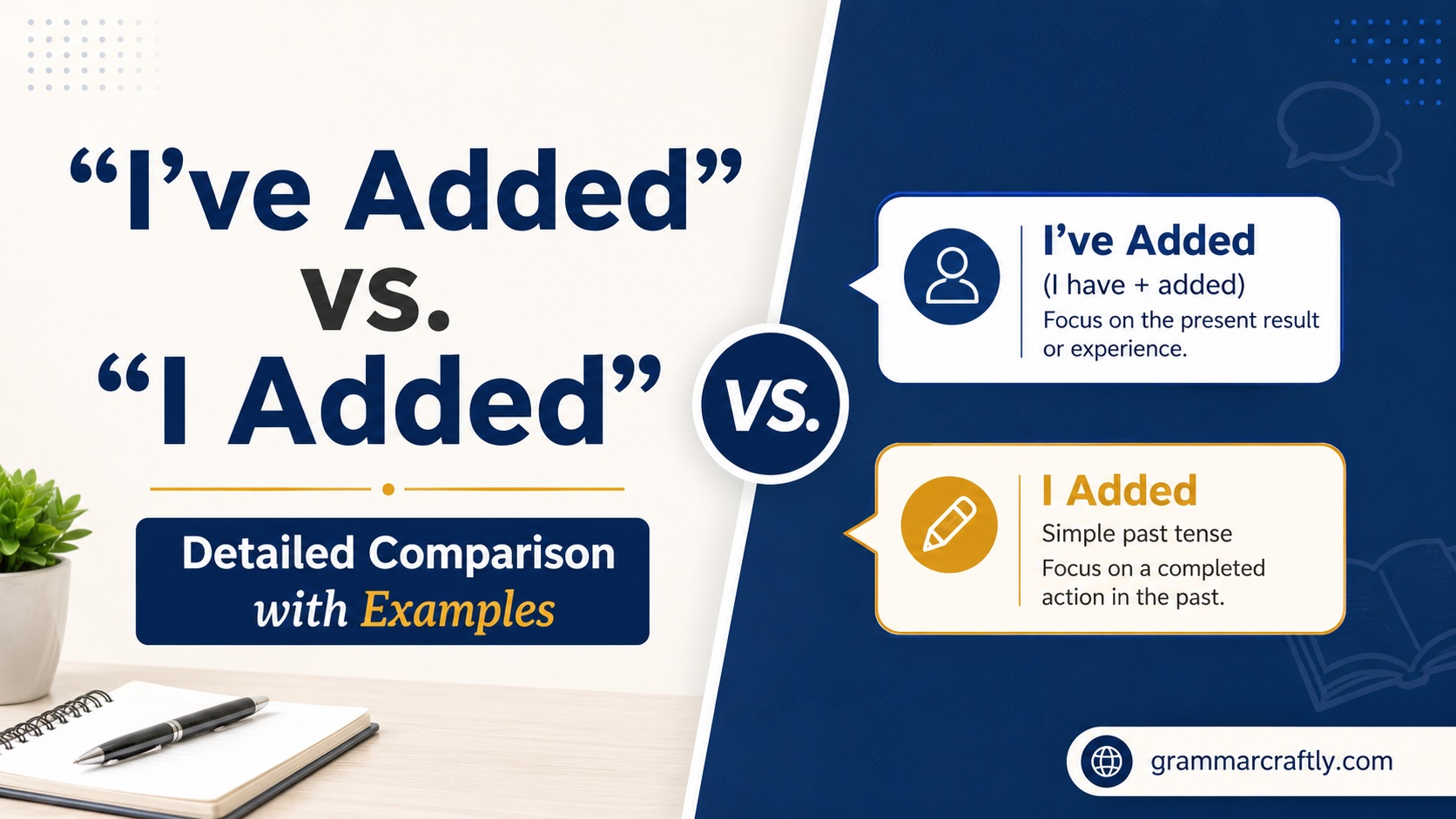
“I’ve added”
This means:
- The result still matters now
- The action connects to the present moment
- You are not mentally closing the event
“I added”
This means:
- The action is complete in the past
- You are reporting it like a finished story
- The present does not matter anymore
Here’s the simplest mental shortcut:
- I’ve added = Look at the result now
- I added = That happened earlier
It’s less about time and more about mental focus.
Think of it like this:
- Present perfect = spotlight on the present outcome
- Past simple = spotlight on the past action itself
That shift changes everything.
Understanding “I’ve Added” in Real Communication
Let’s make this real.
When you say “I’ve added”, you are saying:
“This is done, and it matters right now.”
It feels alive. It stays connected to the current conversation.
Real examples:
- “I’ve added your request to the system.”
- “I’ve added the file, so you can check it now.”
- “I’ve added a few changes based on your feedback.”
Notice something important? These sentences invite action now. They don’t close the conversation.
Where “I’ve added” naturally appears:
- Work chats
- Emails with updates
- Task management tools
- Collaboration discussions
Why it sounds natural:
It keeps the door open. The listener feels like they can respond immediately.
Understanding “I Added” in Real Communication
Now switch gears.
“I added” feels different. It closes the moment.
You are not focusing on the present effect. You are simply reporting a completed event.
Real examples:
- “I added your name to the list yesterday.”
- “I added the file before the meeting started.”
- “I added extra details in the report last night.”
Here, the action feels like a finished chapter.
Where “I added” naturally appears:
- Storytelling
- Reports
- Narratives
- Past explanations
Why it sounds natural:
It creates distance. You are looking back, not forward.
Side-by-Side Breakdown of “I’ve Added vs I Added”
Sometimes you just need a clear comparison.
| Situation | I’ve Added | I Added |
| Chat update | Feels current | Feels past |
| Email reply | Keeps conversation open | Feels finalized |
| Storytelling | Rare | Common |
| Task update | Very natural | Less common |
| Report writing | Sometimes used | Very common |
Now notice something interesting:
👉 Both are correct
👉 But they feel different socially
That emotional difference matters more than grammar rules.
Where Each One Actually Fits in Real Life
Let’s map usage in everyday situations.
Work Communication
You’ll often hear:
- “I’ve added the notes to the document.”
- “I’ve added your request to the backlog.”
Why? Because work updates often stay relevant.
Storytelling
You’ll hear:
- “I added a comment, and then she replied immediately.”
- “I added my details before I left the office.”
Stories live in the past. So past simple dominates.
Casual Conversation
Both appear depending on intent:
- “I’ve added you on WhatsApp.” (feels current)
- “I added you last night.” (finished event)
Project Reports
- Past simple dominates
- Focus is documentation, not interaction
Signal Words That Guide Your Choice
You don’t always need to think hard. Signal words help.
Words that lean toward “I’ve added”:
- just
- already
- recently
- so far
- yet (in questions/negatives)
Words that lean toward “I added”:
- yesterday
- last week
- in 2023
- before
- earlier
Quick insight:
If you can point to a finished time, use the past simple.
If you cannot clearly close the time, present perfect often fits better.
The Decision Shortcut: “Now vs Then” Test
Here’s a fast mental filter you can use instantly.
Ask yourself:
Step 1: Does this still matter now?
- Yes → “I’ve added”
- No → move to step 2
Step 2: Am I telling a finished story?
- Yes → “I added”
That’s it.
No overthinking. No grammar panic.
This method works because it mirrors how native speakers naturally think.
Common Mistakes That Break Natural Fluency
Let’s fix the biggest traps.
Mistake: Overusing “I’ve added”
Some learners overuse the present perfect everywhere.
Example:
❌ “I’ve added the file yesterday.”
Why it sounds off:
“Yesterday” already closes the time. So past simple wins.
Mistake: Treating both forms as interchangeable
They are not identical in tone.
Even if meaning overlaps, tone changes.
Mistake: Ignoring context
A sentence alone is not enough. Conversation decides tense.
Mistake: Thinking grammar first
Native speakers think about the meaning first.
Grammar follows automatically.
Real-Life Case Study: Same Action, Different Impact
Let’s compare a simple scenario.
Situation: You upload a file for your team
You say:
- “I’ve added the file to the drive.”
Team reaction:
👉 Feels current
👉 Someone checks it immediately
👉 Conversation continues
Now compare:
- “I added the file yesterday.”
Team reaction:
👉 Feels like information
👉 No urgency
👉 Conversation shifts away
Same action. Different communication energy.
That’s the real power of I’ve added vs I added.
Mini Dialogue Examples (How It Sounds Naturally)
Work Chat
A: Did you update the document?
B: I’ve added the latest numbers. Check it now.
Friend Conversation
A: Are you done with the playlist?
B: I added a few songs last night.
Email Reply
“I’ve added your comments to the draft. Let me know if you want more changes.”
Notice how present perfect keeps interaction alive.
Practice Challenge: Choose Instantly
Try picking the correct form:
- I ___ (add) your request earlier today.
- I ___ (add) your request, so check it now.
- I ___ (add) new details last week.
- I ___ (add) new details to the system.
Answers:
- added
- have added
- added
- have added
If you got 2–3 correct, you’re already thinking in the right direction.
Read More: Unlocking the Mysteries of “In Fact”: Comma Usage Simplified
Quick Cheat Sheet for Instant Use
Use “I’ve added” when:
- You want to show current relevance
- You expect a response
- The result still matters
Use “I added” when:
- You describe finished actions
- You tell a story
- You mention specific past time
Final Insight: Stop Translating, Start Thinking in Meaning
Here’s what really changes your fluency:
You stop asking:
- “Which grammar rule is correct?”
You start asking:
- “Am I talking about now or then?”
That small mental shift unlocks natural English faster than memorizing 50 rules.
As communication expert William Zinsser once said:
“Clarity comes from thinking clearly, not from complicated language.”
And that’s exactly what I’ve added vs I added is really about.
Not grammar perfection.
Not memorization.
Just clarity of time, meaning, and intent.
If you start noticing how people actually speak, you’ll see this pattern everywhere. And once you do, choosing between I’ve added vs I added stops feeling like a grammar test.