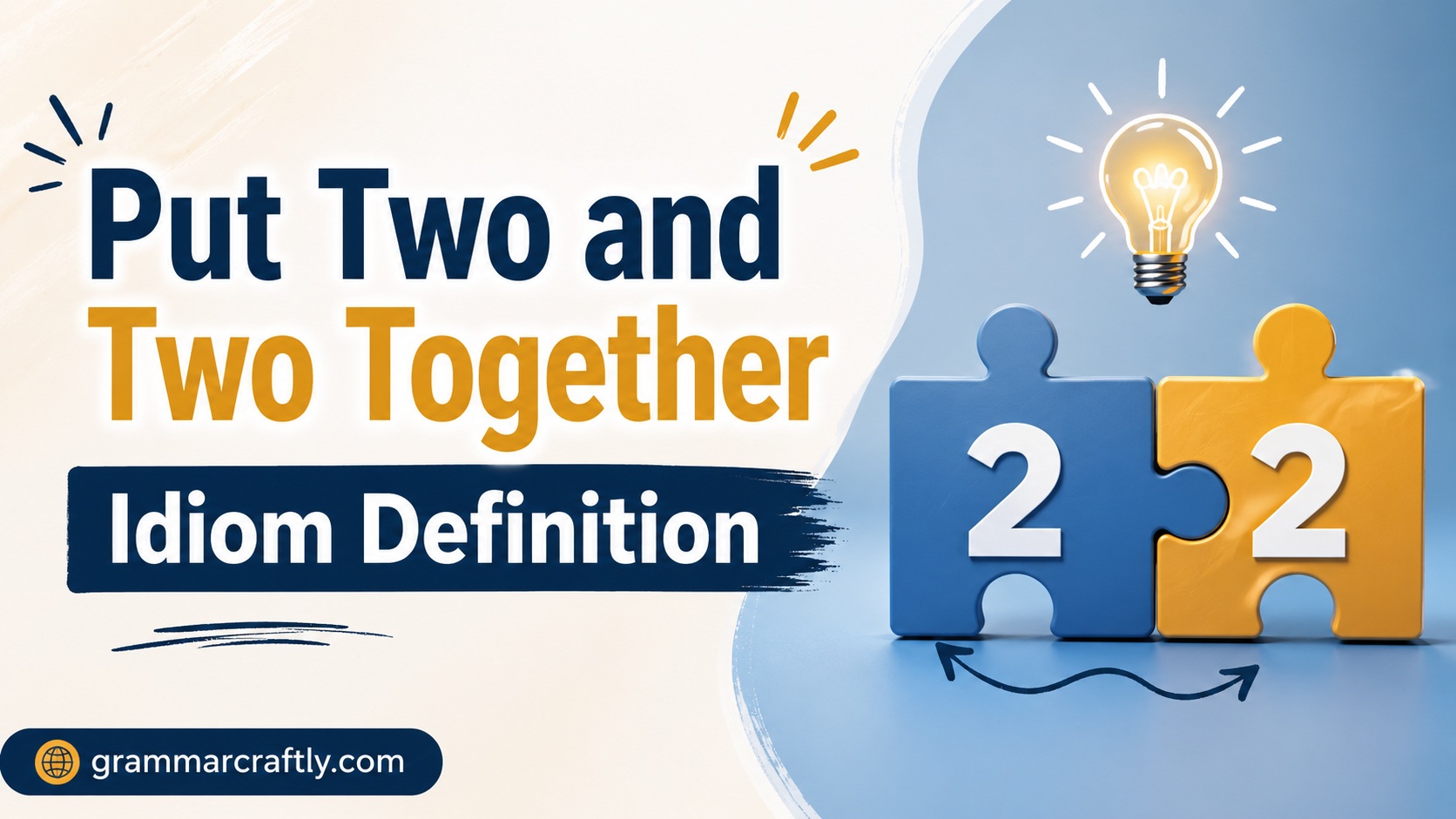
Put Two and Two Together Idiom Definition is a guide to understanding how people infer meaning using clues, facts, and reasoning skills in English.
It explains how idiom, definition, meaning, origin, and usage help in spoken English, written English, everyday conversations, and storytelling. A key idea is how people use information, facts, evidence, and clues to connect the dots, analyze situations, and apply inference in real-life thinking. The phrase supports figurative expressions, literature, business communication, and casual conversations, improving vocabulary skills, critical thinking, and logical thinking. It also works as a practical tool for problem-solving and intuitive learning, helping students in their learning journey through teaching, guides, and master phrases built on reasoning, everyday logic, and smoother communication in natural language.
In my experience, both native speakers and second language learners use this idea in everyday conversations and storytelling without noticing it. They naturally connect ideas, use available information, and reach reasonable conclusions through analytical thinking, interpretation skills, and communication skills. I have seen students grow in language learning, especially when they practice usage examples in spoken English, written English, and figurative language found in literature and business communication. This builds stronger contextual understanding, improves expression meaning, and supports natural communication with better language enrichment and communication practice.
In simple terms:
You see hints → you connect them → you figure things out.
For example:
- You see your friend packing a suitcase
- You hear them mention “early flight tomorrow”
- You put two and two together and realize they’re traveling
No one tells you directly. You just get it.
That’s the power of inference.
And honestly, you do this more than you realize.
On the surface, the idiom looks simple. But it carries a deeper idea about human reasoning.
It suggests three important things:
- You don’t always get direct answers
- You rely on clues and context
- You build meaning mentally, not mechanically
This is where the phrase gets interesting.
Because it doesn’t just describe thinking. It describes how humans naturally think when they are not told everything.
Think about it like this:
Life rarely gives you full instructions. You mostly get fragments.
So your brain fills the gaps.
That’s exactly what this idiom captures.
When someone says, “I just put two and two together,” they often imply something felt obvious in hindsight.
But here’s the twist.
It only feels obvious after you figure it out.
Before that moment, the pieces look unrelated.
For example:
- A coworker suddenly cleans their desk
- They avoid long conversations
- They forward unfinished tasks
Later you realize they might be leaving the job.
Once you know, it feels obvious.
Before you know, it feels hidden.
That gap between “confusing” and “clear” is exactly where this idiom lives.
This phrase uses basic arithmetic for a reason.
In older English education, children learned simple math early:
- 2 + 2 = 4
- Easy, predictable, obvious
So “two and two” became a symbol of something straightforward.
Over time, people began using it metaphorically.
Instead of literally adding numbers, they started combining ideas.
The shift looked like this:
| Literal Math | Mental Meaning |
| 2 + 2 = 4 | Clues + clues = conclusion |
| Simple calculation | Simple inference |
| No confusion | Clear understanding |
The beauty lies in simplicity.
The phrase turns logic into language.
Your brain loves patterns. It always has.
In fact, psychologists often describe humans as pattern-seeking machines.
You don’t wait for complete data. You assemble meaning from fragments.
Your brain constantly does things like:
- Linking tone of voice with emotion
- Connecting behavior with intent
- Predicting outcomes based on past experiences
This process happens automatically.
You don’t ask for it. It just runs in the background.
Think of it like mental autocomplete.
However, it doesn’t always get it right.
You already use this idiom in real life thinking patterns, even if you don’t say it out loud.
Here are common examples:
At home
- You see groceries disappear quickly
- You notice a family member going out often
- You realize someone else is cooking more meals
You connect the dots and understand someone changed their routine.
At work
- A manager stops giving you new tasks
- Meetings get shorter
- Your role shifts quietly
You start wondering about job changes or restructuring.
In social life
- A friend replies slower than usual
- Plans get canceled repeatedly
- Communication feels distant
You begin to suspect something changed in the relationship.
These moments feel small alone.
But together, they tell a story.
Let’s walk through a realistic scenario.
Situation:
Sara notices her friend Maya acting differently.
- Maya stops replying quickly
- She avoids weekend plans
- She often says she’s “busy”
At first, Sara ignores it.
But then she sees Maya posting photos with a new group of friends.
Now Sara puts the clues together.
Conclusion:
Maya likely formed a new social circle.
No direct explanation needed.
That classic put two and two together meaning in action.
But here’s the key insight:
The conclusion feels obvious only after all clues line up.
Now here’s where things get tricky.
Your brain doesn’t just connect facts. It interprets them.
And interpretation can go wrong.
Common mistakes include:
- Jumping to conclusions too fast
- Ignoring missing information
- Overthinking small signals
- Assuming patterns that don’t exist
For example:
You see your friend online but not replying.
You assume they are ignoring you.
But maybe they are just busy or distracted.
This is where logic breaks down.
Because inference without context can mislead you.
Your brain uses shortcuts called heuristics.
These help you think faster, but not always more accurately.
Key cognitive factors include:
- Pattern recognition: You look for repeating signals
- Memory association: You compare current events with past experiences
- Emotional influence: Feelings shape interpretation
- Confirmation bias: You focus on evidence that supports your belief
Here’s a simple truth:
Your brain prefers a quick answer over a slow uncertain one.
That’s why “putting two and two together” feels satisfying.
It resolves uncertainty.
You can actually improve how accurately you connect clues.
Not by guessing more. But by thinking more carefully.
Try these habits:
- Observe before interpreting
- Collect multiple signals, not just one
- Ask “what else could this mean?”
- Avoid rushing to conclusions
- Compare different explanations
Think of it like detective work.
A good detective doesn’t rely on one clue.
They build a full picture.
Language across cultures expresses the same idea in different ways.
Here are some related expressions:
| Idiom | Meaning |
| Read between the lines | Understand hidden meaning |
| Connect the dots | Link separate clues |
| Figure it out | Understand something unclear |
| Join the pieces | Build a full picture |
Each one reflects the same mental process.
Just different wording.
Writers love this concept because it keeps audiences engaged.
Mystery stories, especially, rely heavily on it.
Think about detective films:
- A clue appears early
- It seems meaningless at first
- Later it becomes crucial
That moment when viewers say, “Ohhh now I get it!”
That’s the payoff.
It works because the audience also tries to put two and two together.
Online, people connect dots faster than ever.
Sometimes too fast.
Read More : Commensurate With or To? Which Is the Correct Preposition?
Common examples:
- A cropped tweet sparks rumors
- A photo leads to assumptions about relationships
- A short video creates viral theories
However, digital clues often lack context.
So inference becomes risky.
Still, the brain behaves the same way.
It fills gaps instantly.
This idiom isn’t just about language.
It reflects something deeper about how humans operate.
You constantly:
- Search for meaning
- Build stories from fragments
- Try to reduce uncertainty
Even when life gives incomplete information, your mind pushes forward.
That’s both powerful and dangerous.
Because it helps you understand the world.
But it can also mislead you if you rush.
| Aspect | Explanation |
| Core idea | Connecting clues to form conclusions |
| Mental process | Pattern recognition and inference |
| Strength | Fast understanding of situations |
| Weakness | Risk of incorrect assumptions |
| Everyday use | Work, relationships, media, daily life |
The phrase “put two and two together” survives because it describes something timeless.
You don’t just hear information in life.
You interpret it.
You connect it.
You shape meaning from fragments.
And whether you realize it or not, you do it constantly.
Sometimes you get it right.
Sometimes you don’t.
But either way, your mind keeps working like a quiet detective in the background, always trying to make sense of the next clue.