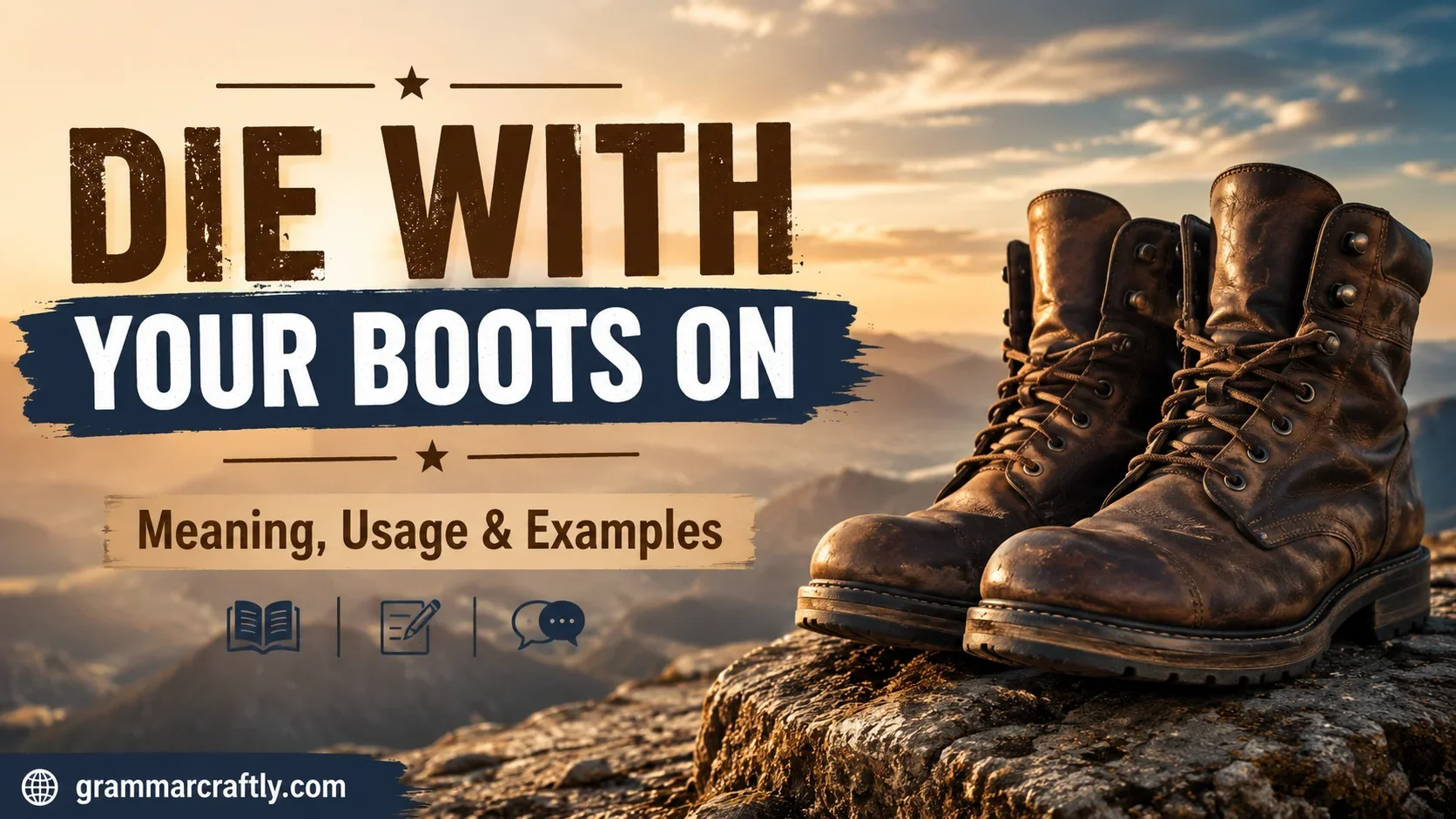
Die With Your Boots on Meaning, Usage & Examples explains an English idiom, expression, and metaphor with symbolic meaning, courage, purpose, and commitment in life.
The phrase reflects a life-approach shaped by determination, bravery, responsibility, and a purpose-driven life. Its historical origins connect to the American Old West, cowboys, frontiersmen, and the frontier spirit, while references to die in harness, William Shakespeare, and Macbeth add depth to its story. Today, its usage appears in everyday speech, literature, and popular culture to describe professionals, business leaders, and artists who show resilience, perseverance, endurance, and strength through hardship and life’s challenges. Famous examples include Patrick Swayze, Henry Starr, They Died with Their Boots On, Iron Maiden, and the image of an aging cowboy on an old ranch repairing a broken fence during a storm, a scene that captures action over comfort, staying active, productivity, ambition, passion, and an unwavering commitment until the very end.
This saying has historical origins in the American Old West, where cowboys and frontiersmen embodied the frontier spirit through hard work, self-discipline, and lifelong commitment. Today, its usage appears in everyday speech, literature, and popular culture to describe professionals, business leaders, and artists who remain actively engaged, show resilience, perseverance, endurance, and strength, and continue moving forward despite hardship. Famous examples include Patrick Swayze, Henry Starr, They Died with Their Boots On, Iron Maiden, and the image of an aging cowboy on an old ranch wearing worn leather boots, facing a storm, repairing a broken fence, and choosing action over comfort until the very end.
Quick Answer: What Does “Die With Your Boots On” Mean?
“Die with your boots on” means to keep working, fighting, living actively, or staying committed until the very end rather than giving up, retreating, or fading away quietly.
In modern figurative use, the idiom often describes someone who:
- Never quits
- Faces challenges bravely
- Remains active until the end of life
- Dies while still engaged in meaningful work or struggle
- Shows courage, determination, or defiance
Simple Example
“He loved his work so much that he planned to die with his boots on.”
In this sentence, the meaning is not literal. It means the person wants to keep doing what he loves until the end of his life.
Understanding the Idiom “Die With Your Boots On” at a Glance
Sometimes idioms confuse people because they sound literal but actually carry a figurative message. This one works the same way.
| Aspect | Meaning |
| Literal Meaning | To die while still wearing boots |
| Figurative Meaning | To stay active, brave, committed, or fighting until the end |
| Emotional Tone | Bold, dramatic, courageous, sometimes dark |
| Common Use | Motivation, determination, bravery, defiance |
| Tone in Conversation | Inspirational, poetic, intense |
Literal Meaning of “Die With Your Boots On”
At face value, the phrase sounds literal.
It suggests someone dies while still dressed and ready for action. In historical settings, boots often symbolized:
- Military readiness
- Work ethic
- Frontier survival
- Physical toughness
- Active duty
Historically, dying in boots meant you did not die peacefully in bed. Instead, you died in action, on duty, or while still engaged in life.
That image later became symbolic.
Figurative Meaning of “Die With Your Boots On”
Today, people usually use the phrase figuratively.
It means:
- Living actively instead of slowing down
- Fighting to the last moment
- Refusing to surrender
- Continuing your mission
- Staying passionate until the end
This is why the phrase often appears in motivational, dramatic, or poetic contexts.
Emotional Tone of the Idiom
The phrase carries a strong emotional punch.
Depending on context, it can sound:
- Heroic
- Inspirational
- Defiant
- Darkly humorous
- Old-fashioned
- Dramatic
That emotional flexibility is one reason the idiom has survived for centuries.
The Origin of “Die With Your Boots On”
Understanding the origin of “die with your boots on” makes the idiom even more fascinating.
The phrase did not appear out of nowhere. It grew from real historical conditions.
Earliest Historical Evidence
The expression has roots in the 18th and 19th centuries, although ideas behind it likely existed earlier.
Historically, boots were associated with:
- Soldiers
- Horsemen
- Cowboys
- Laborers
- Adventurers
- Frontiersmen
These were people who spent much of life on duty, outdoors, and ready for action.
Dying “with boots on” implied a person died while still active rather than retiring into weakness.
That image became powerful.
Military Roots of the Phrase
One of the earliest associations comes from military life.
Soldiers often slept in boots during emergencies or died in battle while fully equipped. Boots became symbolic of:
- Readiness
- Service
- Duty
- Discipline
- Courage
To “die with your boots on” in a military sense suggested:
Dying while still standing in service rather than surrendering.
That idea naturally gained respect and symbolic weight.
Cowboy and Frontier Culture Influence
This is where the phrase gained legendary cultural power.
In the American frontier imagination, cowboys represented:
- Toughness
- Independence
- Risk
- Physical courage
- Action-oriented living
A cowboy who “died with his boots on” symbolized someone who:
- Never backed down
- Stayed active until the end
- Met danger face-first
- Lived boldly
Western culture helped romanticize the idiom and spread it into popular storytelling.
How the Meaning of “Die With Your Boots On” Changed Over Time
Language evolves.
This idiom changed too.
Originally, the phrase leaned more toward literal death in action.
Over time, it shifted into something broader.
Earlier Meaning
Historically, the phrase often implied:
- Violent death
- Death in battle
- Death during work
- Sudden active death
- Not dying peacefully
This had a darker edge.
Modern Meaning
Today, the idiom is usually less literal and more symbolic.
Modern speakers use it to describe:
- Passionate commitment
- Lifelong dedication
- Refusing to give up
- Working until retirement or death
- Living boldly
For example:
“She’ll die with her boots on if they let her keep teaching.”
This means she loves teaching so much that she may continue until the very end.
Why People Still Use “Die With Your Boots On” Today
Many old idioms disappear.
This one didn’t.
Why?
Because the idea behind it still resonates deeply.
It Celebrates Courage
People admire courage.
This phrase expresses:
- Bravery under pressure
- Mental toughness
- Fearlessness
- Persistence
That makes it emotionally powerful.
It Honors Commitment
The phrase often describes someone who remains dedicated to:
- Their work
- Their beliefs
- Their mission
- Their passion
- Their values
Example:
“He’ll die with his boots on running that ranch.”
Meaning: he will never abandon what matters to him.
It Represents Defiance
Sometimes the idiom carries a rebellious spirit.
It says:
“I’m not going quietly.”
That makes it dramatic and memorable.
Is “Die With Your Boots On” Positive, Negative, or Neutral?
This is a common question.
The answer depends on context.
Positive Meaning
In many situations, it sounds inspiring.
Example:
“She wants to die with her boots on, still helping people.”
Positive themes include:
- Dedication
- Passion
- Courage
- Purpose
- Resilience
Negative Meaning
Sometimes it can sound dark or excessive.
Example:
“He works too much and might die with his boots on.”
Here the phrase suggests:
- Overwork
- Obsession
- Lack of balance
- Dangerous commitment
Neutral Meaning
Sometimes the phrase is descriptive without emotional judgment.
Context decides tone.
When to Use “Die With Your Boots On”
Knowing how to use “die with your boots on” in a sentence matters.
This idiom works best in certain situations.
In Everyday Speech
People use it casually when describing someone determined.
Examples:
- “My grandfather plans to die with his boots on.”
- “That coach will die with his boots on.”
- “She’s too passionate to retire quietly.”
In Motivational Writing
The idiom often appears in inspirational contexts.
Example:
“Live boldly. Die with your boots on.”
It works because it symbolizes courage and commitment.
In Storytelling
Writers use it in:
- Biographies
- Western fiction
- Speeches
- Memoirs
- Film dialogue
Its dramatic tone adds character depth.
When You Should Avoid Using “Die With Your Boots On”
Not every idiom fits every situation.
This one can sound intense.
Avoid it in certain contexts.
Sensitive Grief Situations
Because the phrase contains death imagery, it may sound inappropriate in:
- Funeral condolences
- Sensitive medical discussions
- Trauma-related conversations
Formal Corporate Writing
Unless tone allows creativity, the idiom may feel too dramatic.
Better alternatives may work.
International Audiences
Non-native speakers may misunderstand it literally.
Clarification may be needed.
Read More: “See” vs. “Look” vs. “Watch” Unraveling of These Common Verbs
25 Real Examples of “Die With Your Boots On” in Sentences
Here are practical sentence examples.
| Sentence | Meaning |
| He plans to die with his boots on. | Stay active until the end |
| That farmer will die with his boots on. | Lifelong dedication |
| She’d rather die with her boots on than quit. | Refuses surrender |
| The coach died with his boots on. | Active until death |
| He fought and died with his boots on. | Courage in struggle |
| She’s the kind who’ll die with her boots on. | Determined personality |
| My grandfather worked until he died with his boots on. | Never retired mentally |
| He won’t go quietly. He’ll die with his boots on. | Defiance |
| The artist created until the end. He died with his boots on. | Passion |
| She kept serving others and died with her boots on. | Commitment |
| That rancher will die with his boots on. | Deep loyalty |
| He stayed in business and died with his boots on. | Dedication |
| She fought cancer with her boots on. | Courage |
| He died with his boots on metaphorically. | Active spirit |
| Some leaders prefer to die with their boots on. | Commitment |
| He never slowed down. | Lifelong drive |
| She lived fiercely. | Bold living |
| He fought to the end. | Persistence |
| She never quit. | Determination |
| He stayed in action. | Active engagement |
| The captain died with his boots on. | Duty |
| He went down fighting. | Resistance |
| She remained passionate. | Commitment |
| He faced life boldly. | Courage |
| They refused surrender. | Defiance |
Common Mistakes and Misinterpretations
Idioms often get misunderstood.
This one is no exception.
Mistake: Thinking It Means Literal Death Only
Wrong.
Modern use is often symbolic.
It usually refers to:
- Commitment
- Courage
- Active living
Not literal boots.
Mistake: Using It in Casual Light Humor Without Context
Because the phrase includes death imagery, tone matters.
Poor use can sound awkward.
Mistake: Assuming It Always Means Something Positive
Not always.
It can suggest:
- Overwork
- Stubbornness
- Recklessness
Context changes interpretation.
Similar Idioms, Synonyms, and Alternatives
Sometimes another expression works better.
Here are related phrases.
| Idiom | Meaning |
| Go down fighting | Resist until the end |
| Blaze of glory | Dramatic ending |
| Never say die | Refuse defeat |
| Fight to the bitter end | Keep resisting |
| Go out swinging | End with spirit |
| Burn bright | Live intensely |
| Never back down | Stay strong |
| Stand your ground | Resist pressure |
Comparing Similar Idioms
Die with your boots on → emphasizes active courage and lifelong commitment
Go down fighting → emphasizes resistance during defeat
Blaze of glory → emphasizes dramatic ending
Never say die → emphasizes optimism and resilience
Each carries a different shade of meaning.
“Die With Your Boots On” in Movies, Books, Songs & Pop Culture
This phrase has appeared widely in popular culture.
Its dramatic imagery makes it memorable.
In Film
Westerns especially embraced the phrase.
Cowboys, soldiers, sheriffs, and rebels often embodied the idiom.
Classic storytelling used it to symbolize:
- Heroic death
- Rugged masculinity
- Duty
- Defiance
In Literature
Writers use it in:
- Historical fiction
- Memoirs
- War literature
- Character studies
It creates emotional symbolism quickly.
In Music
Rock and metal music especially love phrases like this because they suggest:
- Defiance
- Edge
- Fearlessness
- Rebellion
The phrase has strong lyrical energy.
Case Study: A Modern Metaphorical Use
Consider a doctor who works for decades helping people.
Even in old age, she continues teaching, volunteering, and mentoring.
Someone says:
“She’ll die with her boots on.”
This does not mean literal death in boots.
It means:
- She remains active
- Her passion never faded
- Her work defines her
- She won’t stop living purposefully
That’s modern idiomatic use.
The Philosophy Behind “Die With Your Boots On”
This is where the idiom becomes deeper.
It reflects a life philosophy.
Courage
The phrase honors bravery.
Not fearlessness.
But action despite fear.
That matters.
Legacy
It suggests leaving life while still connected to purpose.
Not drifting.
Not fading.
But standing for something.
Fighting Spirit
Some people see life as a challenge worth meeting directly.
The idiom reflects that spirit.
Quick Facts About “Die With Your Boots On”
The phrase originally had literal historical associations.
Modern use is mostly figurative.
It often symbolizes courage and commitment.
Tone can be positive or dark depending on context.
Fact: It remains common in storytelling and motivational speech.
FAQ :
What does “die with your boots on” mean?
It means to stay active, committed, courageous, or engaged until the very end instead of quitting or fading away quietly.
Is “die with your boots on” positive?
Usually yes, but context matters. It can sound inspiring or dark.
Is it literal or figurative?
In modern English, it is mostly figurative.
Where did the phrase come from?
It has roots in military and frontier culture where boots symbolized readiness and active duty.
Can I use it in everyday conversation?
Yes, especially when describing someone determined, passionate, or resilient.
Conclusion
The meaning of “die with your boots on” goes far beyond its dramatic wording.
not simply about death.
is about how a person lives.
It speaks to courage, commitment, resilience, defiance, and the refusal to surrender before life is truly over.
That is why the phrase still resonates today.
Some hear it as a rugged cowboy expression. Others hear motivation. Some hear philosophy.