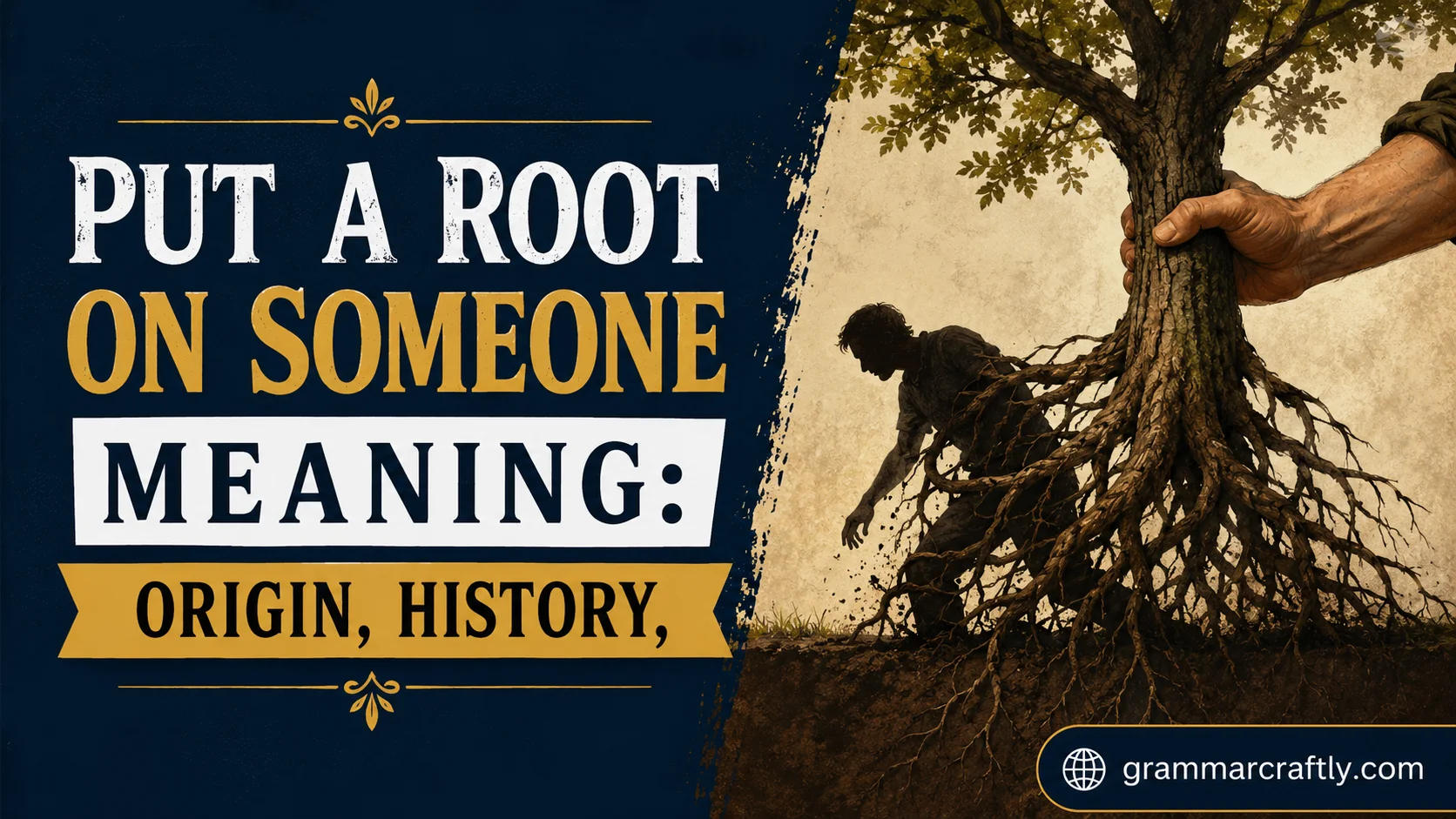
The Put a Root on Someone Meaning: Origin, History, connects to American folklore, African spiritual traditions, and Southern culture, rather than gardening or trees.
The idiom Put a Root on Someone has a long connection with rootwork, conjure, hoodoo, and other spiritual practices associated with African American culture. The phrase can refer to cast a spell, place a spell, or use supernatural powers to affect someone or affect their life. Its origin and history are linked to African spiritual traditions, folk traditions, and mystical folklore. Have you ever heard someone say, “She put a root on him”? The expression may appear in novels, blues songs, television shows, and everyday conversations, where it can sound serious, symbolic, humorous, or like regional speech. Historically, root doctors, traditional healers, and conjurers served communities across the rural South, especially the Black South.
Their folk practices included herbs, roots, potions, spells, and herbal remedies used for healing, protection, and other purposes. The traditions developed from folk beliefs connected to West Africa, the region of origin of many enslaved people brought to the South by white Europeans during the seventeenth century and eighteenth century. Root doctors used remedies made from mint, jimson weed, sassafras, and milkweed, while some practices involved goofer dust, graveyard dirt, powdered snake, or lizard. They might also provide a mojo, such as a dime worn around the ankle or a small bag containing plant ingredients and animal ingredients worn around the neck. These traditions offered believers treatment, protection, spiritual protection, and ways of dealing with curses, love spells, hurting enemies, or attracting lovers. Over time, Voodoo, Hoodoo, rootwork traditions, folk medicine, traditional medicine, magical traditions, spiritual beliefs, and African American folklore became important parts of the cultural history surrounding the expression.
“Let’s dive in”
What Does “Put a Root on Someone” Mean?
The phrase “put a root on someone” means to use spiritual practices, charms, herbs, or ritual objects to influence another person’s life. Traditionally, people believed these actions could bring bad luck, illness, confusion, protection, love, or even good fortune depending on the intention behind the ritual.
Although many people immediately associate the phrase with curses, that isn’t always accurate. In traditional rootwork, practitioners often focused on healing, protection, prosperity, justice, and blessing just as much as harmful magic.
Simple definition
Put a root on someone: To use folk magic or spiritual practices intended to affect another person’s life, either positively or negatively.
Today, the phrase often appears figuratively. Someone might jokingly say:
“Ever since I missed that deadline, I swear somebody put a root on me.”
In this example, the speaker doesn’t literally believe they have been cursed. Instead, they are humorously describing a streak of bad luck.
Literal Meaning vs. Figurative Meaning
One reason the phrase causes confusion is that it can be understood in two very different ways.
| Interpretation | Meaning | Example |
| Literal | Performing traditional rootwork using herbs, roots, charms, or rituals. | “People believed the healer could put a root on an enemy.” |
| Figurative | Describing unusually bad luck, strange events, or someone’s overwhelming influence. | “This week has been terrible. Somebody must’ve put a root on me.” |
In everyday American English, the figurative meaning has become far more common than the literal one.
However, in communities where traditional rootwork remains part of cultural practice, the phrase may still carry its original spiritual meaning.
Is “Put a Root” the Same as “Put a Curse”?
Not exactly.
Many dictionaries simplify the phrase by saying it means to curse someone, but that definition misses much of its cultural depth.
Traditional rootwork includes practices intended to:
- Protect families
- Remove negative influences
- Bring success
- Encourage healing
- Restore justice
- Attract love
- Improve financial opportunities
- Ward off harmful intentions
Only some rituals involve causing misfortune to another person.
Quick comparison
| Phrase | Meaning | Always Negative? |
| Put a root on someone | Spiritual work influencing another person | No |
| Put a curse on someone | Intentionally bring harm | Usually yes |
| Put a hex on someone | Cast harmful magic | Usually yes |
| Bless someone | Invoke positive spiritual protection | No |
| Jinx someone | Bring bad luck, often playfully | Usually figurative |
Understanding this distinction helps avoid oversimplifying an important cultural tradition.
Where Did the Expression “Put a Root on Someone” Come From?
The history behind this expression stretches across continents and centuries.
Its roots lie in the traditions that enslaved Africans brought to North America. Despite enormous hardship, many communities preserved knowledge about medicinal plants, protective rituals, prayers, and spiritual practices. Over generations, these traditions blended with Native American botanical knowledge and elements of European folk customs.
The result became what is now widely known as rootwork or Hoodoo.
The word root refers not only to plant roots but also to the broader practice of working with herbs, minerals, natural materials, prayers, and symbolic objects for spiritual purposes.
Eventually, people began saying someone had “put a root” on another person whenever spiritual work was believed to influence that individual’s life.
The phrase spread throughout the American South before appearing in literature, blues music, and later popular culture.
Why Are Roots So Important?
Plants played a central role in early folk traditions.
Long before modern medicine became widely available, communities relied on herbs and roots for healing, protection, and everyday wellness. Over time, many plants also gained symbolic meanings.
Examples include:
- Protection against evil
- Cleansing negative energy
- Bringing prosperity
- Strengthening courage
- Promoting healing
- Attracting love
Because roots grow beneath the surface and anchor a plant, they became powerful symbols of hidden strength, unseen influence, and deep spiritual connection.
Eventually, the word root evolved from referring only to plants into describing an entire tradition of spiritual practice.
The Historical Development of Rootwork
Understanding the history behind the phrase helps explain why it remains culturally significant today.
African Origins
Many African societies maintained sophisticated knowledge of herbal medicine and spiritual healing long before European colonization.
Traditional healers often combined:
- Botanical expertise
- Community wisdom
- Prayer
- Ritual symbolism
- Spiritual guidance
These practices varied widely across regions but shared an understanding that the physical and spiritual worlds were closely connected.
Survival During Slavery
Enslaved Africans carried this knowledge to North America under unimaginable circumstances.
Although enslavers attempted to suppress cultural traditions, many practices survived through oral teaching, family customs, and community healers.
Plants available in North America replaced some African species, yet the underlying beliefs often remained intact.
This adaptation demonstrated remarkable resilience and creativity.
Growth in the American South
During the eighteenth and nineteenth centuries, rootwork became especially common throughout Southern states.
Practitioners served many roles within their communities.
They might help someone:
- Find lost property
- Seek justice
- Protect a home
- Heal emotional distress
- Improve relationships
- Gain confidence
- Remove spiritual obstacles
These services reflected practical community needs rather than the exaggerated portrayals often found in modern entertainment.
Rootwork vs. Hoodoo vs. Voodoo
Many people mistakenly treat these terms as interchangeable. They are not.
| Tradition | Primary Focus | Geographic Roots | Religious System? |
| Rootwork | Practical use of herbs, roots, charms, and spiritual practices | Southern United States | No |
| Hoodoo | African American folk spiritual tradition that often includes rootwork | United States | Generally no |
| Voodoo (Vodou/Vodun) | Organized religion with ceremonies, spirits, and community worship | Haiti and West Africa | Yes |
This distinction matters because popular culture has blurred the differences for decades.
Many Hollywood films incorrectly portray all three traditions as mysterious systems devoted to curses and supernatural revenge. In reality, each has its own history, beliefs, and practices.
How the Phrase Entered Everyday American English
Not everyone who says “put a root on someone” believes in folk magic.
Like many idioms, the expression gradually entered everyday speech.
People may use it when:
- Nothing seems to go right.
- Someone experiences unbelievable bad luck.
- An unlikely series of problems occurs.
- A friend jokingly blames mysterious forces for everyday setbacks.
For example:
“Every traffic light turned red today. Somebody definitely put a root on me.”
The speaker isn’t making a literal accusation. They’re using colorful language to describe an unusually frustrating day.
Read More: Orientated vs. Oriented: Which Spelling Is Correct?
Symbolism Behind “Putting a Root on Someone”
The phrase “put a root on someone” carries layers of symbolism that go far beyond its literal meaning. In many folk traditions, roots represent the hidden forces that support life. They grow beneath the surface, unseen yet powerful. That symbolism naturally extended to spiritual beliefs, where unseen influences were thought to shape health, relationships, luck, and personal success.
In traditional rootwork, a root wasn’t viewed as magical simply because it came from the ground. Instead, people believed certain plants carried symbolic qualities that aligned with specific intentions. Combined with prayer, ritual, and community knowledge, these natural materials became part of a larger spiritual practice.
Some common symbolic themes include:
- Protection: Guarding a person, family, or home from harm.
- Healing: Supporting physical, emotional, or spiritual recovery.
- Justice: Seeking fairness when legal or social systems failed.
- Prosperity: Attracting opportunities, abundance, or financial stability.
- Love: Encouraging healthy relationships or strengthening existing bonds.
- Cleansing: Removing negative influences and restoring balance.
This broader symbolism explains why reducing the phrase to “placing a curse” overlooks much of its historical meaning.
How Americans Use the Phrase Today
Modern American English often uses “put a root on someone” figuratively rather than literally. Depending on the speaker and the setting, the expression may communicate frustration, humor, or a genuine belief rooted in cultural tradition.
Here are a few common situations where you might hear it.
During a String of Bad Luck
Someone loses their wallet, misses an important meeting, and gets caught in a rainstorm—all in one afternoon.
They laugh and say:
“I think somebody put a root on me.”
The phrase becomes a colorful way to describe a rough day.
In Family Stories
Older generations, especially in parts of the American South, sometimes use the expression while sharing family memories or local folklore.
For example:
“Grandma always warned us not to make enemies because somebody might put a root on you.”
Whether the speaker believes the story literally or not, the phrase reflects a living cultural tradition.
In Literature and Storytelling
Authors often use the expression to create atmosphere, build suspense, or highlight regional identity. A single sentence can immediately place readers in a Southern setting rich with folklore and oral history.
In Popular Conversation
Friends may use the phrase playfully after a surprising setback.
Examples include:
- “Every appliance broke this week. Somebody put a root on this house.”
- “My fantasy football team can’t catch a break. I swear someone put a root on us.”
In these examples, no one is claiming actual supernatural influence. The phrase simply exaggerates a run of bad luck.
Examples of “Put a Root on Someone” in Sentences
Seeing the idiom in context makes its meaning easier to understand.
Literal or Cultural Context
- “Some community members believed a rootworker could put a root on someone who caused harm.”
- “The novel describes characters who feared someone had put a root on the family.”
- “Local folklore included stories about people removing a root through prayer and ritual.”
Figurative Context
- “After losing four games in a row, the coach joked that someone had put a root on the team.”
- “Nothing went according to plan today. It feels like somebody put a root on me.”
- “Every project failed this month, so my coworkers teased that I’d been rooted.”
Creative Writing Example
As the storm rolled across the bayou, whispers spread through the village. Some believed the endless misfortune wasn’t coincidence at all. Someone, they said, had put a root on the family years before.
This example shows how writers use the phrase to create mystery without explaining every detail.
Fiction vs. Reality
Movies and television have shaped public perception of rootwork more than almost anything else. Unfortunately, many portrayals sacrifice accuracy for drama.
Hollywood Stereotypes
Common fictional portrayals include:
- Instant curses.
- Magical dolls controlling people.
- Supernatural revenge with dramatic special effects.
- Evil practitioners working only to harm others.
These depictions create entertaining stories, but they rarely reflect historical practice.
Historical Reality
Historically, rootworkers often served their communities in practical ways.
They were known for helping people with concerns such as:
- Finding emotional comfort.
- Seeking protection during uncertain times.
- Preparing herbal remedies based on local knowledge.
- Offering spiritual guidance.
- Encouraging hope and resilience.
Some traditions did include rituals intended to bring justice against those believed to have committed serious wrongs. Even so, harmful work represented only one part of a much broader practice.
Common Myths About Rootwork
Misunderstandings about rootwork have circulated for generations. Let’s separate myth from reality.
| Myth | Reality |
| Rootwork is the same as Voodoo. | They are different traditions with distinct histories. |
| Every rootworker casts curses. | Many focused on healing, protection, and spiritual support. |
| Rootwork requires supernatural powers. | Traditional practitioners relied on cultural knowledge, ritual, prayer, and symbolic practices. |
| The phrase always means someone is cursed. | Many people now use it figuratively to describe bad luck. |
| Rootwork belongs only to the distant past. | Some communities continue to preserve aspects of the tradition today. |
Understanding these distinctions encourages respectful discussions instead of relying on stereotypes.
Similar Expressions and Related Idioms
English contains several expressions that describe supernatural influence, unusual luck, or symbolic misfortune.
| Expression | Meaning | Tone |
| Put a root on someone | Influence someone through folk spiritual practices | Literal or figurative |
| Put a curse on someone | Intentionally bring harm | Serious |
| Put a hex on someone | Cast harmful magic | Serious |
| Jinx someone | Bring bad luck, often playfully | Informal |
| Give someone the evil eye | Cause misfortune through envy or harmful intent | Cultural belief |
| Cross someone | Betray or wrong another person | Figurative |
While these expressions overlap, each carries its own history and cultural background.
Case Study: How Context Changes the Meaning
Imagine two conversations.
Scenario One
An elderly storyteller in rural Louisiana says:
“People believed someone had put a root on the farmer after his crops kept failing.”
Here, the phrase reflects local folklore and historical belief.
Scenario Two
A college student laughs after spilling coffee, missing the bus, and forgetting an assignment.
They say:
“Who put a root on me today?”
In this case, the expression functions as humor rather than a literal statement.
The words remain the same, but the context completely changes their meaning.
Cultural Sensitivity Matters
Because the phrase comes from African American folk traditions, it’s worth using it thoughtfully.
A few guidelines can help:
- Recognize its historical roots instead of treating it as a joke in every situation.
- Avoid repeating stereotypes about Hoodoo or other spiritual traditions.
- Distinguish between folklore, religion, and entertainment.
- Appreciate the cultural history behind the expression, even if you don’t share the underlying beliefs.
Respectful language helps preserve the richness of cultural traditions while avoiding common misconceptions.
Quick Facts About “Put a Root on Someone”
| Fact | Details |
| Primary meaning | To spiritually influence someone through traditional rootwork |
| Modern usage | Often used humorously to describe bad luck |
| Historical origin | African American folk traditions in the Southern United States |
| Associated practice | Rootwork within Hoodoo traditions |
| Always negative? | No. Rootwork also includes healing, protection, and blessing practices. |
| Common misconception | Many people incorrectly confuse it with Voodoo or assume it always refers to a curse. |
“Folklore often reveals more about a community’s history than its supernatural beliefs.”
That idea fits this expression perfectly. Whether taken literally or figuratively, “put a root on someone” reflects centuries of cultural resilience, storytelling, and shared tradition.
FAQs
What does “put a root on someone” mean?
It usually means placing a spell, curse, or supernatural influence on someone.
Where did the phrase come from?
It is linked to Hoodoo, rootwork, African American folklore, and Southern culture.
What is a root doctor?
A root doctor is a traditional healer or conjurer who works with herbs, roots, and spiritual practices.
Is Hoodoo the same as rootwork?
They’re closely related, but Hoodoo is broader, while rootwork focuses on specific spiritual and folk practices.
Is the phrase still used today?
Yes. You may hear it in folklore, books, songs, TV shows, and regional speech.
Conclusion:
The phrase “put a root on someone” has survived for centuries because it carries more than one meaning. On the surface, it may sound like an old Southern saying about curses or bad luck. Dig a little deeper, though, and you’ll uncover a rich history shaped by resilience, community knowledge, and African American folk traditions.
Originally connected to rootwork and Hoodoo, the expression reflected a system of beliefs that extended far beyond supernatural harm. Practitioners often sought healing, protection, justice, and spiritual guidance using herbs, roots, prayers, and symbolic rituals. Over time, the phrase entered everyday American English, where it gradually evolved into a colorful idiom for describing life’s unexpected setbacks.