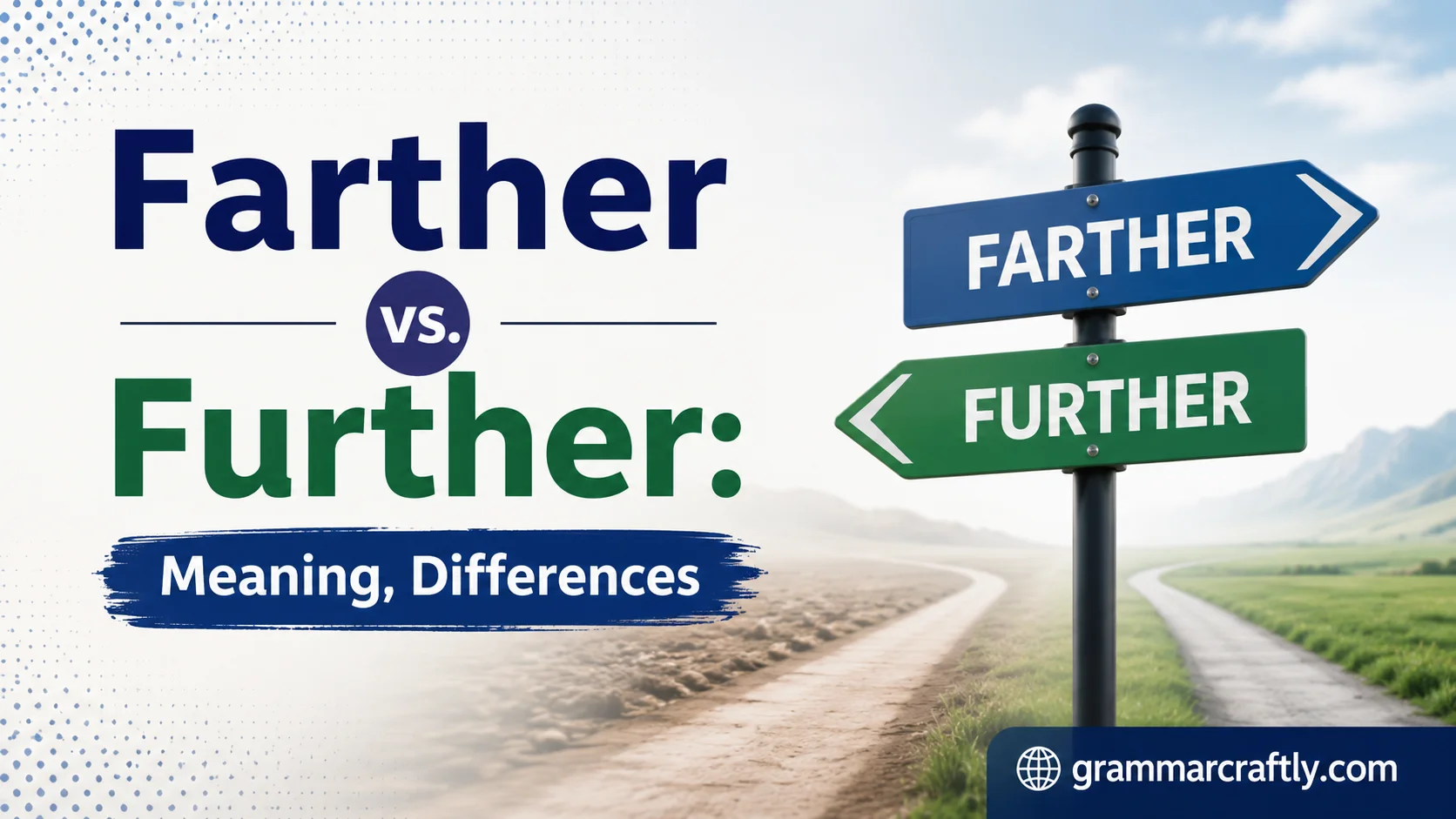
For English speakers, Farther vs. Further: Meaning, Differences, Examples, and Common Mistakes helps clarify why these simple words are often mixed up.
Further and farther look and sound similar, but their meanings and usage can vary. At first glance, their differences may seem like no big deal, yet knowing how to use each word can polish your English skills. Many people mix up these two words because they share a similar meaning, but each has a unique place in the English language. The trick to mastering this aspect isn’t complicated grammar rules or endless memorization. Instead, understanding the simple distinction can help your sentences shine and make English learning easier through useful articles, guides, and resources.
What sets apart further and farther is their connection to distance and extent. In short, both can describe a greater distance, but farther normally refers to a literal, physical sense that can be measured, while further often describes a greater figurative distance, metaphorical distance, or an additional degree. Both words can work as adverbs or adjectives, and their use in speech and writing can overlap. Mixing them up isn’t the biggest mistake, especially because modern language has created a gray area around their correct usage. Still, clear grammar rules and practical examples can clear up the confusion and help your language skills become more precise
What Is the Difference Between Farther and Further?
The easiest way to remember the difference is this:
| Word | Meaning | Usage |
| Farther | Physical distance | Walking, driving, locations |
| Further | Figurative distance or additional information | Ideas, discussions, education, progress |
| Both | Sometimes acceptable | Physical distance in modern English |
Consider these examples:
- She lives farther from the city than I do.
- Before making a decision, we need further information.
- We drove farther down the highway.
- The committee decided to conduct further research.
When speaking about miles, feet, locations, or travel, farther remains the preferred choice in American English. When discussing ideas, time, progress, or additional details, further is almost always correct.
However, modern English introduces an interesting exception. Many respected dictionaries and style guides accept further for physical distance as well.
For instance:
- The hotel is further down the road.
- The hotel is farther down the road.
Both are acceptable today. Nevertheless, many professional writers still prefer reserving farther for measurable distances because it improves clarity.
Why People Confuse Farther and Further
There’s a good reason these words cause confusion. They share the same linguistic roots.
Historically, farther developed as a variation of further. For several centuries, writers used both words interchangeably. The distinction we commonly teach today became more popular during the nineteenth century.
Modern grammar experts recommend separating their meanings because doing so creates clearer writing.
People often become confused because they encounter sentences like these:
- Nothing could be further from the truth.
- The mountains are farther away than they appear.
- Please wait until further notice.
- We traveled farther than planned.
Notice how one word relates to ideas while the other refers to measurable distance.
The Biggest Reasons Writers Make Mistakes
- Both words sound similar.
- Dictionaries recognize overlapping meanings.
- Some style guides permit both forms.
- Modern usage has evolved over time.
- Everyday conversation doesn’t always follow strict grammar conventions.
Fortunately, you don’t need to memorize complicated linguistic history. A simple rule works in almost every situation.
If you can measure it, use farther. If you can’t measure it, use further.
That rule will solve most usage questions immediately.
Farther Meaning, Definition, and Usage
The word farther functions as both an adjective and an adverb. It almost always describes physical or measurable distance.
Farther Means Physical Distance
Examples include:
- Walking farther
- Driving farther
- Living farther away
- Traveling farther north
- Running farther than expected
Consider these sentences:
- Sarah ran farther than anyone else during practice.
- We parked farther from the entrance.
- The cabin sits farther into the forest.
- They traveled farther than five hundred miles.
Notice something important. Every example involves measurable distance.
You can ask questions such as:
- How many miles?
- How many feet?
- How far?
- Which location is more distant?
If the answer involves measurement, farther usually fits perfectly.
Common Uses of Farther
| Example | Correct Usage |
| Walking | farther |
| Traveling | farther |
| Running | farther |
| Driving | farther |
| Living farther away | farther |
| Geographic locations | farther |
Examples in Everyday English
- My office is farther from home than yours.
- She walked farther than she intended.
- Alaska is farther north than most states.
- The campsite lies farther along the trail.
- The children swam farther than their parents expected.
Although these examples may seem simple, professional writers consistently prefer using farther whenever physical distance can be measured.
Further Meaning, Definition, and Usage
Unlike farther, the word further carries several meanings. It often refers to:
- Additional information
- Greater progress
- Abstract distance
- Advancement
- Continued discussion
- Extra development
Further Means Additional or Beyond
Examples include:
- Further investigation is necessary.
- We need further assistance.
- Further discussions will continue tomorrow.
- Please contact us for further details.
- She wishes to further her education.
Notice that none of these examples involve miles or physical measurement.
Instead, they describe:
- Ideas
- Progress
- Education
- Research
- Discussions
- Time
- Opportunities
Common Expressions Using Further
You’ll frequently encounter these phrases:
| Phrase | Meaning |
| Further information | Additional information |
| Further notice | Additional instructions later |
| Further education | Continuing education |
| Further research | Additional investigation |
| Further assistance | More help |
| Further discussion | Continuing conversation |
| Further developments | New progress |
Because these expressions are extremely common, you’ll probably use further more often than farther in everyday writing.
Further as a Verb
Many writers forget that further can also function as a verb.
Examples include:
- She hopes to further her career.
- The grant will further scientific research.
- New technology continues to further medical discoveries.
In these cases, further means:
- Advance
- Promote
- Help develop
- Encourage progress
Interestingly, farther cannot function as a verb.
This distinction makes remembering their differences much easier.
Are Farther and Further Interchangeable?
The answer is both yes and no.
Modern dictionaries accept further when referring to physical distance. Consequently, you’ll encounter examples such as:
- The restaurant is further down the street.
- We couldn’t travel any further because of the storm.
These sentences are grammatically correct.
However, many editors still prefer the traditional distinction:
- Physical distance = farther
- Figurative distance = further
Professional Writing Recommendation
For maximum clarity, follow this simple framework.
| Situation | Preferred Choice |
| Physical distance | Farther |
| Additional information | Further |
| Continuing discussions | Further |
| Education | Further |
| Progress | Further |
| Measurable travel | Farther |
| Research | Further |
| Geographic locations | Farther |
Following this guideline keeps your writing clear and professional.
Read More: Result In or Result To? The Ultimate Grammar Guide
Which Word Is More Common Today?
Modern English favors further more frequently than farther.
Why?
Because further has multiple meanings.
It can describe:
- Additional information
- Progress
- Discussions
- Education
- Abstract concepts
- Physical distance in some contexts
Meanwhile, farther remains much more specialized.
Consider these common phrases:
- Until further notice
- Further investigation
- Further studies
- Further assistance
- Further information
- Further developments
By comparison, farther appears most often when discussing measurable distance.
Examples include:
- Farther down the road
- Farther away
- Farther north
- Farther than expected
- Farther from home
The broader meaning of further explains why it appears more frequently in books, newspapers, business communication, and academic writing.
Grammar Rules Every Writer Should Know
If you only remember four rules from this guide, make them these.
Use Farther for Physical Distance
Examples:
- The museum is farther than I thought.
- He threw the ball farther than anyone else.
- They traveled farther across the country.
Use Further for Abstract Ideas
Examples:
- Further discussion is required.
- Further action will be taken tomorrow.
- She pursued further studies abroad.
Use Further as a Verb
Examples:
- Scholarships further educational opportunities.
- New discoveries further scientific knowledge.
When Both Words Are Correct
Sometimes both words work naturally.
- We couldn’t drive any farther.
- We couldn’t drive any further.
Modern English accepts both versions. Nevertheless, many editors would recommend farther because measurable distance is involved.
Quick Decision Guide
Are you discussing distance?
|
Yes
|
Can it be physically measured?
/ \
Yes No
| |
Farther Further
|
Ideas, progress, time,
education, discussions,
or additional?
|
Further
This simple diagram solves most grammar questions in seconds.
Memory Tricks You’ll Never Forget
The easiest trick involves looking at the spelling.
Farther contains “far.”
Ask yourself:
Can I measure how far something is?
If the answer is yes, use farther.
Examples:
- Farther down the road.
- Farther from school.
- Farther north.
- Farther away.
For everything else, choose further.
Examples:
- Further information.
- Further studies.
- Further research.
- Further discussion.
Another helpful trick is this:
Farther = Feet
Further = Future
Physical movement involves your feet. Abstract progress involves the future.
It’s simple and remarkably effective.
FAQs:
What is the main difference between farther and further?
Farther usually refers to a greater physical distance that you can measure, while further commonly refers to a figurative distance, extent, degree, or additional development. For example, “The store is farther down the road,” but “We need to discuss this further.”
Can farther and further be used interchangeably?
Sometimes, yes. In modern English, farther and further overlap in some contexts, especially when talking about figurative distance. However, using farther for physical distance and further for figurative or abstract ideas is a useful rule for clear writing.
Is farther an adjective or an adverb?
Farther can be both an adjective and an adverb. As an adjective, you might say, “the farther shore.” As an adverb, you could say, “She walked farther than I did.”
Is further used only for figurative distance?
No. Further has several uses. It can describe figurative distance, additional information, progress, or a greater extent. It can also mean “additional,” as in “Further instructions will be provided.”
Which word should I use in formal writing?
For formal writing, use farther when you mean measurable physical distance and further for additional or figurative ideas. This distinction isn’t absolute in modern English, but it provides a simple and reliable way to avoid confusion.
Conclusion:
Understanding farther vs. further doesn’t require memorizing complicated grammar rules. Think of farther as the natural choice for measurable physical distance, while further generally works better for figurative distance, additional information, progress, or a greater degree. Although modern English sometimes allows the two words to overlap, this simple distinction can make your writing clearer and more precise. Once you recognize the context, choosing the right word becomes much easier.