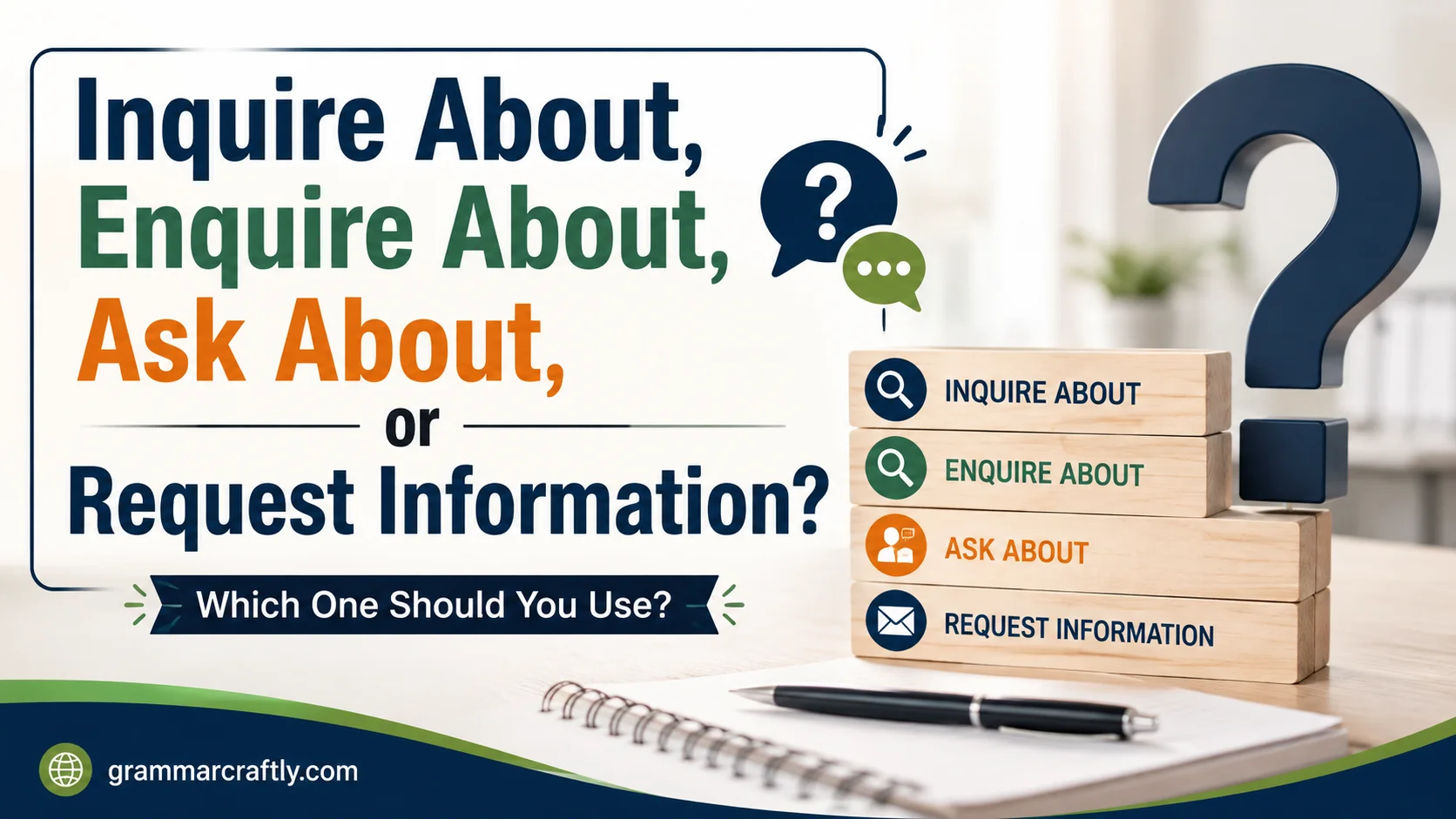
Inquire About, Enquire About, Ask About, or Request Information? helps you choose the right words for every situation with confidence and clarity.
When you ask, ask about, ask for information, or request information, your word choice should match the context, communication, and level of formality. From my experience, many learners and confident speakers confuse this pair because inquire, enquire, inquire about, and enquire about are commonly confused and often seen as confusing words. Traditionally, British English in the UK made a slightly different distinction, but in modern English, the difference is much smaller. Today, both forms are accepted across the English language in spoken English and written English.
The usage of each English phrase depends on grammar, grammatical rules, vocabulary, spelling, meaning, expression, phrase, and correct usage instead of a single rule. In formal English and business English, “I would like to inquire about something” is a polite and professional choice for an official email, emails, official messages, or any formal message. A clear sentence introduces your query, enquiry, or inquiry, presents the requested information, and keeps the wording easy to understand.
Why This Confuses So Many Writers
Many English words share similar meanings while carrying different levels of formality. That is exactly what happens with inquire, enquire, ask, and request information.
Consider these sentences:
- I want to ask about the course.
- I want to inquire about the course.
- I want to request information about the course.
All three sentences communicate a similar idea. Yet each creates a slightly different impression.
Native speakers often choose words based on context rather than strict grammar rules. As a result, learners and even experienced writers sometimes struggle to determine which option sounds best.
The confusion grows because American and British English do not always treat these words the same way.
Understanding the subtle differences can make your writing more polished and professional.
Is “Inquire About Something” Correct?
Yes. “Inquire about something” is completely correct.
The phrase means:
To ask for information regarding a specific topic, subject, person, product, service, or situation.
Examples:
- I called to inquire about the job opening.
- She wanted to inquire about the membership fees.
- We contacted customer support to inquire about our order.
In each sentence, the speaker seeks information.
The verb inquire naturally pairs with the preposition about when discussing a topic.
Quick Grammar Breakdown
| Component | Function |
| Inquire | Verb |
| About | Preposition |
| Something | Object of the preposition |
Structure:
Inquire + About + Topic
Examples:
- Inquire about prices
- Inquire about availability
- Inquire about services
- Inquire about admission requirements
This pattern is widely accepted in academic, business, and everyday writing.
Understanding the Difference Between Similar Expressions
Although several expressions seem interchangeable, they are not always identical.
Each phrase carries its own tone and level of formality.
Comparison Overview
| Expression | Meaning | Formality |
| Ask About | Seek information | Informal |
| Inquire About | Request information | Professional |
| Enquire About | Request information | Common in British English |
| Request Information | Formally ask for details | Formal |
| Investigate | Examine deeply | Very Formal |
The differences may appear small, but they affect how readers and listeners perceive your message.
Inquire vs Enquire
One of the most common grammar questions involves inquire and enquire.
Are They Different?
Historically, the two words meant essentially the same thing.
Both mean:
- To ask
- To seek information
- To request details
Modern English still treats them as near synonyms.
American English Preference
In the United States, inquire dominates.
Examples:
- Inquire about tuition.
- Inquire about job opportunities.
- Inquire about delivery times.
American style guides generally recommend inquire in both formal and informal contexts.
British English Preference
British English often uses both words.
Traditionally:
- Enquire = ask a question.
- Inquire = conduct a formal investigation.
However, modern usage has blurred this distinction.
Many British publications now use the words interchangeably.
Practical Recommendation
If you write for an international audience, choose inquire because it is recognized globally and appears more frequently in professional communication.
Inquire vs Ask
Many writers wonder whether inquire sounds too formal.
Let’s compare the two.
Ask
“Ask” is simple, direct, and conversational.
Examples:
- I asked about the meeting.
- She asked about the price.
- They asked about the schedule.
Inquire
“Inquire” sounds more professional and polished.
Examples:
- I inquired about the meeting.
- She inquired about pricing options.
- They inquired about scheduling availability.
Side-by-Side Comparison
| Feature | Ask | Inquire |
| Simplicity | High | Medium |
| Formality | Low | High |
| Business Use | Good | Excellent |
| Everyday Speech | Common | Less Common |
| Professional Emails | Acceptable | Preferred |
Example
Casual:
I wanted to ask about your services.
Professional:
I am writing to inquire about your services.
Both are correct. The second simply sounds more formal.
Inquire vs Request
People often use these terms interchangeably, but they are not identical.
Inquire
You seek information.
Example:
I would like to inquire about your pricing plans.
Request
You ask someone to provide something.
Example:
I would like to request a copy of the report.
Key Difference
| Word | Main Purpose |
| Inquire | Gather information |
| Request | Obtain something |
You can inquire before making a request.
For example:
I am writing to inquire about your services and request additional information regarding pricing.
This combination appears frequently in professional correspondence.
Inquire About vs Inquire Into
This distinction matters more than many people realize.
Inquire About
Means to ask for information.
Example:
The customer called to inquire about shipping costs.
The customer simply wants information.
Inquire Into
Means to investigate thoroughly.
Example:
The committee will inquire into the allegations.
The committee is conducting an investigation.
Comparison Table
| Phrase | Meaning |
| Inquire About | Ask for information |
| Inquire Into | Investigate deeply |
Examples
Correct:
- Inquire about hotel rates.
- Inquire about admissions.
Correct:
- Inquire into fraud allegations.
- Inquire into misconduct claims.
Using these phrases incorrectly can change the meaning of an entire sentence.
Formality Scale Comparison
Choosing the right expression often depends on your audience.
Formality Ranking
| Expression | Formality Level |
| Ask About | Casual |
| Check On | Casual |
| Find Out About | Informal |
| Inquire About | Professional |
| Request Information | Formal |
| Investigate | Highly Formal |
Visual Guide
Casual
|
Ask About
|
Find Out About
|
Inquire About
|
Request Information
|
Investigate
|
Highly Formal
This scale helps writers match language to context.
Which Expression Sounds Most Natural Today?
Modern communication values clarity and simplicity.
Because of that, many professionals choose language that sounds approachable without sacrificing credibility.
Everyday Conversations
Most people say:
- Ask about
- Check on
- Find out about
Examples:
- I asked about the concert.
- I checked on my application.
Business Communication
Professionals often prefer:
- Inquire about
- Request information regarding
Examples:
- I would like to inquire about your consulting services.
- We are writing to inquire about partnership opportunities.
Academic Writing
Academic contexts frequently use:
- Inquire
- Investigate
- Examine
These words convey precision and professionalism.
Commonly Confused Examples
Let’s examine some real-world examples.
Example 1
Incorrect:
I would like to inquire into your prices.
Correct:
I would like to inquire about your prices.
Reason:
You want information, not an investigation.
Example 2
Incorrect:
The police inquired about the corruption allegations.
Correct:
The police inquired into the corruption allegations.
Reason:
The police are investigating.
Read More: Oh My Stars and Garters: Meaning, Origin?
Example 3
Acceptable:
I asked about the internship.
More Formal:
I inquired about the internship.
Both are grammatically correct.
Example 4
Acceptable:
She requested information about the scholarship.
More Natural:
She inquired about the scholarship.
Both work depending on context.
Professional Email Examples Using “Inquire About”
One area where inquire about something truly shines is email communication.
Job Inquiry Email
Subject: Inquiry Regarding Marketing Position
Dear Hiring Manager,
I am writing to inquire about the Marketing Specialist position advertised on your website. I would appreciate additional information regarding the application process and required qualifications.
Thank you for your time.
Best regards,
[Your Name]
Product Inquiry Email
Subject: Inquiry About Product Availability
Hello,
I would like to inquire about the availability of the premium software package. Could you please let me know whether it is currently in stock?
Thank you.
Best regards,
[Your Name]
Service Inquiry Email
Subject: Inquiry About Consulting Services
Dear Team,
I am interested in learning more about your consulting services and would like to inquire about pricing, project timelines, and available packages.
I look forward to hearing from you.
Sincerely,
[Your Name]
Common Mistakes People Make
Even native speakers occasionally misuse these expressions.
Using the Wrong Preposition
Incorrect:
Inquire on pricing.
Correct:
Inquire about pricing.
Confusing “About” and “Into”
Incorrect:
The committee inquired about the scandal.
Correct:
The committee inquired into the scandal.
Sounding Overly Formal
Some writers use “inquire” in casual conversations where “ask” sounds more natural.
Awkward:
I inquired about what time dinner starts.
Natural:
I asked what time dinner starts.
Repeating Formal Language
Avoid stacking formal phrases unnecessarily.
Awkward:
I am writing to formally inquire regarding information concerning your services.
Better:
I am writing to inquire about your services.
Shorter and clearer wins.
Style Guide Recommendations
Major English style guides generally support the use of inquire about.
Common Guidance
- American publications typically favor inquire.
- British publications may use inquire and enquire.
- Professional writing often prefers inquire over ask.
- Plain language advocates encourage writers to choose simpler alternatives when appropriate.
What Editors Prefer
Editors usually prioritize:
- Clarity
- Accuracy
- Consistency
If your document uses inquire, use it consistently throughout the piece.
Switching between inquire and enquire can distract readers.
Real-World Case Study: Customer Service Communication
Imagine two companies responding to customer inquiries.
Company A
What do you want?
Technically understandable.
Professional? Not really.
Company B
Thank you for contacting us regarding your inquiry about product availability.
This response sounds respectful and professional.
Result
Customers often perceive Company B as more trustworthy.
Word choice influences credibility.
That is why businesses frequently use inquire about, inquiry, and request information in customer communication.
Best Alternatives to “Inquire About”
Sometimes variety improves writing.
Here are excellent alternatives.
| Alternative | Best Use |
| Ask About | Casual conversations |
| Find Out About | Informal writing |
| Request Information About | Formal requests |
| Learn About | Educational content |
| Seek Information About | Professional writing |
| Check On | Status updates |
| Investigate | Formal investigations |
Examples
Instead of:
I would like to inquire about the course.
You can say:
- I’d like to learn more about the course.
- I’d like information about the course.
- I’d like to ask about the course.
Each option serves a slightly different purpose.
When Should You Use “Inquire About Something”?
Use this phrase when:
- Writing professional emails
- Contacting customer support
- Asking about products or services
- Communicating with educational institutions
- Making business inquiries
- Requesting details from organizations
Avoid it when:
- Speaking casually with friends
- Writing informal text messages
- Using conversational social media language
Context matters.
The best writers adjust their language to fit the situation.
Final Recommendation
So, is it correct to say “inquire about something”?
Absolutely.
The phrase is grammatically correct, widely accepted, and commonly used in professional English. It works especially well in business communication, academic settings, customer service interactions, and formal correspondence.
When comparing similar expressions, remember these simple guidelines:
- Use ask about for casual conversations.
- Use inquire about for professional communication.
- Use enquire about primarily in British English contexts.
- Use request information when making a formal request.
- Use inquire into when discussing investigations.
Mastering these subtle differences helps your writing sound clearer, more confident, and more professional. The next time you need information, you’ll know exactly whether to ask about, inquire about, or request information regarding a topic.
FAQs:
Is it correct to say “inquire about something”?
Yes, “inquire about something” is grammatically correct and widely used in both written and spoken English. The phrase means to ask for information about a particular topic, service, product, or situation. It is especially common in professional, academic, and business communication.
What is the difference between “inquire about” and “inquire into”?
The phrase “inquire about” means to request information or ask questions about something. In contrast, “inquire into” means to investigate a matter in depth. For example, you might inquire about a job opening, but a committee may inquire into allegations of misconduct.
Is “inquire” more formal than “ask”?
Yes, “inquire” generally sounds more formal and professional than “ask.” While both words have similar meanings, “inquire” is often preferred in business emails, customer service communication, and official correspondence. “Ask” is more common in everyday conversations.
Should I use “inquire” or “enquire”?
The choice often depends on your audience. In American English, “inquire” is the standard spelling and is used in almost all situations. In British English, both “inquire” and “enquire” are acceptable, although “enquire” is sometimes used for general questions while “inquire” may refer to formal investigations.
Can I use “inquire about” in a professional email?
Absolutely. In fact, “inquire about” is one of the most common phrases used in professional emails. For example, you can write, “I am writing to inquire about the status of my application” or “I would like to inquire about your service packages.” It sounds polite, respectful, and professional.
Conclusion:
The phrase “inquire about something” is correct, professional, and widely accepted in modern English. Whether you’re contacting a company, asking about a job opportunity, seeking details about a course, or requesting information about a product, this expression helps communicate your message clearly and politely.Understanding the differences between inquire about, enquire about, ask about, request information, and inquire into can make your writing more precise and effective. While “ask about” works well in casual situations, “inquire about” remains a strong choice for formal and professional communication.By choosing the right expression for the right context, you can sound more confident, improve your writing, and ensure your message leaves the impression you intend.