Please Advise or Please Advice: Understanding the Right Choice in American English helps writers avoid confusion in professional emails today.
In real professional communications, I often notice English learners and even experienced speakers facing confusion while deciding between Please Advise and Please Advice, especially in business emails, formal letters, and customer service messages. The right form depends on grammatical functions, where advice works as a noun and advise works as a verb, showing a clear distinction in American English and British English usage. This subtle difference is important for correct usage, especially when dealing with UK audiences and US audiences, because using the wrong structure can lead to unpolished, incorrect, and confusing writing in daily use.
From my experience in reviewing emails and messages, a strong simple tip is to always break down the sentence, pause, and check phrases before sending anything in formal writing or professional tone situations. This improves clarity, strengthens communication skills, and helps avoid misusing terms in everyday workplace communication and business correspondence. It also ensures correct structure, supports confidence, and makes the message more polished, natural, and effective, especially in modern work chats, formal business notes, and real-world communication where maintaining professionalism and reader clarity is always important.
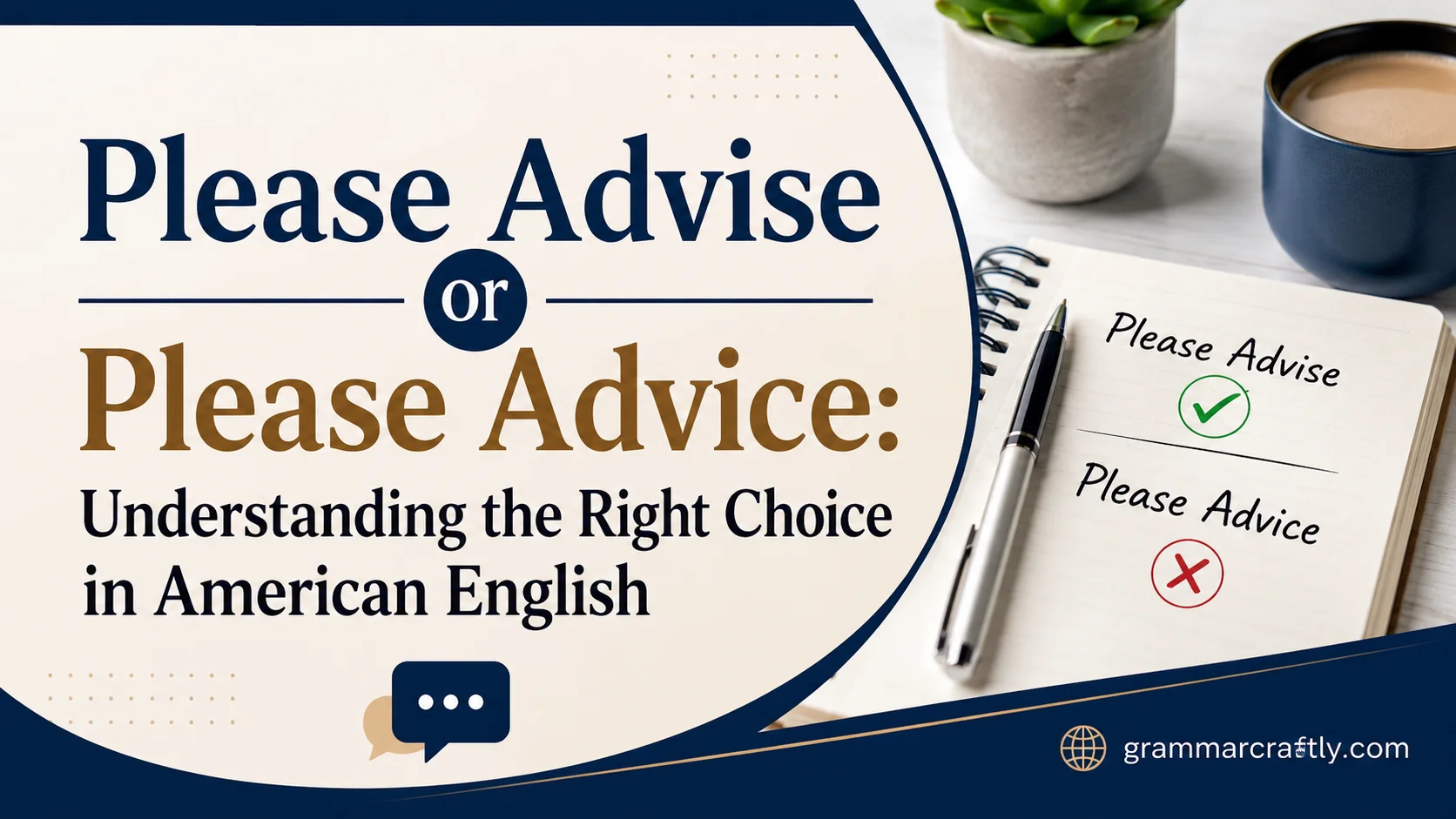
Quick Answer: Is It “Please Advise” or “Please Advice”?
The correct phrase is:
✅ Please advise
The incorrect phrase is:
❌ Please advice
Why?
Because advise is a verb. It means to give advice, recommend, or tell someone what to do.
Example:
Please advise on the next steps.
In this sentence, you are asking someone to advise you.
On the other hand, advice is a noun. It refers to guidance, recommendations, or suggestions.
Example:
Thank you for your advice.
You can’t say “please advice” because advice is a thing, not an action.
Quick Grammar Rule
| Word | Part of Speech | Meaning | Example |
| Advise | Verb | To recommend or guide | Please advise me |
| Advice | Noun | Guidance or recommendation | Thanks for your advice |
Simple shortcut:
If you need an action, use advise.
If you need a thing, use advice.
“Advise” vs “Advice” — The Simple Difference
This confusion happens because these words come from the same root and share almost the same spelling.
But grammar treats them very differently.
“Advise” Is a Verb
A verb is an action word.
Advise means:
- To recommend
- To guide
- To counsel
- To inform
Examples:
- Please advise me on this issue.
- My lawyer advised me to wait.
- Can you advise us?
In all of these examples, someone is doing something.
That’s why advise = action.
“Advice” Is a Noun
A noun is a person, place, thing, or idea.
Advice means:
- Guidance
- Recommendation
- Opinion offered to help
Examples:
- She gave me good advice.
- I appreciate your advice.
- That was useful advice.
In these examples, advice is the thing being given.
That’s why advice = thing.
Easy Memory Trick
A simple trick can help:
- AdviSE = Something you DO
- Advice = Something you GET
Another memory trick:
Verb = action = advise
Noun = object = advice
Short. Easy. Effective.
Why “Please Advise” Is Correct
Let’s break down the grammar.
The phrase “please advise” is an imperative sentence.
That means you are politely asking someone to perform an action.
Structure:
Please + Verb
Examples:
- Please review
- Please confirm
- Please respond
- Please advise
Notice the pattern?
The word after please is usually a verb.
Since advise is a verb, the sentence works.
Example:
Please advise on how to proceed.
This means:
Please tell me what to do.
That’s grammatically correct.
Grammar Formula
| Structure | Example |
| Please + Verb | Please confirm |
| Please + Verb | Please review |
| Please + Verb | Please advise |
Now look at this:
Please advice
That would mean:
Please + Noun
That structure breaks grammar.
It’s like saying:
- Please chair
- Please table
- Please coffee
It doesn’t work.
Why “Please Advice” Is Incorrect
This is one of the most common workplace grammar mistakes.
At first glance, “please advice” looks right because people know it relates to guidance.
But grammar says otherwise.
The Problem
“Please” usually asks for an action.
That means the next word should be a verb.
But advice is a noun.
That creates a broken sentence.
Incorrect:
Please advice me.
Correct:
Please advise me.
Incorrect:
Kindly advice.
Correct:
Kindly advise.
Why People Still Make This Mistake
There are several reasons.
Similar spelling
Only one letter changes:
- advise
- advice
That’s easy to miss.
Similar pronunciation
In fast speech, many learners don’t clearly hear the difference.
Non-native English confusion
In some languages, the noun and verb form look similar or follow different rules.
Typing habits
Autocorrect and fast typing often create mistakes.
Pronunciation Difference Most People Miss
Pronunciation can actually help you remember the rule.
Here’s how native speakers say them:
| Word | Pronunciation | Sound |
| Advise | /ədˈvaɪz/ | Ends with z |
| Advice | /ədˈvaɪs/ | Ends with s |
Listen to the Ending
- adviZ = action = verb
- adviS = noun
Examples:
Please adviz
Good advis
This small sound difference helps many learners lock the rule into memory.
What Does “Please Advise” Actually Mean in Emails?
In business communication, please advise means:
- Please tell me what to do
- Please provide guidance
- Please let me know your recommendation
- Please clarify next steps
It’s often used in:
- Work emails
- Customer service messages
- Legal communication
- Technical requests
- Internal business communication
Example:
The client rejected the proposal. Please advise on next steps.
This means:
Tell us what we should do next.
Hidden Meaning Behind the Phrase
Sometimes please advise carries different tones depending on context.
It can mean:
- I need guidance
- I need a decision
- I need instructions
- I need clarification
That’s why context matters.
Is “Please Advise” Too Formal or Rude?
This is where things get interesting.
Grammatically, please advise is correct.
But tone is another story.
Many professionals feel it sounds:
- Formal
- Direct
- Stiff
- Abrupt
- Old-fashioned
Example:
Please advise.
This can sound cold because it’s short and command-like.
Compare:
Could you let me know what you recommend?
That sounds warmer.
When “Please Advise” Works Well
Use it when:
- Writing formal business emails
- Asking for technical guidance
- Communicating in legal settings
- Requesting clear instructions
Example:
We’ve attached the revised contract. Please advise if further changes are needed.
That sounds appropriate.
When It Sounds Too Blunt
It can feel abrupt in casual settings.
Example:
I sent the files. Please advise.
This sounds stiff.
Better:
Let me know what you think.
or
Could you share your thoughts?
Is “Please Advise” Outdated in Modern Business Writing?
Some business writers think so.
Traditional corporate communication often used phrases like:
- Please advise
- Kindly revert
- As per our discussion
- Do the needful
Modern email writing prefers language that feels more human.
Instead of:
Please advise.
Writers now often use:
- What do you recommend?
- Could you guide me here?
- Let me know your thoughts.
- Can you confirm next steps?
Why?
Because modern communication values:
- Clarity
- Warmth
- Collaboration
- Conversational tone
That doesn’t mean please advise is wrong.
It just means it may sound formal in some contexts.
Read More: Is It Correct to Say “Very Helpful”?
Better Alternatives to “Please Advise”
If you want something more natural, here are better options.
Polite Alternatives
- Could you let me know?
- Could you advise?
- I’d appreciate your guidance.
- Please let me know.
Friendly Alternatives
- What do you think?
- Let me know your thoughts.
- Can you help here?
- What would you suggest?
Professional Alternatives
- Please share your recommendation.
- Kindly confirm next steps.
- Please provide guidance.
- Could you clarify?
Customer-Facing Alternatives
- Please let us know how you’d like to proceed.
- We’d appreciate your input.
- Kindly share your preference.
“Please Advise” Alternatives Comparison Table
| Phrase | Tone | Formality | Best Use |
| Please advise | Direct | High | Formal business |
| Please let me know | Neutral | Medium | Everyday email |
| What do you recommend? | Friendly | Medium | Guidance requests |
| Could you clarify? | Polite | Medium | Questions |
| Share your thoughts | Warm | Low | Team collaboration |
| Please confirm next steps | Clear | High | Project management |
Real Email Examples: Before and After
Example 1
Old style:
We have not received the document. Please advise.
Better:
We have not received the document. Could you let us know how you’d like to proceed?
Example 2
Old style:
Deadline missed. Please advise.
Better:
The deadline has passed. What would you recommend as the next step?
Example 3
Old style:
Attached for review. Please advise.
Better:
I’ve attached the file for review. Let me know your thoughts.
Common Grammar Mistakes Related to “Advise” and “Advice”
People don’t just confuse please advise and please advice.
Here are other common mistakes.
Wrong: Give Me An Advise
❌ Incorrect
Correct:
✅ Give me some advice.
✅ Give me a piece of advice.
Why?
Advice is uncountable.
Wrong: Can You Advice Me?
❌ Incorrect
Correct:
✅ Can you advise me?
Wrong: Thanks for Advise
❌ Incorrect
Correct:
✅ Thanks for the advice.
Wrong: He Gave Many Advices
❌ Incorrect
Correct:
✅ He gave a lot of advice.
Grammar Cheat Sheet
| Incorrect | Correct |
| Please advice | Please advise |
| Advice me | Advise me |
| Give me an advise | Give me some advice |
| Many advices | A lot of advice |
| Can you advice? | Can you advise? |
A Simple Memory Trick You’ll Never Forget
Here’s a foolproof method.
Think of the letters
AdviSE = Verb
Ends in SE like action words:
- revise
- supervise
- advise
Advice = Noun
Ends in CE like a thing.
Sentence Test Trick
Ask:
Can I replace it with “tell me”?
If yes:
Use advise
Example:
Please advise.
becomes:
Please tell me.
Works.
So advise is correct.
Why This Tiny Grammar Mistake Matters Professionally
Some people think grammar mistakes are minor.
Not always.
In professional writing, small errors can create:
- Confusion
- Negative impressions
- Reduced credibility
- Communication mistakes
Example
Imagine a client receives:
Please advice urgently.
Many readers will understand it.
But some will notice the grammar issue.
That can make the writing feel rushed or less polished.
Communication Psychology
Language affects perception.
Correct grammar often signals:
- Attention to detail
- Professionalism
- Competence
- Trustworthiness
That’s especially important in:
- Job applications
- Client communication
- Legal writing
- Academic communication
Mini Case Study: Workplace Email Impact
Scenario
A junior employee writes:
Kindly advice on this matter.
The manager notices the error.
The message still makes sense.
But the wording creates a small impression problem.
Now compare:
Could you advise on this matter?
Clear. Correct. Professional.
Tiny change. Better result.
That’s how grammar works in real life.
FAQs
Is “please advice” ever correct?
No.
Please advice is grammatically incorrect because advice is a noun.
The correct phrase is:
Please advise
Why do people say “please advice”?
Usually because:
- The words look similar
- Pronunciation causes confusion
- Non-native speakers mix noun and verb forms
- Typing errors happen
What does “please advise” mean?
It means:
- Tell me what to do
- Give guidance
- Recommend next steps
- Clarify the situation
Is “please advise” rude?
Not usually.
But it can sound:
- Formal
- Abrupt
- Stiff
Tone depends on context.
Is “please advise” outdated?
Not exactly.
It is still common in business writing.
But many professionals now prefer warmer alternatives.
Can I use “advice” in a sentence?
Yes.
Examples:
- Thank you for your advice.
- That was helpful advice.
- I need your advice.
Can I use “advise” in a sentence?
Yes.
Examples:
- Please advise me.
- I advise waiting.
- The consultant advised caution.
Which is better in professional emails?
If grammar is the question:
Please advise is correct.
If tone is the question:
Alternatives may sound more natural.
Examples:
- Let me know your thoughts.
- Could you clarify?
- What do you recommend?
Final Verdict: “Please Advise” or “Please Advice”?
Here’s the rule you need to remember.
Use “please advise” because advise is a verb.
Never use “please advice” because advice is a noun.
Final Shortcut
- Advise = action
- Advice = thing
If you’re asking someone to do something, use:
Please advise
If you’re referring to guidance itself, use:
Advice
That one-letter difference may seem tiny.
But in English grammar, it changes everything.