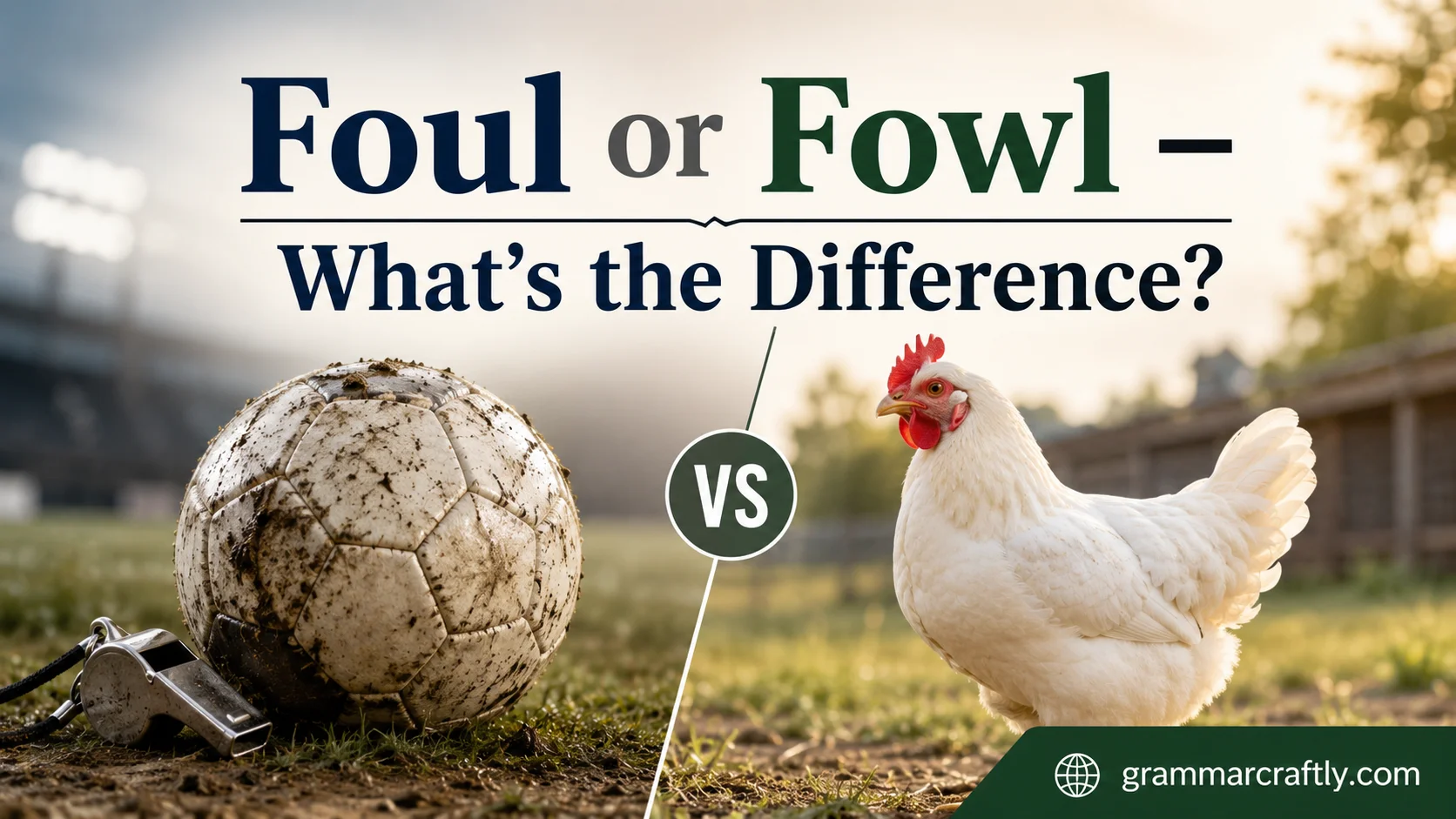
Foul or Fowl – What’s the Difference? foul and fowl are pronounced the same but different, creating confused language sound and meaning for learners.
In daily English, people often feel puzzled when words are sharing similar sound, causing confusion in conversation and language usage. I have heard this difference in real life where a friend talks about foul behavior in a game while another mentions fowl on a farm, creating a natural mix of meanings. Over years of studying and writing, learners build understanding through trial and error, improving pronunciation, attention, and vocabulary in their journey of learning new words.
The confusion becomes clearer when birds, chickens, and ducks appear in real life, often creating smells that feel bad or smelly, especially around a certain time when sports or daily activities are mentioned. A fowl-mouthed rooster or a joke among kids at a farm can make the idea more quirky, while wings and meat being prepared for dinner show the role of fowl in everyday usage. At the same time, foul relates to offensive or illegal actions, a violation in a game, or a move that feels unpleasant, showing how context and mindset help learners grasp the correct meaning through hearing, sharing, and real conversations over the years.
Why One Tiny Letter Can Change Everything
Picture this.
You text someone:
“That player made a fowl move.”
Technically, you just said the player turned into a bird. Not ideal.
Now switch it:
“That player made a foul move.”
That makes sense. It implies something unfair or against the rules.
This is the power of homophones—words that sound the same but mean completely different things. And foul vs. fowl is one of the trickiest pairs.
What Are Homophones (And Why They Trick You So Easily?)
Homophones are words that share the same pronunciation but have different meanings and spellings.
Here are a few you’ve probably seen:
- Their / There / They’re
- Flour / Flower
- Break / Brake
- Foul / Fowl
Your brain processes sound faster than spelling. So when you write quickly, it often picks the wrong version.
That’s why this mistake happens so often.
Foul vs. Fowl: The Core Difference in One Sentence
Here’s the simplest way to remember it:
- Foul = Something bad, unpleasant, unfair, or offensive
- Fowl = A type of bird, usually raised for food
If you remember just that, you’re already ahead of most people.
What Does “Foul” Really Mean?
The word foul carries a negative tone. It usually describes something unpleasant, wrong, or offensive.
Common Meanings of Foul
- Unpleasant smell
That garbage smells foul. - Unfair behavior (especially in sports)
That was a clear foul in the game. - Offensive language or behavior
He used foul language. - Bad weather conditions
They sailed through foul weather. - Criminal or dishonest actions
The police suspect foul play.
Common Phrases with “Foul”
These show up often in daily English:
- Foul play → dishonest or criminal behavior
- Foul mood → angry or irritable state
- Foul smell → something stinks badly
- Foul language → swearing or offensive speech
Real-Life Examples of “Foul”
- The referee called a foul during the match.
- There’s a foul odor coming from the fridge.
- The movie contains foul language, so it’s not for kids.
What Does “Fowl” Actually Refer To?
Now let’s switch gears.
Fowl has nothing to do with negativity. It refers to birds—especially those raised for food.
Common Types of Fowl
Here are the most common examples:
- Chicken
- Turkey
- Duck
- Goose
- Quail
These birds fall under the category of domestic fowl.
Fowl in Everyday Language
You’ll mostly see fowl in:
- Cooking
- Farming
- Agriculture
- Food-related content
Examples of “Fowl” in Sentences
- The farm raises different kinds of fowl.
- We had roasted fowl for dinner.
- Ducks and chickens are common fowl species.
Side-by-Side Comparison Table
Here’s a quick visual to lock it in:
| Feature | Foul | Fowl |
| Meaning | Bad, unpleasant, unfair | Bird (usually for food) |
| Usage | Emotions, behavior, sports | Animals, farming, cooking |
| Tone | Negative | Neutral |
| Example | Foul smell | Farm fowl |
| Context | Language, rules, weather | Agriculture, food |
Real-Life Examples You’ll Recognize Instantly
Let’s bring this into everyday situations.
In Sports
- Correct: That was a foul.
- Wrong: That was a fowl.
In Cooking
- Correct: We cooked fresh fowl.
- Wrong: We cooked fresh foul.
In Daily Conversation
- Correct: He has a foul attitude today.
- Wrong: He has a fowl attitude today.
Common Mistakes (And Why People Get Them Wrong)
People confuse foul vs. fowl for a few simple reasons.
Top Reasons
- They sound exactly the same
- Spellcheck doesn’t always catch it
- Both are short, simple words
- People rely on memory instead of meaning
Most Common Errors
- Writing “fowl smell” instead of “foul smell”
- Using “foul chicken” instead of “fowl”
- Mixing them in sports contexts
Quick Fix Strategy
Always ask yourself:
“Am I talking about something bad… or a bird?”
That one question solves the confusion instantly.
Memory Hacks That Actually Work
You don’t need to memorize definitions. You need tricks that stick.
Simple Word Associations
- Foul = Fail / Filthy / Funky (all negative)
- Fowl = Farm + Owl (bird connection)
Visual Memory Trick
Picture this:
- A foul smell → garbage, dirt, something unpleasant
- A fowl → chicken walking on a farm
Your brain remembers images better than words.
Spelling Trick
- Foul → contains “ou” like ouch (something bad)
- Fowl → contains “owl” (a bird)
That one works surprisingly well.
Mini Quiz: Test Yourself in 30 Seconds
Try this quick test.
Fill in the blanks:
- The referee called a ______.
- The soup has a ______ smell.
- The farmer raises ______ on his land.
- That was a ______ move in the game.
- We ate roasted ______ for dinner.
Answers
- Foul
- Foul
- Fowl
- Foul
- Fowl
Case Study: How a Small Mistake Changed Meaning Completely
A restaurant once advertised:
“We serve fresh foul daily.”
That’s a problem.
Customers interpreted it as bad or spoiled food. Sales dropped immediately.
They corrected it to:
“We serve fresh fowl daily.”
Sales improved almost overnight.
One letter made the difference between appealing and disgusting.
Expert Insight on Language Confusion
“Homophones are one of the most common sources of writing errors in English because they rely heavily on context rather than sound.”
— Oxford Language Studies
That’s exactly what’s happening with foul vs. fowl.
Bonus: Other Confusing Homophones You Should Know
If you struggle with foul vs. fowl, you might also mix these up:
- Their / There / They’re
- Your / You’re
- Its / It’s
- Flour / Flower
- Brake / Break
Mastering these gives your writing a serious upgrade.
Practical Tips to Never Mix Them Up Again
Let’s make this permanent.
Use Context First
Ask:
- Is it negative? → Foul
- Is it a bird? → Fowl
Read Your Sentence Out Loud
Does it make sense logically?
Example:
- “That chicken smells fowl” → doesn’t sound right
- “That chicken smells foul” → correct
Practice With Real Sentences
Write your own examples:
- The weather turned foul quickly.
- The farm has many types of fowl.
Repetition builds confidence.
Use Grammar Tools (Smartly)
Tools like Grammarly help, though they’re not perfect. Always double-check context.
Deep Insight: Why Context Beats Spelling
Here’s something interesting.
Your brain doesn’t read every letter. It recognizes patterns.
So when you see:
- foul
- fowl
Your brain treats them as identical unless context forces a correction.
That’s why even experienced writers slip up.
Read More: Masonary vs Masonry – Which is Correct?
Quick Recap (Save This Section)
- Foul = bad, unpleasant, unfair
- Fowl = bird, usually for food
- They sound the same but mean completely different things
- Context is the key to choosing the right word
Final Takeaway: Never Mix Them Up Again
You don’t need to overthink it.
Just remember this:
If it stinks, it’s foul.
If it clucks, it’s fowl.
Simple. Clear. Unforgettable.
Once you start noticing the difference, you’ll catch mistakes everywhere—on menus, in social media posts, even in professional writing.
And now, you won’t be one of the people making them.