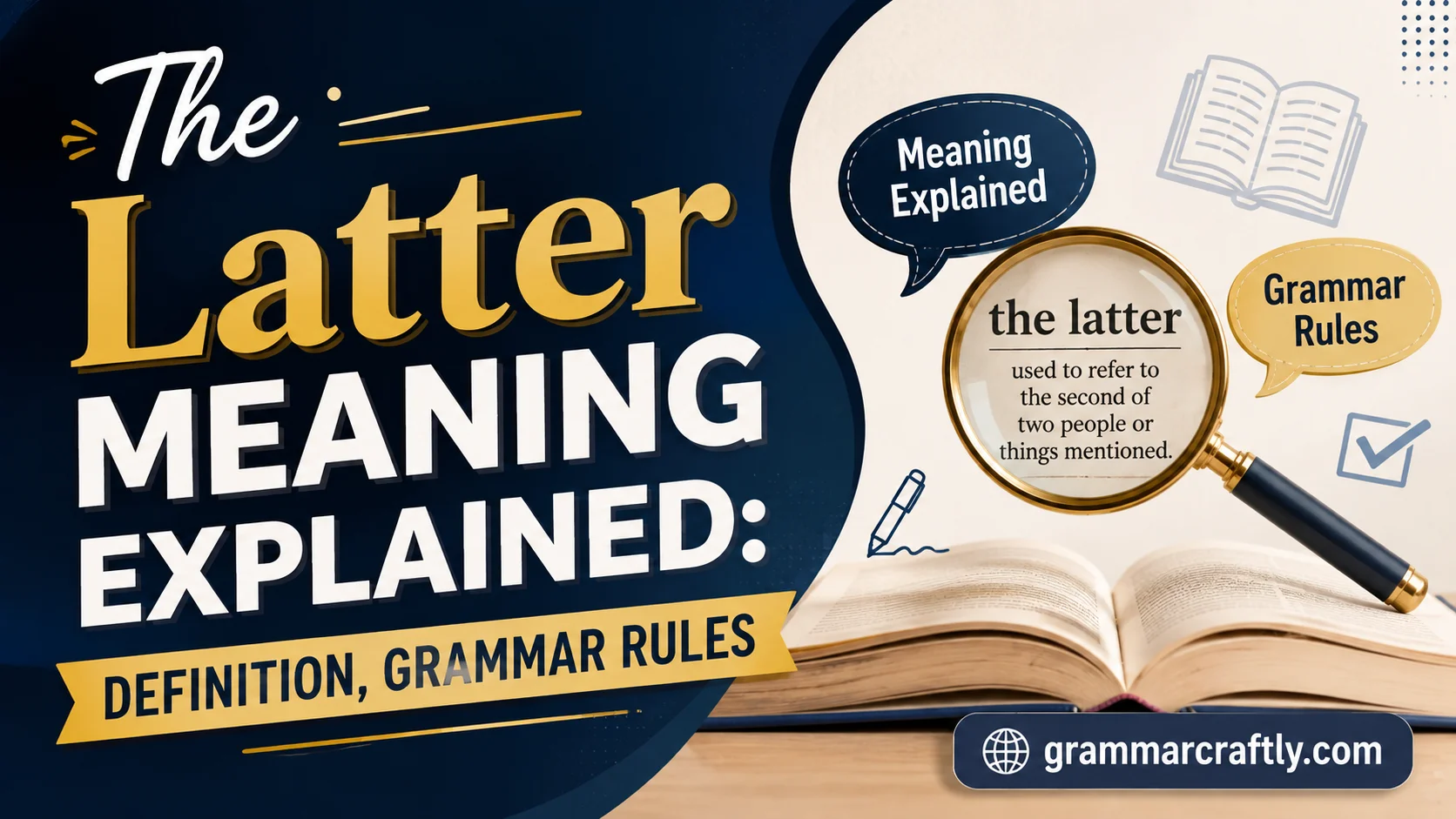
The Latter Meaning Explained: Definition, Grammar Rules explains the latter meaning, grammar rules, and terms used in formal writing.
When you read a sentence like “John and Michael applied for the job, but the latter got hired,” the word latter refers to the second person or thing mentioned. These terms are used to distinguish between two options, while former points to the first. This simple rule helps English learners and native speakers avoid confusion when they encounter these common phrases and expressions.
The definition of former and latter becomes easier when you understand their roles. Former can act as a noun or adjective and denotes a reference to the first thing or person among two items. The latter is the opposite term and identifies the second choice. These grammar rules are straightforward compared with other tricky words. For example, if John and Michael applied for a job and John was hired, John would be the former because he appeared first.
To avoid mistakes, remember that you should only use these words when referring to two things rather than more. This complete guide helps you learn how to use former and latter correctly in academic, professional, and formal writing. The good news is that the rule is surprisingly simple. By following practical examples, tips, and alternatives, you can make your writing clearer and more engaging while remembering the difference between them.
What Does “The Latter” Mean?
The phrase the latter refers to the second of two people, things, ideas, or options that were mentioned previously.
In simple terms:
- First item mentioned = the former
- Second item mentioned = the latter
Example
Sarah and Emma both submitted reports. The latter received an award.
In this sentence:
- Sarah = former
- Emma = latter
Therefore, the latter refers to Emma because she was mentioned second.
This expression helps writers avoid repeating names or nouns unnecessarily.
The Origin of the Phrase “The Latter”
The word latter comes from Old English and has existed for centuries.
Historically, it meant:
- Later in time
- Closer to the end
- The second of two things
The term developed from the comparative form of the word late.
Over time, English speakers began using the latter specifically to identify the second item in a pair.
Today, it remains common in:
- Academic writing
- Journalism
- Business reports
- Legal documents
- Professional communication
Although the phrase sounds somewhat formal, it still appears frequently in modern English.
When to Use “The Latter” in a Sentence
You should use the latter when:
- Two items have been mentioned
- You want to refer to the second item
- Repeating the noun would make the sentence awkward
Example
We can travel by train or plane. The latter is usually faster.
The second option mentioned is plane, so that is the latter.
Another Example
Coffee and tea both contain caffeine, but the latter often contains less.
The latter refers to tea because it was mentioned second.
Using the phrase correctly makes writing more concise and professional.
Understanding “The Former” vs. “The Latter”
Many people learn these two terms together because they function as a pair.
Quick Rule
ExpressionRefers ToThe FormerThe first item mentionedThe LatterThe second item mentioned
Example
Dogs and cats are popular pets. The former often require more outdoor activity, while the latter are generally more independent.
Here:
- Dogs = former
- Cats = latter
This structure eliminates repetition and improves flow.
The Easy Memory Trick That Makes Them Impossible to Forget
A simple memory trick can help you remember the difference forever.
Think of Position
- Former = First
- Latter = Last
Although “last” isn’t exactly the same as “latter,” both start with L, making the connection easy.
Another trick:
WordLetter HintFormerF = FirstLatterL = Last
This shortcut works remarkably well when reading or writing.
Side-by-Side Comparison Table
FeatureFormerLatterPositionFirst MentionedSecond MentionedPurposeRefers Back to First ItemRefers Back to Second ItemCommon UsageFormal WritingFormal WritingWorks Best WithTwo ItemsTwo ItemsAvoid WithThree or More ItemsThree or More Items
Examples of “The Latter” in Everyday English
Let’s explore practical situations where the phrase appears naturally.
Workplace Examples
Marketing and sales departments collaborated on the campaign. The latter focused on customer outreach.
Emma and David presented proposals. The latter’s presentation received the highest score.
Academic Examples
Quantitative and qualitative research methods serve different purposes. The latter often provides deeper insights into human behavior.
Biology and chemistry are core sciences. The latter focuses heavily on molecular interactions.
Casual Conversation Examples
We could order pizza or burgers. The latter sounds better tonight.
Tom and Ryan offered help. The latter arrived first.
These examples show how naturally the phrase fits into many contexts.
How “The Latter” Works in Grammar
Grammatically, the latter functions as a noun phrase.
Instead of repeating a noun, it acts as a substitute.
Example
Without substitution:
Lisa and Hannah attended the meeting. Hannah presented the report.
With substitution:
Lisa and Hannah attended the meeting. The latter presented the report.
Both sentences mean exactly the same thing.
The second version simply avoids repetition.
The Two-Item Rule You Must Know
This is the most important rule regarding the latter.
Use It Only for Two Items
Correct:
Summer and winter are popular travel seasons. The latter attracts many ski enthusiasts.
Incorrect:
Summer, spring, and winter are popular travel seasons. The latter attracts many ski enthusiasts.
Why is the second sentence problematic?
Because readers must guess which item “the latter” refers to when more than two items exist.
Best Practice
Use the latter only when exactly two options, people, or ideas appear.
This keeps your writing precise.
Visual Diagram: Former and Latter Relationship
Option A → Former Option B → Latter
Example
Apple → Former Orange → Latter
Sentence:
Apples and oranges are healthy fruits. The latter contains significant amounts of vitamin C.
Examples for Beginners
Learning through examples makes the concept easier to understand.
Example 1
Jack and Oliver entered the competition. The latter won first place.
The latter = Oliver.
Example 2
Swimming and running are excellent exercises. The latter burns many calories.
The latter = running.
Example 3
History and geography were difficult subjects. The latter required more memorization.
The latter = geography.
Example 4
Red and blue are common logo colors. The latter often conveys trust and reliability.
The latter = blue.
Read More: Dead in the Water Meaning: Definition, Origin
Advanced Examples for Professional Writing
Professional writing often relies on concise references.
Business Example
The company considered expansion through acquisition and organic growth. The latter offered lower financial risk.
Research Example
Researchers evaluated interviews and surveys. The latter generated larger data samples.
Legal Example
The agreement addressed liability and indemnification. The latter section required extensive negotiation.
Financial Example
Investors compared stocks and bonds. The latter provided greater stability during market volatility.
Common Mistakes People Make With “The Latter”
Even experienced writers sometimes misuse the phrase.
Referring to More Than Two Items
Incorrect:
Math, science, and English were difficult subjects. The latter was the hardest.
This creates ambiguity.
Unclear References
Incorrect:
Emily spoke to Sarah after meeting Jessica. The latter seemed upset.
Who exactly is the latter?
Readers may struggle to determine the intended reference.
Excessive Use
Overusing the phrase can make writing sound stiff.
Instead of repeatedly using the latter, alternate with:
- Names
- Pronouns
- Descriptive nouns
This improves readability.
Is “The Latter” Formal or Informal?
The phrase generally sounds formal.
You will frequently encounter it in:
- Academic papers
- News articles
- Legal writing
- Business reports
- Professional correspondence
However, people occasionally use it in conversation.
Formal Example
The board considered restructuring and expansion. The latter received unanimous approval.
Casual Example
We could watch a movie or play video games. The latter sounds more fun.
Both are correct.
The difference lies mainly in tone.
The Latter vs. The Last
Many writers confuse these expressions.
The Latter
Refers specifically to the second of two previously mentioned items.
Example:
Dogs and cats are popular pets. The latter are often more independent.
The Last
Refers to the final item in a sequence.
Example:
Dogs, cats, rabbits, and birds are common pets. The last option is especially popular among apartment dwellers.
Notice the difference:
- Latter = second of two
- Last = final item in any sequence
The Latter vs. Later
Although these words look similar, they serve different functions.
WordMeaningLatterSecond of two itemsLaterAt a future time
Examples
Latter:
Coffee and tea are available. The latter is decaffeinated.
Later:
We’ll discuss the issue later.
Confusing these words can change the meaning entirely.
The Latter vs. Latest
These terms are also frequently confused.
Latter
Refers to the second item in a pair.
Latest
Means most recent.
Examples:
Apple and Samsung released smartphones. The latter introduced a new camera system.
The latest smartphone includes advanced AI features.
The meanings are completely different.
Alternatives to “The Latter”
Sometimes a direct reference works better.
Use the Actual Noun
Instead of:
Marketing and sales collaborated. The latter managed outreach.
Consider:
Marketing and sales collaborated. Sales managed outreach.
Use Pronouns
Instead of:
Emma and Rachel attended. The latter arrived early.
Try:
Emma and Rachel attended. Rachel arrived early.
Use Descriptive Labels
Instead of:
The company considered remote work and hybrid work. The latter gained popularity.
Try:
The hybrid model gained popularity.
These alternatives often improve clarity.
When You Should Avoid Using “The Latter”
Not every sentence benefits from this expression.
Avoid It When Clarity Matters Most
If readers must stop and think, rewrite the sentence.
Avoid It With Long Distances
Example:
A lengthy paragraph mentions two concepts at the beginning. Several sentences later, the latter appears.
Readers may forget the original pair.
Avoid It With Multiple References
Too many former-latter constructions create unnecessary complexity.
Simple writing often wins.
Style Guide Recommendations
Many professional editors encourage careful use of the latter.
Academic Writing
Accepted and frequently used.
Legal Writing
Common due to precision requirements.
Journalism
Used sparingly because clarity matters.
Digital Content
Many SEO writers avoid excessive usage since readers prefer straightforward language.
The best approach is balance.
Case Study: How One Small Word Improved a Business Report
A consulting firm prepared a report comparing:
- Remote work
- Hybrid work
The original report repeatedly restated both terms.
After revision, editors used the latter strategically.
Before
Remote work and hybrid work were evaluated. Hybrid work showed stronger productivity gains. Hybrid work also improved retention.
After
Remote work and hybrid work were evaluated. The latter showed stronger productivity gains and improved retention.
The revised version became shorter and easier to read.
This illustrates the true purpose of the phrase: reducing repetition without sacrificing meaning.
Famous Examples From Professional Writing
Many respected publications use the latter when comparing two ideas.
For example:
Investors often choose between growth and value stocks. The latter may perform better during uncertain economic periods.
Similarly:
Businesses must prioritize efficiency and innovation. The latter often drives long-term competitive advantage.
These examples demonstrate concise professional communication.
Expert Tips for Using “The Latter” Naturally
Keep References Close Together
Readers should immediately recognize what the latter refers to.
Limit Usage
Use it occasionally rather than repeatedly.
Prioritize Clarity
If a name works better, use the name.
Remember the Two-Item Rule
This rule prevents most mistakes.
Read Aloud
If the sentence sounds awkward, revise it.
Quick Reference Cheat Sheet
QuestionAnswerWhat does the latter mean?The second of two items mentionedWhat does the former mean?The first of two items mentionedCan it refer to three items?NoIs it formal?UsuallyCan it be used in conversation?YesIs it grammatically correct?AbsolutelyShould it be overused?NoBest use case?Comparing two people, things, or ideas
FAQs:
1. What does “latter” mean in English grammar?
The word latter refers to the second of two people, things, or ideas mentioned in a sentence. It helps writers avoid repeating the name or description of the second item.
2. What is the difference between former and latter?
Former refers to the first person or thing mentioned, while latter refers to the second. For example, in “Tea and coffee are popular drinks, but the latter is my favorite,” coffee is the latter because it appears second.
3. Can I use former and latter when talking about more than two things?
No. The words former and latter should only be used when comparing or mentioning two items. Using them for three or more options can confuse readers.
4. Is latter only used in formal writing?
Although latter appears often in academic, professional, and formal writing, you can also use it in everyday English when you need to refer clearly to the second of two mentioned things.
5. What is an easy way to remember the meaning of latter?
A simple trick is to remember that latter starts with “L,” which can remind you of “last.” Since it refers to the last-mentioned item out of two, it becomes easier to identify.
Conclusion:
Understanding The Latter Meaning Explained: Definition, Grammar Rules helps you use former and latter with confidence. These terms make writing shorter and clearer by replacing repeated words when discussing two things. Remember that former points to the first-mentioned item, while latter identifies the second. By following these simple grammar rules and practicing with examples, you can avoid confusion and improve the accuracy of your academic, professional, and everyday writing.