Bunk vs Debunk – Difference, Meaning & Examples is important for understanding false bunk and correct debunk in communication and media now.
Understanding Bunk and Debunk is important in everyday writing, speech, and online discussions because it shows the real difference between false, misleading, and nonsense content and how it can expose or prove wrong ideas using facts, logic, and verification. From my own experience while reading media and using social platforms, I noticed how fast misinformation, fake news, and incorrect ideas can spread, so knowing this distinction really helps in spotting doubtful claims early and improving communication skills.
This understanding also improves communication skills in academic, professional, and everyday life situations. When people identify reliable sources, analyze evidence-based information, and avoid spreading rumors or propaganda, they build stronger critical thinking, logical reasoning, and better decision-making. It also strengthens clarity, accuracy, and expression, making discussions and conversations more effective, confident, and reducing misunderstanding in both personal communication and public communication.
Bunk vs Debunk: The Core Difference in Plain English
At the simplest level:
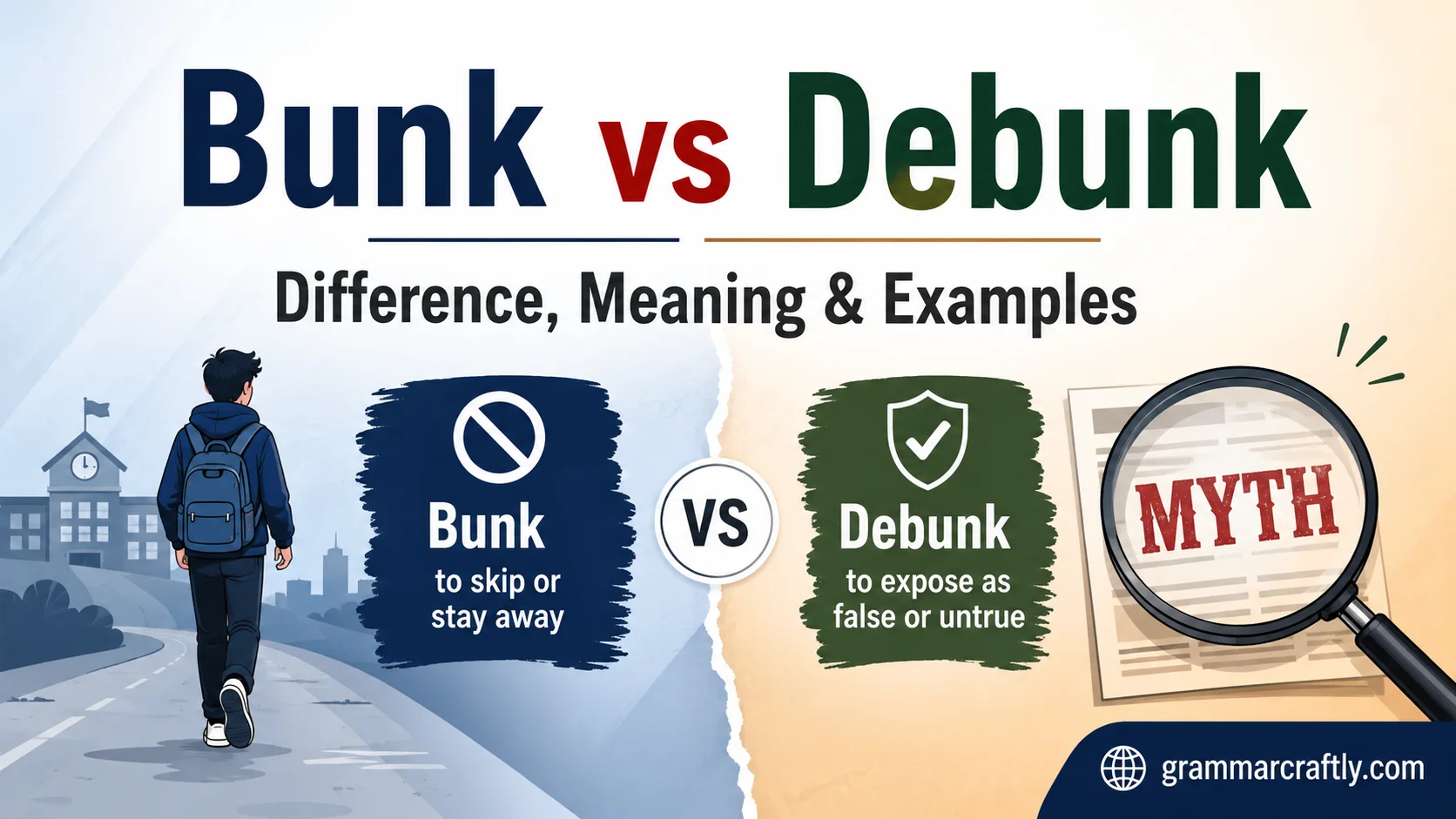
- Bunk means nonsense, garbage, or something not worth believing.
- Debunk means to expose something as false by giving evidence and explanation.
That difference matters more than it seems. When you say something is bunk, you are mostly dismissing it. When you debunk something, you are showing why it is wrong.
Think of it like this:
- Bunk is a shrug.
- Debunk is a proof-backed answer.
That one shift changes the whole tone.
Quick comparison table
| Word | Basic meaning | Tone | What it does | Best use |
| Bunk | Nonsense, rubbish, nonsense talk | Casual, dismissive, informal | Rejects an idea quickly | Everyday conversation, opinionated speech |
| Debunk | Prove something false with evidence | Analytical, fact-based, corrective | Explains why a claim is wrong | Writing, reporting, education, fact-checking |
This is why the words should not be treated as interchangeable. They perform different jobs.
What “Bunk” Really Means in Everyday English
The word bunk often means something like “nonsense.” It can also suggest that an idea is silly, false, or not worth taking seriously. You will hear it in casual conversation more than formal writing.
For example:
- “That excuse is bunk.”
- “Don’t give me bunk.”
- “The whole story sounds like bunk.”
In these examples, the speaker is not carefully analyzing the claim. They are brushing it aside. That is the key point.
Bunk carries attitude
Bunk does not usually sound neutral. It often carries impatience, skepticism, or even irritation. Sometimes it sounds playful. Other times it sounds harsh.
That makes it useful in relaxed speech. It is not the best choice when precision matters. If you are writing an article, preparing a report, or explaining a complicated issue, bunk may feel too vague.
Bunk in modern speech
In modern use, bunk can act like a shortcut word for “this is obviously not true” or “I do not buy it.” That makes it appealing because it is short and strong. But strength is not the same thing as clarity.
That is where many people slip. They use bunk when they really need debunk.
What “Debunk” Really Means and Why It Hits Differently
Debunk means to expose something as false, exaggerated, misleading, or mistaken. It usually involves reasoning, facts, or evidence.
For example:
- A journalist debunks a viral rumor.
- A teacher debunks a common myth.
- A doctor debunks a health claim that has no support.
Notice the pattern. Debunk does not stop at rejection. It moves into explanation.
Debunk is about correction
If someone says, “That claim is debunked,” they are saying the claim has been shown to be false. That usually means someone checked the facts and provided a stronger answer.
That is why debunk feels more serious than bunk. It belongs to the world of analysis, verification, and clarity.
Debunk often needs evidence
You do not really debunk something by simply saying “no.” You debunk it by showing why the claim fails.
For example:
- A fake quote can be debunked by finding the original source.
- A myth about exercise can be debunked by pointing to reliable studies.
- A rumor can be debunked by comparing it with verified facts.
This is why debunk is such a useful word in journalism, science, education, and public discussion.
Bunk vs Debunk: Dismissal vs Explanation
This is the heart of the difference.
Bunk dismisses.
Debunk explains.
That seems small, but it changes communication in a big way.
When you call something bunk, you are saying it is not worth believing. When you debunk something, you are helping someone understand why it should not be believed.
Here is the practical difference
Imagine someone says:
“Drinking lemon water cures every disease.”
A reply using bunk might be:
“That is bunk.”
A reply using debunk might be:
“That claim has been debunked. Lemon water may be refreshing, but it does not cure disease.”
The second response does more work. It addresses the idea and explains the reason. It invites understanding instead of just shutting the door.
Why this matters in real conversations
In daily talk, people often want to sound confident. So they reach for the sharper word. But if the goal is to be clear, debunk is usually the better choice.
You do not just want to sound strong. You want to be understood.
Why People Confuse Bunk and Debunk
The confusion makes sense. The words share a similar sound. They also appear in similar conversations about truth, doubt, and bad information.
There are a few reasons people mix them up.
Similar sound, similar vibe
Both words feel slightly informal. Both can show skepticism. Both can appear in arguments, commentary, and online debates.
That overlap makes them easy to blur together.
Fast speech creates sloppy meaning
When people speak quickly, they often choose the first word that feels right. In a heated conversation, there is rarely time to pause and ask whether the word means dismissal or correction.
That is why language gets sloppy in everyday use.
Social media makes it worse
Online conversation rewards speed. People post reactions, not careful explanations. A short, punchy word often wins over a precise one.
So bunk gets used as a quick label for anything suspicious. Debunk gets thrown around as a general synonym for “call out” or “disagree,” even when no real evidence appears.
That is not great communication. It is just fast communication.
The Emotional Tone of Bunk vs Debunk
Words do more than carry meaning. They carry mood.
Bunk sounds casual and dismissive
Bunk often feels informal, slangy, and a little sharp. It can sound like someone waving a hand and saying, “Please. Spare me.”
That can be effective when you want a conversational tone. It can also sound careless if the subject deserves a real answer.
Debunk sounds thoughtful and analytical
Debunk feels more serious. It suggests that someone took the time to test a claim, review evidence, and respond carefully.
That makes it a better fit for:
- news writing
- academic discussions
- educational content
- fact-checking
- expert commentary
Tone shapes trust
Here is the hidden truth: people often trust the tone before they trust the content.
If you say, “That is bunk,” the reader hears dismissal.
If you say, “That myth has been debunked,” the reader hears evidence.
One sounds like a reaction. The other sounds like a conclusion.
Bunk vs Debunk in Social Media and Online Arguments
Social media is where these words get messy fast.
That is because online spaces are built for speed, emotion, and attention. Nuance often gets flattened. A complex claim becomes a meme. A careful explanation becomes a caption. A half-baked theory spreads faster than a corrected one.
Why bunk thrives online
Bunk thrives because it is easy. It works as a one-word shutdown. It also fits the tone of quick reactions.
People use it when they are angry, amused, or annoyed. That makes it useful in comment sections and casual posts.
Why debunking struggles online
Debunking takes effort. You need evidence. You need context. You often need more than one sentence.
That is a problem in a digital space where attention spans are short and outrage moves fast.
A common online pattern
A rumor appears.
Someone reposts it.
A commenter says, “This is bunk.”
Another person says, “Actually, it has been debunked.”
The second person does the harder job. The first person only reacts.
That difference matters because audiences often remember the loud claim more than the careful correction.
Why Your Brain Likes the Word “Bunk”
There is a psychological reason people lean toward dismissive words.
Cognitive shortcuts save effort
The brain likes to save energy. That is normal. Instead of carefully judging every claim, people often use shortcuts.
A word like bunk gives the brain a fast exit:
“This does not feel right, so toss it out.”
That can be helpful in some situations. But it can also lead to lazy thinking.
Confirmation bias sneaks in
People are more likely to dismiss ideas that already bother them. If something clashes with their beliefs, they may call it bunk without checking it.
That is not critical thinking. That is a mood.
Debunking takes patience
To debunk something well, you have to slow down. You need to ask questions. You need to check sources. You need to explain the gap between claim and fact.
That makes debunking more demanding. It also makes it more valuable.
Good debunking does not just reject a claim. It shows the work.
That one sentence captures the whole point.
Bunk vs Debunk in Professional Settings
In professional communication, precision matters. A lot.
In business
If a manager says, “That proposal is bunk,” the message is blunt but vague. It says the idea is bad, but it does not explain why.
If the manager says, “We should debunk this assumption before moving forward,” the team understands that analysis is needed.
In education
Teachers and trainers often need to correct false beliefs. That is classic debunking work.
For example, a science teacher might debunk the myth that humans use only 10% of their brains. That is much more helpful than simply saying, “That is bunk.”
In journalism
Journalists often debunk misinformation. They investigate claims, trace sources, and compare evidence.
The word debunk fits that work because it includes the idea of verification. It is not just opinion. It is correction backed by facts.
In legal and technical settings
These environments demand careful language. A word like bunk might sound too casual or too emotional. Debunk can still work, but even then, it often needs support from direct evidence.
That is why professionals usually prefer specific terms over vague dismissals.
Real-Life Examples of Bunk vs Debunk
Examples make the difference stick.
Everyday conversation
Bunk:
“His excuse for being late was bunk.”
Debunk:
“The claim that traffic caused a two-hour delay was debunked when the route data showed normal traffic flow.”
The first is quick and judgmental. The second is specific and supported.
Health claims
Bunk:
“Detox teas are bunk.”
Debunk:
“The idea that detox teas remove toxins has been debunked because the body already uses the liver and kidneys to process waste.”
The second answer teaches something. That is a huge advantage.
History and culture
Bunk:
“That story about the famous quote is bunk.”
Debunk:
“The quote was debunked after researchers traced it to a later source and found no evidence the original speaker ever said it.”
Again, one is a brush-off. The other is an explanation.
Workplace example
Bunk:
“That performance excuse is bunk.”
Debunk:
“The explanation was debunked when the project timeline showed the deadline had been missed before the reported issue occurred.”
The difference is obvious when you place the words in context.
Case Study: A Viral Claim and the Power of Debunking
A popular claim spreads online. It sounds believable. People share it because it confirms what they already suspect.
Now two people respond.
Response A
“That is bunk.”
This response is quick. It may feel satisfying. But it does not help anyone learn.
Response B
“That claim has been debunked. The original source was traced, the numbers were checked, and the conclusion did not hold up.”
This response does more. It slows the rumor down. It gives the reader a reason to stop and think.
What this shows
The word bunk can express skepticism.
The word debunk can change minds.
That is the real difference.
A Simple Way to Remember Bunk vs Debunk
A memory trick helps here.
Think of it this way
- Bunk = “That is nonsense.”
- Debunk = “Here is why that nonsense is false.”
Or even shorter:
- Bunk = dismiss
- Debunk = disprove
That pair is easy to remember and hard to mix up once it clicks.
Another quick rule
Ask yourself:
- Am I only rejecting the idea?
- Or am I proving it wrong with evidence?
If you are only rejecting it, bunk may fit.
If you are proving it wrong, debunk is the right word.
When to Use Bunk
Use bunk when the setting is informal and you want a short, casual dismissal.
Good uses of bunk
- casual conversation
- humorous comments
- strong personal reactions
- informal writing
Examples
- “That story sounds like bunk.”
- “Most of that excuse was bunk.”
- “I think the rumor is bunk.”
When bunk may not be enough
Avoid bunk when you need:
- evidence
- careful analysis
- professional tone
- educational clarity
In those cases, debunk or a more specific phrase works better.
When to Use Debunk
Use debunk when you want to show that a claim is false and explain why.
Good uses of debunk
- fact-checking
- journalism
- teaching
- research writing
- myth correction
- expert communication
Examples
- “Researchers debunked the myth.”
- “The article debunks a common misconception.”
- “The report debunked the claim with data.”
Why debunk is usually stronger
It does not just say “wrong.” It says, “Here is the process that proves it wrong.”
That makes it more useful in serious communication.
Bunk vs Debunk in Teaching and Learning
Teachers, trainers, and writers often need to correct bad information. That is where the distinction really shines.
Why students need debunking, not just dismissal
If a student hears, “That is bunk,” they may understand the speaker’s frustration. But they may not learn the truth.
If they hear a debunking explanation, they get the correction plus the reasoning behind it. That helps them remember the lesson.
Example in a classroom
Instead of saying:
“That idea is bunk.”
A better version is:
“That idea has been debunked because the evidence points in a different direction.”
That small change improves learning. It also models better thinking.
Teaching works best when it explains
Good education does not just tell people what is wrong. It shows them why it is wrong and what to believe instead.
That is why debunk belongs in teaching. Bunk mostly belongs in casual speech.
Bunk vs Debunk and the Language of Critical Thinking
Critical thinking is not just about spotting falsehoods. It is about asking better questions.
Bunk can short-circuit thinking
When someone says, “That is bunk,” the conversation may end right there. That can feel decisive. But it can also stop useful discussion.
Debunk keeps inquiry alive
When someone says, “That claim has been debunked,” there is usually room for follow-up:
- How was it debunked?
- What evidence was used?
- What is the correct explanation?
That makes the conversation more productive.
Why this matters
In a world full of headlines, viral clips, and fast opinions, critical thinking is a survival skill. Precise language helps build that skill.
And precise language starts with choosing the right word.
Common Misuse Examples
People often misuse these words in predictable ways.
Misuse example
“The scientist debunked the theory by saying it was bunk.”
This sounds awkward because bunk and debunk are doing two very different jobs in the same sentence. It is not wrong in meaning, but it can feel clumsy.
Better version
“The scientist debunked the theory by presenting evidence that contradicted it.”
That version is cleaner and more useful.
Another misuse example
“That article was bunk because it debunked the claim.”
This sentence creates confusion because it mixes dismissal with verification in a way that blurs the meaning.
Better version
“That article was strong because it debunked the claim with evidence.”
That makes the function of debunked clear.
Quick Reference Table for Bunk vs Debunk
| Situation | Better word | Why |
| Casual conversation | Bunk | Short and informal |
| Fact-checking an online rumor | Debunk | Needs evidence and explanation |
| Sarcastic remark | Bunk | Fits the tone |
| Academic or journalistic writing | Debunk | More precise and credible |
| Explaining a myth to students | Debunk | Educates instead of just dismissing |
| Blunt personal opinion | Bunk | Works as a strong reaction |
This table makes the pattern easy to see. The more serious the communication, the more likely debunk is the better choice.
Read More: Ardor or Ardour – Which Is Correct?
Why This Difference Matters in the Real World
At first glance, the difference between bunk and debunk looks tiny. In practice, it changes how people understand your message.
It affects credibility
If you use debunk well, you sound careful and informed. If you throw around bunk in serious contexts, you may sound vague or overly emotional.
It affects persuasion
People are more likely to trust a claim when they see evidence. Debunking provides that evidence. Bunk does not.
It affects clarity
Good communication should reduce confusion, not create it. The right word helps the listener know whether you are dismissing an idea or proving it false.
It affects tone
A single word can make you sound thoughtful, rude, funny, smart, dismissive, or helpful. That is a lot of pressure for such small terms. But language works that way.
A Final Rule You Can Use Every Time
Here is the easiest rule of all:
- Use bunk when you want to say something is nonsense.
- Use debunk when you want to prove something is nonsense.
That rule works in most situations.
Think of the relationship like this
Bunk is the verdict.
Debunk is the process.
Or even more simply:
Bunk reacts.
Debunk explains.
That is the core difference. Once you see it, the confusion clears up fast.
Conclusion: Bunk vs Debunk Is a Small Difference with a Big Impact
The words bunk and debunk may sound related, but they do not do the same job. Bunk is a casual dismissal. Debunk is a reasoned correction. One is a brush-off. The other is a response built on evidence.
That difference matters in conversation, writing, teaching, media, and online communication. It matters because people trust clarity. They trust the explanation. They trust words that show real thinking.
So the next time you hear a questionable claim, pause for a second. Ask whether you are just rejecting it or actually proving it wrong. That little pause can improve your language, sharpen your thinking, and make your message far more effective.
In the end, bunk vs debunk is not just a grammar question. It is a communication question. And when you choose the right word, your meaning lands much better.