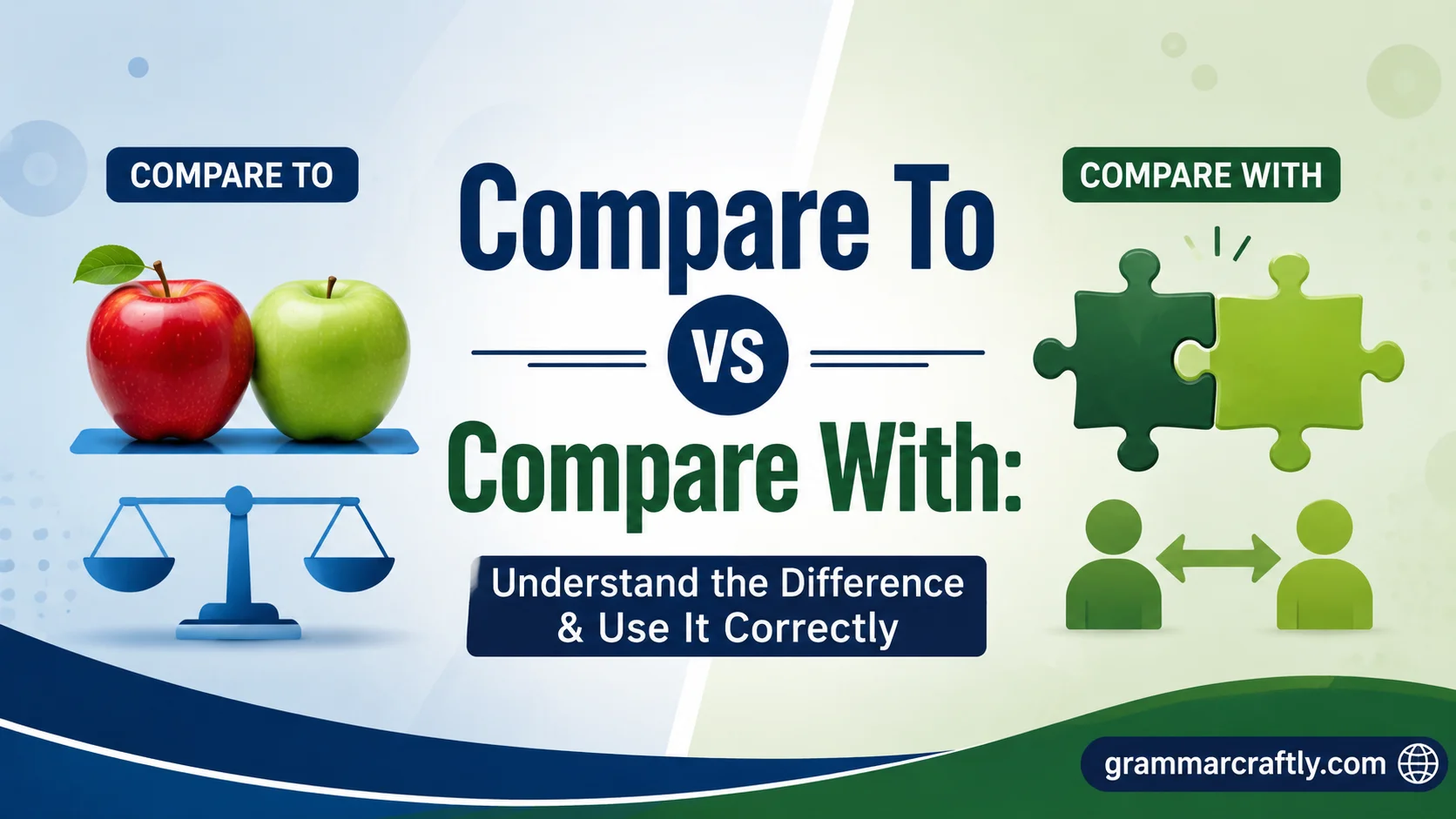
Compare To vs Compare With: when comparing two or more things, these phrases can bounce around daily conversations and cause confusion about meaning.
In my experience with writing, essays, articles, and teaching English grammar, this small detail can change a sentence. Compare To often highlights similarities in a creative or figurative way, such as saying coffee tastes like chocolate. You’re noting a shared taste or quality instead of analyzing it in depth. Writers may use the two interchangeably, but knowing their differences makes your writing more confident and correct. On the other hand, Compare With is better for examining items side by side to find differences and similarities. For example, when you compare ours with theirs, you can look closely at each, understand the nuances, and see which is better. This purpose serves different needs in speech and everyday conversation.
The rules become easier when you use each phrase at the right time and right place. Compare To can show a relationship or explore a similarity, while Compare With can teach, examine, and show the truth behind semantics. This approach helps you avoid common mistakes and make your messages clearer and more interesting for people. Editing may be a tedious task for a detail-oriented copyeditor, because a word can shift slightly when paired with another. These extremely similar phrases have stumped many readers over the years, and unfortunately, there’s no straight answer for every situation. Thankfully, there’s a way to make the debate clearer. Start with the basics: Compare can act as a transitive verb or intransitive verb. The American Heritage Dictionary says it can consider or describe things as similar, equal, or analogous, liken them, examine them to note similarities or differences, or draw comparisons. Merriam-Webster’s Dictionary of English Usage explains that the choice between to and with depends on what you mean. Use compare to when you mean “to liken,” and compare with when you want to examine and discover resemblances and differences.
“Let’s dive in”
Compare To vs Compare With: The Quick Answer
If you’re looking for the simplest explanation, remember this:
| Expression | Primary Purpose | Example |
| Compare to | Showing similarities or making figurative comparisons | She compared his voice to music. |
| Compare with | Examining similarities and differences | We compared this year’s sales with last year’s figures. |
A useful shortcut is this:
Compare to = resemblance.
Compare with = analysis.
Modern English isn’t always rigid, though. In some situations, both expressions are acceptable. Understanding their traditional meanings will help you choose the most natural option.
Why Compare To and Compare With Confuse Writers
Part of the confusion comes from the fact that both phrases use the same verb.
For example:
- Compare apples to oranges.
- Compare apples with oranges.
Both are grammatically correct. Yet they create slightly different expectations for readers.
The first sentence often suggests a figurative or broad comparison. The second implies a detailed examination of similarities and differences.
English has also evolved considerably over time. Contemporary American English allows greater flexibility than older grammar books suggest. Professional writers frequently use both expressions interchangeably when context makes the meaning clear.
That doesn’t mean the distinction has disappeared. Rather, it has become more nuanced.
Understanding that nuance will immediately improve your writing.
The Core Difference Between Compare To and Compare With
The traditional distinction remains useful.
Use Compare To When:
- Showing resemblance
- Making figurative comparisons
- Creating imagery
- Drawing broad parallels
- Writing creatively
Examples include:
- Shakespeare compared love to a summer’s day.
- The teacher compared the brain to a computer.
- Her smile was compared to sunshine.
Use Compare With When:
- Examining similarities
- Identifying differences
- Conducting research
- Making detailed analyses
- Writing reports or studies
Examples include:
- Scientists compared the new findings with previous research.
- The company compared quarterly earnings with last year’s results.
- We compared two smartphones with one another.
The distinction may seem subtle, but readers often notice it instinctively.
Compare To Meaning and Grammar Rules
The expression compare to traditionally emphasizes resemblance.
When writers use it, they usually want readers to think about how two things are alike rather than how they differ.
Formula
Compare + noun + to + noun
Examples:
- He compared her kindness to a warm embrace.
- Teachers often compare learning to building a house.
- Critics compared the novel to a modern classic.
- The coach compared teamwork to an orchestra performing together.
Notice that these examples focus on similarities rather than detailed evaluation.
Compare To in Literature
Creative writers love using compare to because it creates vivid imagery.
Consider these examples:
- Time is compared to a river.
- Knowledge is compared to light.
- Life is compared to a journey.
Such comparisons help readers visualize abstract ideas.
When Compare To Sounds Better
Use it when writing:
- Stories
- Essays
- Speeches
- Creative articles
- Inspirational content
For example:
“Success is often compared to climbing a mountain.”
The sentence paints a picture immediately.
Compare With Meaning and Grammar Rules
Compare with usually suggests careful examination.
Researchers, business professionals, and educators frequently prefer this expression because it sounds analytical.
Formula
Compare + noun + with + noun
Examples include:
- Compare this report with last year’s findings.
- Compare the two proposals with one another.
- Compare these products with competing brands.
- Compare your answers with the answer key.
Readers naturally expect some form of analysis after hearing compare with.
Compare With in Professional Writing
You’ll frequently encounter it in:
- Research papers
- Scientific studies
- Business reports
- Product reviews
- Educational materials
For example:
“Researchers compared patient outcomes with earlier clinical trials.”
This sentence implies detailed investigation rather than simple resemblance.
Compare To vs Compare With at a Glance
| Feature | Compare To | Compare With |
| Shows similarity | Yes | Yes |
| Shows differences | Rarely | Yes |
| Figurative language | Common | Less common |
| Detailed analysis | Rarely | Common |
| Academic writing | Sometimes | Frequently |
| Creative writing | Frequently | Sometimes |
| Business reports | Occasionally | Frequently |
| Research papers | Occasionally | Frequently |
This distinction remains useful even in modern English.
Compare To vs Compare With in Modern Usage
Modern American English has relaxed many traditional grammar rules.
You’ll often find newspapers, business publications, and academic sources using both expressions naturally.
Consider these examples:
- Compare today’s technology to that of twenty years ago.
- Compare today’s technology with that of twenty years ago.
Both sentences are acceptable.
The difference lies primarily in emphasis.
The first suggests drawing broad parallels.
The second suggests examining similarities and differences more closely.
The Modern Rule
If both expressions sound natural, ask yourself:
Are you emphasizing resemblance or analysis?
If the answer is resemblance, choose compare to.
If you’re emphasizing examination, choose compare with.
Read More: Spin One’s Wheels Idiom: Meaning, Origin Examples
American English vs British English Usage
American English tends to use both expressions flexibly.
British English traditionally preserves the distinction more consistently, particularly in formal writing.
American English
Common examples include:
- Compare today’s economy to the 1990s.
- Compare this phone with last year’s model.
Both sound perfectly natural.
British English
British editors are sometimes more likely to write:
- Compare these results with previous studies.
- Compare the character to his literary predecessor.
Although the distinction isn’t absolute, British style guides often encourage preserving the traditional meanings.
Compared To vs Compared With
Writers frequently confuse these forms.
Examples include:
Compared To
- Compared to last year, profits increased substantially.
- Compared to earlier models, this laptop performs better.
Compared With
- Compared with similar products, this model offers better durability.
- Compared with previous studies, the findings remain consistent.
Again, context matters.
Modern usage allows some overlap. Formal writing, however, still benefits from making thoughtful choices.
Compare Against vs Compare With
Another expression deserves attention.
Compare Against
You’ll often hear:
- Compare prices against competitors.
- Compare performance against industry standards.
This phrase emphasizes benchmarking.
Comparison Table
| Expression | Usage |
| Compare to | Similarities |
| Compare with | Similarities and differences |
| Compare against | Measuring performance |
| Versus | Direct competition |
| Similar to | Describing resemblance |
Each serves a slightly different purpose.
Compare To vs Similar To vs Versus
Many writers accidentally overuse compare when other expressions work better.
Similar To
Use when discussing resemblance.
Examples:
- The design is similar to earlier versions.
- His writing style is similar to Hemingway’s.
Versus
Use when discussing opposition or competition.
Examples:
- Android versus iPhone
- Online learning versus classroom learning
Compare To
Use when drawing meaningful parallels.
Examples:
- She compared perseverance to planting seeds.
- Critics compared the performance to a masterpiece.
Choosing the most precise expression improves readability immediately.
Compare To and Compare With in Academic Writing
Academic writing values precision.
Researchers typically prefer compare with because it signals careful analysis.
Examples include:
- Compare the results with previous experiments.
- Compare both teaching methods with established standards.
- Compare survey responses with historical data.
However, scholars sometimes use compare to when discussing theoretical parallels.
For example:
“Some historians compare modern economic shifts to those experienced during earlier industrial periods.”
The distinction remains valuable because it communicates intent.
Compare To and Compare With in Business Writing
Business professionals constantly make comparisons.
You’ll frequently encounter:
- Compare this quarter’s revenue with last year’s figures.
- Compare employee satisfaction scores with industry averages.
- Compare customer feedback with previous reports.
Meanwhile, marketers may write:
“Customers compare our commitment to excellence to that of world-class organizations.”
Both expressions have important roles depending on context.
Compare To vs Compare With in Literature
Literary writing provides some of the most beautiful examples.
Authors regularly compare:
- Love to fire.
- Hope to light.
- Courage to an unshakable tree.
- Time to flowing water.
These comparisons create emotional connections.
Creative language naturally favors compare to because writers emphasize imagery and symbolism.
Common Grammar Mistakes
Avoid these frequent errors.
Mistake One
Incorrect: Compare between these products.
Correct: Compare these products with one another.
Mistake Two
Incorrect: Compare by last year’s figures.
Correct: Compare with last year’s figures.
Mistake Three
Incorrect: Similar with.
Correct: Similar to.
Mistake Four
Using compare to when discussing detailed statistical analysis.
Instead of:
Compare this study to previous data.
Prefer:
Compare this study with previous data.
Small adjustments often produce clearer writing.
Fifty Everyday Examples
Compare To Examples
- Life is compared to a journey.
- Her voice was compared to music.
- Success is compared to climbing a mountain.
- Teachers compare memory to a library.
- He compared friendship to sunshine.
- Critics compared the movie to a timeless classic.
- Patience can be compared to planting seeds.
- The city was compared to a living museum.
- Leadership is often compared to navigation.
- Reading has been compared to opening new doors.
Compare With Examples
- Compare today’s prices with yesterday’s.
- Compare these two smartphones carefully.
- Compare student performance with national averages.
- Compare both proposals objectively.
- Compare this year’s statistics with previous findings.
- Compare available options before purchasing.
- Compare insurance plans with competing policies.
- Compare customer reviews with expert opinions.
- Compare specifications with manufacturer guidelines.
- Compare job offers carefully before deciding.
The remaining examples follow the same principle. Once you understand the distinction, choosing naturally becomes much easier.
Easy Memory Tricks
Remember these three shortcuts.
The Picture Rule
Think visually.
Compare TO = pointing TO something similar.
Compare WITH = placing things WITH one another for examination.
The Writer’s Rule
Ask yourself:
- Am I creating imagery?
- Am I conducting analysis?
Imagery usually points toward compare to.
Analysis usually points toward compare with.
The Three-Word Shortcut
TO = Similarity
WITH = Analysis
AGAINST = Competition
Simple memory devices are surprisingly effective.
Mini Grammar Quiz
Choose the correct answer.
- Scientists compared their findings ___ previous studies.
- The poet compared hope ___ a bird.
- Compare this proposal ___ last year’s report.
- Critics compared the actor’s performance ___ a legendary role.
- Compare both software programs ___ each other.
Answers
- With
- To
- With
- To
- With
If you answered all five correctly, you’ve already mastered the fundamental distinction.
Expert Writing Tips
Professional editors often recommend these practices:
- Prioritize clarity over rigid grammar rules.
- Consider your audience.
- Maintain consistency throughout formal documents.
- Choose compare with when discussing data and analysis.
- Choose compare to when emphasizing imagery or resemblance.
- Avoid unnecessary repetition.
- Use examples whenever possible.
Most importantly, don’t force either expression into situations where another phrase communicates more clearly.
Sometimes:
- Similar to
- Unlike
- In contrast to
- Versus
- Relative to
may provide better alternatives.
FAQs:
1. What is the difference between “compare to” and “compare with”?
Compare to usually emphasizes a similarity or likeness between two things, often in a creative or figurative way. Compare with is commonly used when examining two or more things side by side to identify both similarities and differences.
2. Is “compare to” grammatically correct?
Yes. Compare to is grammatically correct when you want to liken one thing to another. For example, “She compared his voice to a soft melody.”
3. Is “compare with” grammatically correct?
Yes. Compare with is also correct. It works well when you want to examine things carefully and identify how they are similar or different. For example, “Compare this report with last year’s report.”
4. Can “compare to” and “compare with” be used interchangeably?
Sometimes, yes. Modern English doesn’t always enforce a strict distinction between them. However, choosing compare to for likeness and compare with for detailed examination can make your meaning clearer.
5. Can “compare with” start a sentence?
Yes. There is nothing grammatically wrong with starting a sentence with compare with. For example, “Compared with last year, this year’s results are much better.”
Conclusion:
Understanding Compare To vs Compare With becomes easier when you focus on the intended meaning. Use compare to when you want to emphasize likeness or make a figurative comparison, while compare with is often the better choice for a detailed examination of similarities and differences. Although the distinction isn’t absolute in modern English, choosing the phrase that best matches your purpose can make your writing more precise, natural, and clear.