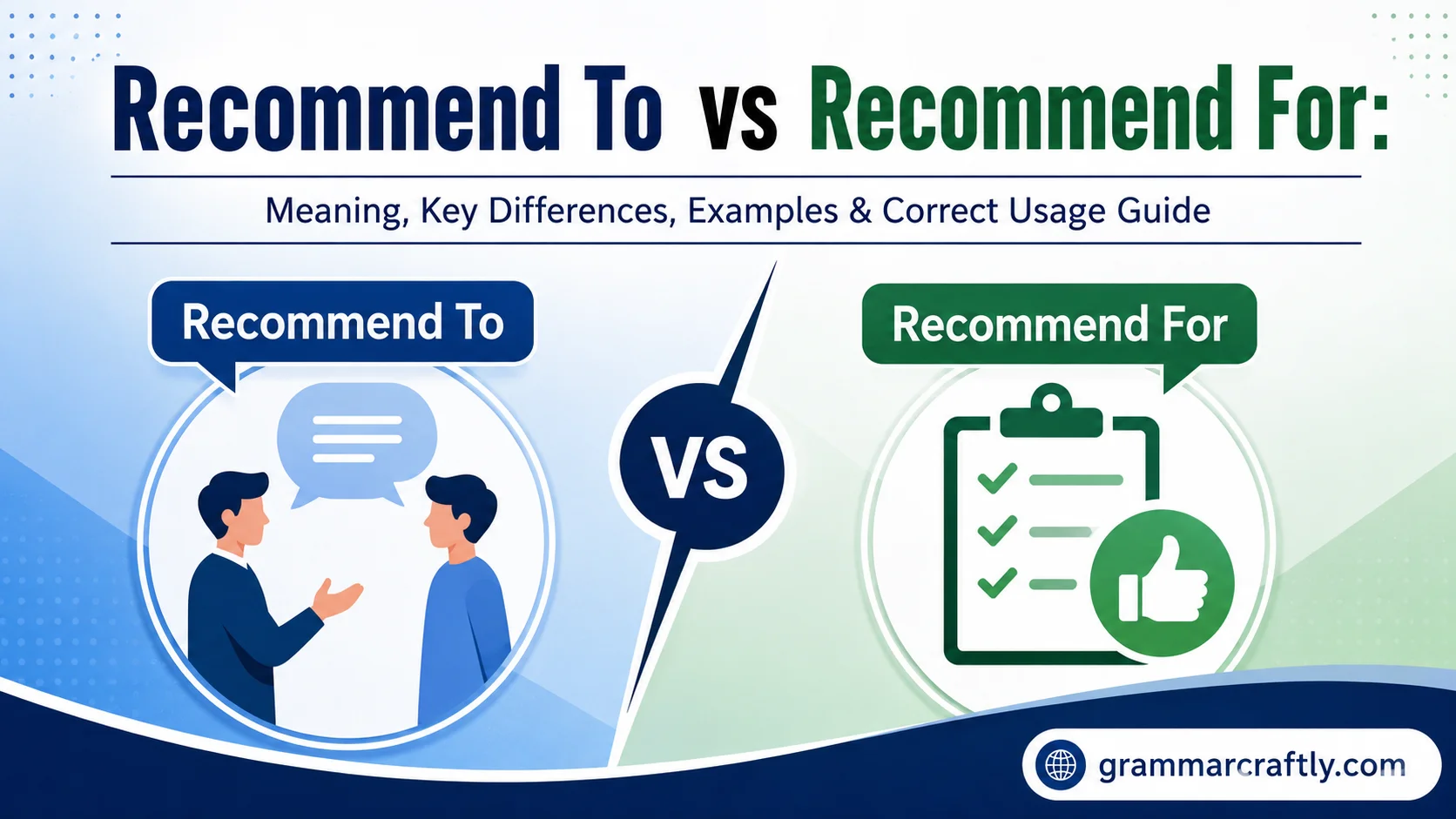
Recommend To vs Recommend For: explains how these similar phrases differ, helping English learners choose the right preposition in context clearly.
When learners, writers, and speakers see these phrases, they may feel confused because recommend to and recommend for can seem interchangeable. However, their meaning, usage, and context are different. Recommend to usually targets a person, such as when suggesting a book to a friend, while recommend for often identifies a suitable person, role, job, or specific purpose. Using real examples and practical examples makes this distinction easier to understand and apply.
When recommending someone for a job, the focus is on their suitability for a position or opportunity, while recommending something to someone focuses on the recipient. A wrong choice can change the message, make a sentence sound strange, or hurt your credibility with native speakers who expect precise language. These tiny words can create sneaky grammar traps, even for fluent speakers, so it helps to pause and consider the purpose of what you want to convey. From a Communications & Media Studies view, this small distinction may seem minor, but it remains essential in professional and everyday speech. For ESL learners mastering English, understanding this rule can become a game-changer through simple sentences, regular practice, and reliable language resources instead of guessing.
“Let’s dive in”
Recommend To vs Recommend For: Quick Difference Explained
Before exploring the rules in detail, let’s look at the basic difference between recommend to and recommend for.
| Phrase | Main Focus | Meaning | Example |
| Recommend to | A person or receiver | Giving a suggestion to someone | I recommend this movie to my brother. |
| Recommend for | A purpose, role, or situation | Saying something is suitable for something | This movie is recommended for teenagers. |
Think of it this way:
“To” points toward a person.
It answers the question: Who receives the recommendation?
“For” points toward a purpose.
It answers the question: Who or what is this suitable for?
Here’s another simple comparison:
“I recommend this laptop to Sarah.”
Sarah receives the suggestion.
“I recommend this laptop for graphic designers.”
Graphic designers are the intended users.
The difference may seem small, but it changes the meaning completely.
What Does “Recommend To” Mean?
The phrase recommend to means that you suggest something directly to a person, group, or audience.
You use it when you want someone else to know about something because you believe they will benefit from it.
The common structure is:
Recommend + something + to + someone
Examples:
- I recommend this book to all my students.
- She recommended a great doctor to her neighbor.
- They recommended a new restaurant to us.
- My friend recommended that website to me.
In each example, someone receives information about something valuable.
The recommendation travels from one person to another.
Recommend To Sentence Pattern
| Structure | Example |
| Recommend + noun + to + person | I recommend this app to beginners. |
| Recommend + person + to + person | I recommend John to the hiring manager. |
| Recommend + that + person + verb | I recommend that you try this method. |
When Should You Use Recommend To?
When Giving Advice Directly to Someone
If you are personally suggesting something to another person, recommend to is usually the right choice.
Examples:
- I recommend this podcast to you because it explains grammar clearly.
- She recommended a travel guide to her cousin.
- The teacher recommended extra practice exercises to the students.
The person receiving the suggestion matters most.
When Sharing Personal Suggestions
Many everyday recommendations follow this pattern.
Imagine your friend asks:
“What restaurant should I try?”
You might say:
- “I recommend this Italian restaurant to you.”
You are directing your recommendation toward your friend.
Other examples:
- I recommend this movie to anyone who enjoys mystery stories.
- I recommend this product to people who work from home.
- I recommend this course to new writers.
What Does “Recommend For” Mean?
The phrase recommend for describes something as suitable for a specific purpose, group, job, condition, or situation.
The focus is not the person receiving the message. Instead, the focus is the reason something fits.
The common structure is:
Recommend + something/someone + for + purpose
Examples:
- This laptop is recommended for students.
- This exercise program is recommended for beginners.
- She was recommended for the position.
- This book is recommended for advanced learners.
The phrase answers:
“What is this good for?”
When Should You Use Recommend For?
When Talking About Suitability
Use for when explaining who or what something works well for.
Examples:
- This camera is recommended for professional photographers.
- This software is recommended for small businesses.
- These shoes are recommended for long-distance runners.
You are describing the ideal user or purpose.
When Recommending Someone for a Position
One important use of recommend for involves jobs, awards, and opportunities.
Examples:
- She was recommended for the manager position.
- The employee was recommended for promotion.
- He was recommended for the scholarship.
Here, for introduces the opportunity or role.
Compare:
- I recommended Sarah to the company.
→ I introduced Sarah as a candidate. - I recommended Sarah for the position.
→ I suggested Sarah is suitable for that specific job.
Both can be correct, but they communicate different ideas.
Recommend To vs Recommend For: Side-by-Side Comparison
The easiest way to understand the difference is by comparing similar sentences.
| Sentence | Meaning |
| I recommend this book to my friend. | My friend should read this book. |
| I recommend this book for beginners. | Beginners will find this book suitable. |
| She recommended me to her manager. | She introduced me to her manager. |
| She recommended me for the manager role. | She said I was suitable for the role. |
| The doctor recommended this treatment to me. | The doctor suggested it personally to me. |
| This treatment is recommended for adults. | Adults are the intended group. |
A helpful memory trick:
Recommend to = direction
Recommend for = purpose
Imagine a package:
- To shows where the package goes.
- For shows who or what the package is meant for.
The Three Main Ways We Use “Recommend”
The verb recommend appears in three major sentence patterns.
Understanding all three will help you avoid common mistakes.
Recommend Something To Someone
This is the classic recommendation structure.
Formula:
Recommend + something + to + someone
Examples:
- I recommend this book to my classmates.
- She recommended a movie to her sister.
- The guide recommended a hotel to travelers.
This structure focuses on the receiver.
Recommend Something For Something
This structure explains suitability.
Formula:
Recommend + something + for + purpose
Examples:
- This keyboard is recommended for gaming.
- This course is recommended for beginners.
- This medicine is recommended for certain conditions.
The focus is the use or purpose.
Recommend That Someone Do Something
English also commonly uses recommend that.
Examples:
- I recommend that you practice every day.
- The doctor recommends that he get more rest.
- Experts recommend that people save money regularly.
This pattern is especially common in formal English.
A common mistake is saying:
❌ I recommend you to practice daily.
Although some speakers use this construction, many grammar experts consider it less natural.
Better options:
✅ I recommend that you practice daily.
✅ I recommend practicing daily.
Read More: Toxicated Meaning: Is It a Real Word?
Common Mistakes With Recommend To and Recommend For
Even advanced English learners sometimes confuse these expressions.
Let’s fix the most common problems.
| Incorrect | Correct | Explanation |
| I recommend this book for you. | I recommend this book to you. | You are receiving the suggestion. |
| This course is recommended to beginners. | This course is recommended for beginners. | Beginners are the target group. |
| She recommended me for her friend. | She recommended me to her friend. | Her friend receives the recommendation. |
| He recommended this job to me. | He recommended this job for me. | Depends on meaning: suggestion vs suitability. |
Why “Recommend You To” Confuses English Learners
One of the most common questions is:
Is “I recommend you to try this” correct?
The answer depends on the variety of English, but many native speakers find it unnatural.
Instead, use these forms:
✅ I recommend that you try this.
✅ I recommend trying this.
✅ I recommend this to you.
Examples:
Instead of:
❌ I recommend you to watch this movie.
Say:
✅ I recommend that you watch this movie.
✅ I recommend watching this movie.
These versions sound smoother and more natural.
Recommend To vs Recommend For vs Suggest vs Advise
Many learners confuse recommend with similar verbs like suggest and advise.
Here is the difference:
| Word | Meaning | Example |
| Recommend | Say something is good or suitable | I recommend this book. |
| Suggest | Offer an idea or possibility | I suggest trying another option. |
| Advise | Give guidance based on knowledge | I advise you to be careful. |
Examples:
Recommend:
I recommend this restaurant.
You believe it is a good choice.
Suggest:
I suggest this restaurant.
You are offering an option.
Advise:
I advise you to avoid that restaurant.
You are warning or guiding someone.
Real-Life Examples of Recommend To vs Recommend For
Movies and Books
Recommend to:
- I recommend this movie to my friends.
- She recommended this novel to her book club.
Recommend for:
- This movie is recommended for teenagers.
- This novel is recommended for advanced readers.
Jobs and Careers
Recommend to:
- The manager recommended Lisa to the company director.
Recommend for:
- The manager recommended Lisa for the leadership position.
Products
Recommend to:
- I recommend this phone to my coworkers.
Recommend for:
- This phone is recommended for photographers.
Education
Recommend to:
- The teacher recommended a dictionary to the student.
Recommend for:
- This dictionary is recommended for language learners.
How Native Speakers Choose Between Recommend To and Recommend For
Native speakers usually decide based on one simple question:
Are you focusing on the receiver?
Use to.
Example:
I recommend this restaurant to my sister.
Question:
Who gets the recommendation?
Answer:
My sister.
Are you focusing on suitability?
Use for.
Example:
This restaurant is recommended for families.
Question:
Who is it suitable for?
Answer:
Families
Practice Quiz: Recommend To or Recommend For?
Choose the correct word.
The teacher recommended this website ___ her students.
Answer:
✅ to
The students receive the recommendation.
This software is recommended ___ small businesses.
Answer:
✅ for
Small businesses are the intended users.
She was recommended ___ the award.
Answer:
✅ for
The award is the opportunity.
I recommend this podcast ___ anyone learning English.
Answer:
✅ to
Anyone learning English receives the suggestion.
FAQs:
Is “recommend to” grammatically correct?
Yes. Recommend to is correct when you are showing who receives the recommendation. For example, “I recommend this book to my friend.” Here, the book is being recommended, and the friend is the recipient.
When should I use “recommend for”?
Use recommend for when you are talking about suitability for a role, position, job, purpose, or opportunity. For example, “I recommend Sarah for the position” means you believe Sarah is suitable for that position.
Can “recommend to” and “recommend for” be used interchangeably?
No. They usually have different purposes. Recommend to focuses on the person receiving a suggestion, while recommend for focuses on suitability for a particular role or purpose.
Which is correct: “recommend this book to me” or “recommend this book for me”?
“Recommend this book to me” is normally correct when you mean that someone suggests the book to you. “Recommend this book for me” can have a different meaning, such as suggesting that the book is suitable for a particular purpose or situation.
What is an easy way to remember the difference?
Think of to as pointing toward the recipient of a recommendation and for as pointing toward a purpose, role, or position. This simple rule can help you choose the right phrase in everyday English.
Conclusion:
Understanding Recommend To vs Recommend For becomes much easier when you focus on the purpose of the preposition. Use recommend to when identifying the person who receives a suggestion, and use recommend for when describing suitability for a role, job, purpose, or opportunity. With regular practice and attention to context, you can avoid common mistakes and make your English sound more natural, precise, and confident.