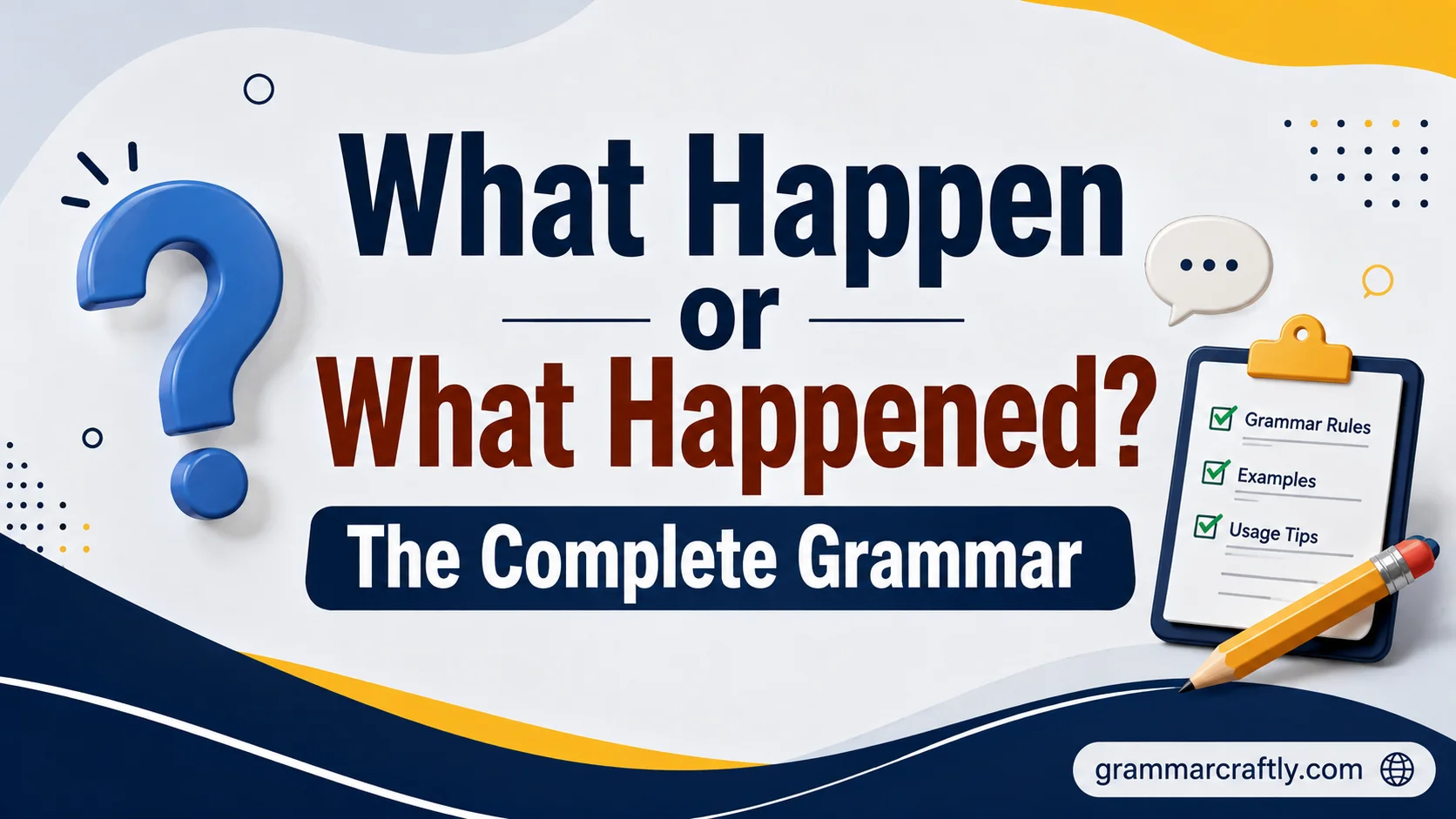
What Happen or What Happened? The Complete Grammar explains why What Happened is the proper form for a past event and how to avoid mistakes in everyday English.
When chatting with friends online or texting quickly, you may have typed What Happen and wondered if it seems natural. At first glance, both options may sound right, but standard English makes the difference clear. What Happened uses the correct past tense, while happen is the base form. This small verb tense choice affects clarity, meaning, and credibility, especially when people are typing quickly with their fingers flying over the keyboard. The common grammar mistake is understandable, but What Happen is incorrect for a completed past event.
The easiest way to avoid mistakes is to remember that what happened asks about something that has already taken place. Imagine a friend who comes around with a long, sad face; you would naturally ask, “What happened?” The phrase works when inquiring about a prior occurrence or circumstance that does not match present time. In everyday conversation, the right wording feels simple, and the answer is usually clear. Understanding how the question is formed also prevents mixing verb tenses, which can make a sentence sound incomplete or grammatically wrong. This guide can explain the rule in easy-to-understand language, provide useful examples, and help you clearly understand the correct usage.
“Let’s dive in”
What Is the Difference Between “What Happen” and “What Happened”?
The main difference between “what happen” and “what happened” is the verb tense.
Happen is the base form of the verb. It refers to something occurring in the present, future, or general situations when another verb supports it.
Happened is the simple past form of the verb. It describes something that already took place.
Here is a quick comparison:
| Phrase | Verb Form | Meaning | Example |
| Happen | Base form | Something occurring generally or with a helping verb | What will happen next? |
| Happened | Simple past | Something already occurred | What happened last night? |
Think of “happen” as a door that is still open to different times. The word itself does not tell you exactly when something occurred. However, “happened” closes the timeline because it clearly points to the past.
Simple Rule to Remember
If the event already occurred, use:
What happened?
If you are asking about something that may occur, use:
What will happen?
If you are talking about repeated or regular events, use:
What happens?
The surrounding words usually reveal which form you need.
What Does “What Happened” Mean?
“What happened?” is a question used to ask about an event, situation, problem, or change that occurred in the past.
The word happened tells the listener that the event has already taken place.
You might use it when:
- Something surprising occurs
- Someone looks upset
- A problem appears
- You missed an event
- You want an explanation
Examples of “What Happened?” in Daily Conversations
Situation 1: A friend looks worried
“You seem upset. What happened?”
Here, you are asking about something that caused the person’s current emotional state.
Situation 2: A machine suddenly stops working
“The computer was working a minute ago. What happened?”
The speaker wants to know what caused the problem.
Situation 3: You arrive late to a meeting
“Sorry I missed the beginning. What happened?”
You want information about an event that has already occurred.
Common Expressions With “What Happened?”
English speakers often combine “what happened” with other words:
| Expression | Meaning | Example |
| What happened? | Asking about an event | What happened at school today? |
| What happened to you? | Asking about someone’s situation | What happened to you yesterday? |
| What happened next? | Asking about the following event | What happened next in the story? |
| What happened here? | Asking about a situation or problem | What happened here? Everything looks different. |
Is “What Happen” Ever Correct?
Although “what happen” is usually incorrect by itself, the word happen is not wrong. The problem is that it often needs another verb or structure to make the sentence grammatically complete.
For example:
❌ What happen yesterday?
The sentence talks about yesterday, which means it refers to the past. Because of that, the verb needs past tense:
✅ What happened yesterday?
However:
✅ What will happen tomorrow?
This sentence is correct because the helping verb will already shows future time. The main verb stays in its base form: happen.
Correct Uses of “Happen”
Here are situations where “happen” works correctly:
With Modal Verbs
Modal verbs include:
- can
- could
- will
- would
- may
- might
- should
Examples:
- What can happen if we ignore the warning?
- What might happen after the decision?
- What will happen next?
The modal verb carries the tense, so “happen” stays unchanged.
In Present Tense Questions
When asking about regular events, use:
What happens…?
Examples:
- What happens when water freezes?
- What happens if you mix these chemicals?
- What happens during the final stage?
Notice that happen becomes happens because the sentence is in the present tense.
Why Is “What Happens” Usually Incorrect?
The phrase “What happen” creates a grammar problem because English questions need the correct verb form.
When asking about the past, the verb must show past tense.
Compare these examples:
| Incorrect | Correct | Reason |
| What happen last night? | What happened last night? | Past event needs past tense |
| What happen at the party? | What happened at the party? | The event already ended |
| What happen to your car? | What happened to your car? | Asking about a previous event |
English verbs often change depending on time.
For the verb happen:
| Time | Correct Form | Example |
| Present | happen/happens | Things happen every day. |
| Past | happened | Something happened yesterday. |
| Future | will happen | Something will happen tomorrow. |
A missing tense marker can make a sentence sound unnatural even if the listener understands your meaning.
Understanding the Verb “Happen”
The verb happen means to occur, take place, or come about.
It usually describes events that occur without someone directly controlling them.
Examples:
- Accidents happen.
- Mistakes happen.
- Strange things happen sometimes.
- Life happens.
The word often appears when discussing unexpected situations.
Examples:
“I didn’t plan to move here. It just happened.”
This means the move occurred naturally without a specific plan.
“How did that happen?”
This asks about the reason or cause behind an event.
Read More: Compare To vs Compare With:
The Three Main Forms of “Happen”
Understanding the different forms of this verb makes choosing the correct phrase much easier.
| Verb Form | Usage | Example |
| Happen | Base form | Things can happen quickly. |
| Happens | Present tense | What happens next? |
| Happened | Past tense | What happened yesterday? |
Present Form: Happen
Used with:
- Modal verbs
- Infinitives
- Certain grammatical structures
Examples:
- Anything can happen.
- What will happen after the announcement?
- It is likely to happen soon.
Present Form: Happens
Used for:
- Regular events
- Scientific facts
- Repeated situations
Examples:
- What happens when ice melts?
- Bad things happen when people ignore warnings.
- This happens every year.
Past Form: Happened
Used for:
- Finished events
- Previous experiences
- Historical moments
Examples:
- What happened during the meeting?
- Something strange happened last night.
- The accident happened near the highway.
“What Happened” vs. “What Happens” vs. “What Will Happen”
Many learners confuse these phrases because they look similar. The key difference is the time being discussed.
| Phrase | Time | Example |
| What happened? | Past | What happened after you left? |
| What happens? | Present/general | What happens when you click this button? |
| What will happen? | Future | What will happen next year? |
Think of It Like a Timeline
PAST PRESENT FUTURE
What happened? What happens? What will happen?
↓ ↓ ↓
Finished event Regular event Possible event
This simple timeline helps you choose the correct phrase quickly.
“What Happened” vs. “What Has Happened”
Another common confusion is the difference between:
- What happened?
- What has happened?
Both are grammatically correct, but they have different meanings.
What Happened?
Use this when talking about a completed event in the past.
Example:
“What happened at the concert last night?”
The concert is finished.
What Has Happened?
Use this when a past event connects to the present moment.
Example:
“What has happened to the company?”
The speaker is interested in the current result.
More examples:
| Sentence | Meaning |
| What happened yesterday? | Asking about a completed past event |
| What has happened recently? | Asking about recent changes |
| What happened to your phone? | Asking about a past problem |
| What has happened here? | Asking about a current situation caused by something earlier |
Common Mistakes With “What Happen” and “What Happened”
Even fluent speakers sometimes make mistakes when speaking quickly. Here are common errors and how to fix them.
Mistake: Using “What Happen” for Past Events
Incorrect:
What happen after the game?
Correct:
What happened after the game?
The word “after” often refers to a completed event, so the past form fits.
Mistake: Forgetting Helping Verbs
Incorrect:
What happen tomorrow?
Correct:
What will happen tomorrow?
The future needs a helper word like will.
Mistake: Confusing “Happen” and “Happened” With “Did”
A common grammar rule:
After did, use the base form of the verb.
Incorrect:
What did happened?
Correct:
What did happen?
However, in normal conversation, people usually say:
What happened?
Both are grammatically possible, but they have slightly different structures.
Compare:
What happened?
A simple question asking about an event.
What did happen?
Used for emphasis.
Example:
“Everyone blamed John, but what did happen was completely different.”
Real-Life Examples of “What Happen” and “What Happened”
Grammar becomes easier when you see how people actually use these phrases.
At Work
Manager:
“The report was supposed to be finished yesterday. What happened?”
Employee:
“I had a problem with the data, but I fixed it.”
With Friends
Friend:
“You disappeared suddenly. What happened?”
Response:
“My phone died, so I couldn’t call.”
During Learning
Teacher:
“What happens when plants don’t receive sunlight?”
Student:
“They become weak and stop growing.”
Talking About the Future
Parent:
“What will happen if you don’t study?”
Child:
“I might fail the exam.”
How to Remember the Difference Easily
Use this simple trick:
Happened = Has already happened
The extra “-ed” reminds you that the event is finished.
Examples:
- Yesterday → happened
- Last week → happened
- Before → happened
- A long time ago → happened
Future words usually need:
- will happen
- might happen
- could happen
Present habits usually need:
- happens
FAQs:
Is “What Happen?” grammatically correct?
No. “What Happen?” is generally incorrect when you’re asking about a completed past event. The correct question is “What Happened?” because happened is the past-tense form of happen.
Why do we say “What Happened?”
We use “What Happened?” to ask about something that already occurred. For example, if your friend looks upset, you can ask, “What happened?” The question refers to a past event or situation.
Can “Happen” ever be used after “What”?
Yes. “Happen” can be correct when the sentence refers to the present, future, or follows an auxiliary verb. For example, “What will happen next?” and “What does happen here?” are grammatically different from “What happened?”
What is the difference between “What Happen” and “What Happened”?
The main difference is verb tense. Happen is the base form, while happened is the past form. Therefore, when asking about something that occurred in the past, use “What happened?”
How can I remember the correct form?
Use a simple rule: if you’re asking about something that already took place, choose “happened.” In everyday conversation, professional communication, and formal writing, “What happened?” is the standard choice.
Conclusion:
“What Happened?” is the correct phrase when you’re asking about a past event or situation. “What Happen?” is not correct for this purpose because happen is the base form, while happened expresses the past. Once you connect happened with completed events, the difference becomes easy to remember. Whether you’re texting, writing an email, speaking with friends, or preparing for an English exam, choosing the correct form will make your communication clearer and more natural.