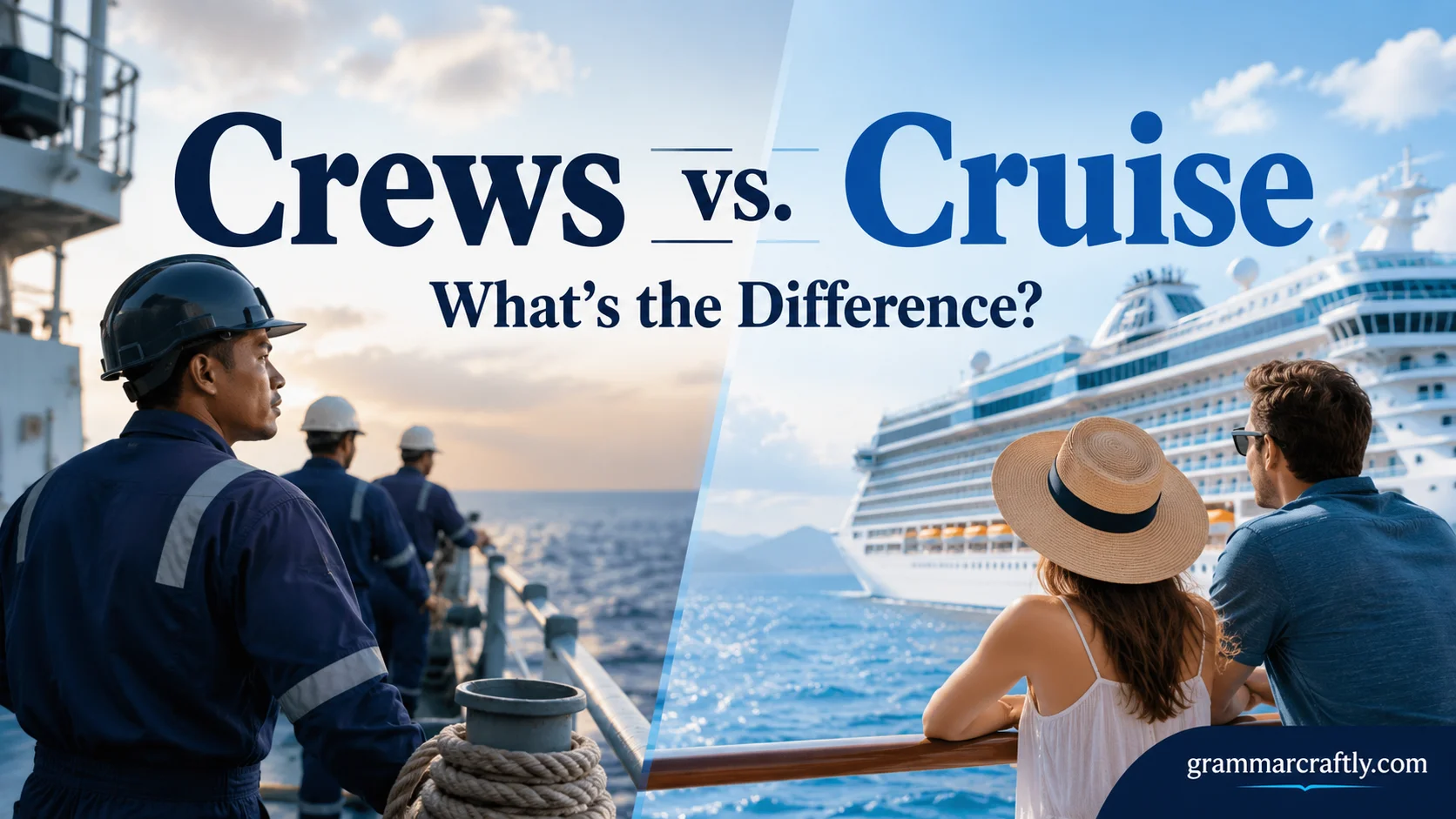
Guide “Crews vs. Cruise: What’s the Difference?” helps English learners understand confusing homophones with different meanings, uses, and contexts.
These words may have the same sound and pronunciation when spoken, but their spellings, meanings, and uses are not the same. A crew refers to a group of people or individuals who work together as a team with shared responsibilities. In maritime situations, a ship’s crew works on a ship, boat, or vessel, while an airplane crew handles tasks related to aircraft and aviation. A film crew works on a film project and creates movies in creative contexts, where different roles, teamwork, and coordination are important. The plural form is crews, which describes more than one team.
The word cruise has a different meaning and usage because it focuses on movement, travel, and a relaxing journey. It can work as a verb or noun. A cruise as a noun describes a trip for pleasure, vacation, or relaxation, such as a family cruise, luxury cruise, or cruise vacation near the coast or through an area. As a verb, it means to move smoothly or travel easily at a steady speed, like driving a car with cruise control or sailing a vessel. This contrast between crews as people and cruise as travel makes the concept easier to understand.
Crews vs. Cruise at a Glance
Before diving deeper, here’s a quick comparison.
FeatureCrewsCruiseMeaningGroups of workers or team membersA journey for pleasure, usually by shipPart of SpeechNoun (plural)Noun or VerbPronunciationKroozKroozContextWork, transportation, film, emergency servicesTravel, vacations, driving, sailingExampleThe rescue crews arrived quickly.We plan to cruise through Alaska next summer.
Quick Answer
- Crews refers to groups of people working together.
- Cruise refers to traveling smoothly or taking a pleasure trip, especially by ship.
Although they sound exactly alike, their meanings are completely different.
What Does “Crews” Mean?
The word crews is the plural form of crew.
A crew is a group of people who work together to perform a specific task. Depending on the situation, crews can be found in transportation, construction, filmmaking, emergency response, and many other industries.
Definition of Crews
Crews means multiple teams or groups of workers assigned to a common task.
Examples of Crews
- Construction crews repaired the highway.
- Flight crews prepared passengers for takeoff.
- Film crews spent weeks shooting the movie.
- Emergency crews responded to the storm damage.
In each example, the word refers to people working together toward a shared goal.
Industries That Commonly Use the Word Crews
IndustryExampleAviationFlight crewsConstructionRoad crewsFilm ProductionCamera crewsEmergency ServicesRescue crewsMaritimeShip crewsRail TransportationTrain crews
Interesting Fact
A large commercial airline may employ thousands of crew members. For example, major airlines often operate hundreds of flights daily, requiring pilots, flight attendants, maintenance teams, and ground crews to keep operations running smoothly.
What Does “Cruise” Mean?
The word cruise has multiple meanings.
Most people associate it with vacation travel on a ship. However, it can also function as a verb meaning to move smoothly or travel at a steady speed.
Definition of Cruise
Cruise can mean:
- A pleasure voyage
- Traveling smoothly
- Moving at a constant speed
- Sailing for recreation
Examples of Cruise
- We booked a Caribbean cruise.
- The family plans to cruise through Europe.
- The car can cruise comfortably at highway speeds.
- The yacht cruised along the coastline.
In every case, the focus is on movement, travel, or leisure.
Types of Cruises
TypeDescriptionOcean CruiseLarge ship traveling across oceansRiver CruiseSmaller vessel traveling riversLuxury CruisePremium travel experienceExpedition CruiseAdventure-focused journeysFamily CruiseDesigned for all agesWorld CruiseExtended global voyage
Interesting Fact
Some world cruises last more than 100 days and visit dozens of countries across multiple continents.
Are Crews and Cruise Homophones?
Yes.
Crews and Cruise are homophones because they are pronounced exactly the same.
Pronunciation
WordPronunciationCrewsKroozCruiseKrooz
This identical pronunciation explains why many people accidentally swap the words when writing.
Why Homophones Cause Problems
When speaking, listeners rely on context.
For example:
“The crews arrived early.”
and
“The cruise arrived early.”
Although they sound identical when spoken, the meaning changes completely when written.
That’s why spelling matters.
Crews vs. Cruise: Key Differences Explained
Understanding the distinctions becomes much easier when comparing them directly.
Meaning
Crews
- Teams of workers
- Groups performing tasks
- Human resources
Cruise
- Travel experience
- Leisure journey
- Movement or transportation
Usage
Crews
- Construction crews
- Flight crews
- Rescue crews
Cruise
- Cruise ship
- Cruise vacation
- Cruise control
Function
WordFunctionCrewsPlural nounCruiseNoun and verb
Example Comparison
Correct:
- The rescue crews reached the area quickly.
- The tourists enjoyed a luxury cruise.
Incorrect:
- The rescue cruise reached the area quickly.
- The tourists enjoyed a luxury crews.
The mistakes instantly sound unnatural because the meanings don’t match the context.
Real-Life Examples of Crews
Seeing the word in context helps reinforce its meaning.
Aviation
Modern airlines rely on highly trained flight crews.
A typical flight crew includes:
- Captain
- First Officer
- Flight Attendants
Together they ensure passenger safety and operational efficiency.
Construction
Construction crews build:
- Bridges
- Roads
- Homes
- Skyscrapers
Large projects often involve multiple crews working simultaneously.
Film Industry
Movie productions depend on specialized crews.
Examples include:
- Camera crews
- Lighting crews
- Sound crews
- Makeup crews
A major Hollywood film can involve hundreds of crew members.
Emergency Response
Emergency crews play a vital role during:
- Hurricanes
- Floods
- Earthquakes
- Wildfires
Their quick response helps save lives and protect communities.
Real-Life Examples of Cruise
The word cruise appears in many everyday situations.
Vacation Travel
Most people first think of cruise vacations.
Popular cruise destinations include:
- Caribbean Islands
- Alaska
- Mediterranean Sea
- Norwegian Fjords
- South Pacific
Millions of travelers choose cruises each year because they combine transportation, lodging, dining, and entertainment.
Driving
The word cruise also appears in driving.
Example:
The vehicle cruised smoothly down the highway.
This usage describes relaxed, steady movement.
Cruise Control
Many vehicles feature cruise control systems.
Benefits include:
- Reduced driver fatigue
- Improved fuel efficiency
- Consistent speed maintenance
Boating
People often cruise recreationally on:
- Sailboats
- Yachts
- Motorboats
This meaning emphasizes enjoyable travel rather than transportation alone.
Common Mistakes People Make
Many writing mistakes occur because people focus on pronunciation rather than spelling.
Mistake #1: Using Cruise Instead of Crews
Incorrect:
The maintenance cruise repaired the runway.
Correct:
The maintenance crews repaired the runway.
Mistake #2: Using Crews Instead of Cruise
Incorrect:
We booked a seven-day crews to Alaska.
Correct:
We booked a seven-day cruise to Alaska.
Mistake #3: Spellcheck Dependence
Spellcheck may not catch homophone errors because both words are spelled correctly.
Example:
The cruise completed the bridge repairs.
A spellchecker sees nothing wrong because “cruise” is a valid word.
Only careful proofreading catches the mistake.
Read More: Work Alongside You vs. Work Alongside With You:
Crews vs. Cruise in Professional Writing
Professional communication demands precision.
Using the wrong homophone can affect credibility.
Business Communication
Correct:
- Construction crews completed the project ahead of schedule.
Incorrect:
- Construction cruise completed the project ahead of schedule.
Journalism
News reports frequently mention:
- Rescue crews
- Ground crews
- Medical crews
Using “cruise” in these situations creates confusion.
Academic Writing
Students often lose points for homophone errors because instructors expect precise language.
Learning these distinctions improves writing quality across every subject.
Popular Phrases Using Crews
Many common expressions contain the word crews.
Flight Crews
Teams responsible for operating aircraft.
Ground Crews
Personnel who support aircraft on the ground.
Rescue Crews
Emergency teams responding to disasters.
Film Crews
Groups involved in movie production.
Road Crews
Workers responsible for highway maintenance.
Construction Crews
Teams that build and repair structures.
Popular Phrases Using Cruise
The word cruise appears in many familiar expressions.
Cruise Ship
A passenger vessel designed for leisure travel.
Cruise Vacation
A holiday taken aboard a cruise ship.
Cruise Control
A vehicle system maintaining a set speed.
River Cruise
A journey along inland waterways.
Luxury Cruise
An upscale travel experience with premium amenities.
World Cruise
A long voyage visiting multiple countries and continents.
Case Study: How One Letter Changes Meaning
Consider these two sentences.
Sentence A
Several rescue crews arrived after the storm.
Readers immediately understand that teams of emergency workers responded.
Sentence B
Several rescue cruise arrived after the storm.
The sentence suddenly becomes confusing.
The word “cruise” suggests a vacation voyage rather than emergency workers.
A single letter completely changes the meaning.
This demonstrates why choosing the correct spelling matters.
Easy Memory Tricks to Remember the Difference
Memory aids can make these words impossible to confuse.
Think Team for Crews
The word crews contains the letter sequence found in many team-related contexts.
Associate it with:
- Workers
- Teams
- Groups
Whenever people are involved, crews is likely correct.
Think Vacation for Cruise
A cruise is something people take for fun.
Imagine:
- Cruise ships
- Ocean travel
- Vacations
If travel is involved, choose cruise.
Team vs. Trip Rule
A simple shortcut:
ContextWordTeamCrewsTripCruise
This rule works surprisingly well.
Quick Quiz: Test Yourself
Choose the correct word.
Question 1
The construction _____ completed the bridge.
A. Cruise
B. Crews
Answer: B. Crews
Question 2
We booked a seven-day _____ through the Caribbean.
A. Cruise
B. Crews
Answer: A. Cruise
Question 3
Ground _____ prepared the aircraft for departure.
A. Crews
B. Cruise
Answer: A. Crews
Question 4
The yacht will _____ along the coast tomorrow.
A. Crews
B. Cruise
Answer: B. Cruise
Question 5
Emergency _____ arrived within minutes.
A. Cruise
B. Crews
Answer: A. Crews
Related Homophones You Might Also Confuse
If Crews vs. Cruise causes trouble, these pairs might too.
Word 1Word 2TheirTherePrincipalPrincipleStationaryStationeryWeatherWhetherBrakeBreakPeacePieceAllowedAloud
Studying homophones strengthens both writing accuracy and reading comprehension.
Why Understanding Homophones Improves Writing
Homophones may seem like small details, but they influence how readers perceive your work.
Benefits of mastering homophones include:
- Better clarity
- Greater professionalism
- Stronger communication
- Improved academic performance
- Fewer embarrassing mistakes
Writers who understand subtle word differences produce cleaner and more trustworthy content.
As author Mark Twain famously noted:
“The difference between the almost right word and the right word is really a large matter.”
That observation perfectly applies to Crews vs. Cruise.
FAQs:
What is the main difference between crews and cruise?
Crews refers to groups of people who work together, such as a ship’s crew, film crew, or airplane crew. On the other hand, cruise refers to a journey, trip, or movement, usually related to travel by ship or smooth movement.
Are crews and cruise homophones?
Yes, crews and cruise are homophones because they have the same pronunciation but different spellings and meanings. Understanding their context helps you choose the correct word in English sentences.
When should I use the word crews?
Use crews when you are talking about teams or groups of workers. For example, a film crew creates movies, and a ship’s crew manages operations on a vessel.
When should I use the word cruise?
Use cruise when describing a journey, vacation, or smooth movement. For example, you can take a luxury cruise for relaxation or cruise along the coast at a steady speed.
How can I remember the difference between crews and cruise?
A simple way to remember is that crews are people who work together, while cruise is about movement, travel, or a trip. Think of “crew” as a team and “cruise” as a journey.
Conclusion:
Understanding Crews vs. Cruise: What’s the Difference? helps you avoid common English mistakes and communicate more clearly. Although these words sound similar, their meanings are completely different. Crews describes groups of people working together with shared responsibilities, while cruise describes travel, movement, or a relaxing journey. By learning their uses, examples, and contexts, you can confidently choose the right word in everyday conversations, writing, and professional situations. Practice using these words regularly, and the difference between them will become easy to remember.