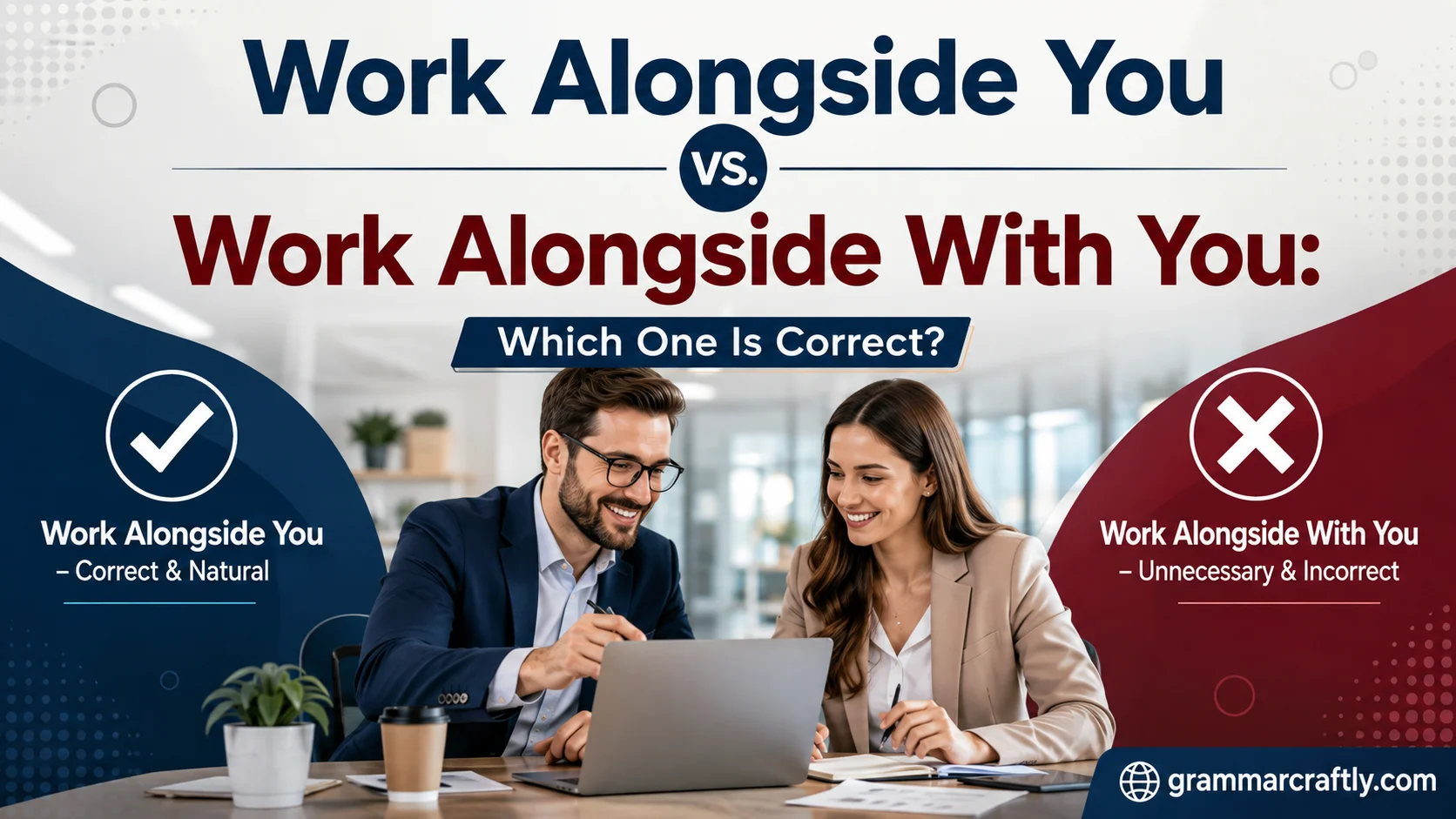
Work Alongside You vs. Work Alongside With You: helps learners understand the correct usage of this grammar and avoid common mistakes today. Many English learners and native speakers feel unsure when choosing these phrases because both express the same idea of working together. This important grammar comparison explains the meaning, examples, and why work alongside you is the more natural expression. The word alongside works as a preposition that shows being next to someone or cooperating with them, while along can describe movement in a line, by the side of something, or following the length of something else.
The phrase work alongside you is the more correct and commonly used expression because it already shows connection with another person. Adding “with” creates unnecessary words and can make the sentence sound less natural. This common mistake often appears in professional emails, cover letters, LinkedIn profiles, resumes, business proposals, and workplace conversations. Although work alongside with you may seem acceptable, modern English generally considers work alongside you the grammatically correct choice for professional English communication.
Understanding this difference improves your English accuracy and helps your writing become more polished and effective. The phrase can describe collaborating with someone in a professional setting or personal setting, while showing support, companionship, and alignment in a working relationship or connection. If you have written “I look forward to working alongside with you” and wondered whether it sounded right, you are not alone. This guide helps you learn the grammar rule, explore real-world examples, and find professional alternatives for better business communication.
Understanding the Meaning of “Work Alongside”
Before comparing the two phrases, it’s important to understand what alongside actually means.
The word alongside means:
- Next to
- Beside
- Together with
- In cooperation with
- Side by side
When used in professional communication, it typically refers to collaborating or performing tasks together with another person or group.
Examples
- I worked alongside experienced engineers.
- She works alongside her colleagues every day.
- We will work alongside industry experts on this project.
In each sentence, alongside already communicates the idea of working together.
That detail becomes important when deciding whether the extra word with is necessary.
Is “Work Alongside You” Grammatically Correct?
Yes.
Work alongside you is the grammatically correct and widely accepted phrase.
In this construction, alongside functions as a preposition that already connects the action of working with the person involved.
Correct Examples
- I would love to work alongside you.
- Our team looks forward to working alongside your organization.
- She has worked alongside industry leaders for years.
- We are excited to work alongside talented professionals.
These sentences sound natural, concise, and professional.
Why It Works
The phrase already contains everything needed to express partnership:
ComponentFunctionWorkActionAlongsideIndicates partnership or proximityYouPerson involved
The sentence is complete without adding another preposition.
Is “Work Alongside With You” Correct?
In most situations, no.
The phrase work alongside with you is generally considered redundant because alongside already expresses the meaning that with adds.
Think of it this way:
When you say:
Work alongside you
you are already saying:
Work together with you
Adding with repeats the same idea.
Example
❌ Work alongside with you
✅ Work alongside you
The second version is cleaner and more natural.
Why It Sounds Wrong
English generally prefers concise expressions.
When unnecessary words appear, the sentence may feel awkward or overly complicated.
Professional writers, editors, and business communicators usually remove redundant words whenever possible.
Why “Alongside With” Sounds Natural to Some Speakers
If work alongside with you is usually incorrect, why do so many people say it?
The answer lies in language patterns.
People often combine familiar phrases without realizing it.
Consider these common expressions:
- Work with you
- Collaborate with you
- Partner with you
- Coordinate with you
Because the word with frequently follows these verbs, many speakers instinctively add it after alongside as well.
Language Habit Example
Someone might think:
Work with you
and
Work alongside
Then accidentally blend them into:
Work alongside with you
This type of language mixing happens frequently in English.
The Hidden Grammar Rule Behind the Phrase
To understand why the phrase matters, let’s examine the grammar.
What Is a Preposition?
A preposition shows a relationship between words.
Examples include:
- With
- On
- In
- At
- Beside
- Alongside
These words help explain location, direction, time, or relationships.
How “Alongside” Functions
In the phrase:
Work alongside you
the word alongside acts as a preposition.
It already introduces the object you.
Because the preposition is already doing its job, another preposition is unnecessary.
Grammar Breakdown
Correct:
Work → Alongside → You
Incorrect:
Work → Alongside → With → You
The second structure adds an extra layer that contributes no additional meaning.
Work Alongside You vs. Work Alongside With You: Side-by-Side Comparison
The easiest way to understand the difference is through direct comparison.
FeatureWork Alongside YouWork Alongside With YouGrammatically correctYesUsually NoProfessional writingPreferredAvoidBusiness emailsRecommendedNot RecommendedNatural soundingYesLess NaturalResume usageExcellentPoor ChoiceLinkedIn profilesCommonRare
Quick Verdict
If you’re writing professionally, choose:
✅ Work alongside you
Avoid:
❌ Work alongside with you
Examples in Business Emails
Business communication requires clarity and professionalism.
Using the correct phrase helps your writing sound more polished.
Example 1: Job Offer
Correct
I am excited to work alongside you and contribute to the success of the company.
Incorrect
I am excited to work alongside with you and contribute to the success of the company.
Example 2: Team Collaboration
Correct
Our department will work alongside your team during the implementation phase.
Example 3: Client Communication
Correct
We look forward to working alongside your organization on this project.
Example 4: Project Management
Correct
Our specialists will work alongside your internal staff throughout the process.
Read More: Switch vs. Swap: What’s the Difference
Examples in Resumes and Cover Letters
Job seekers often use this phrase when describing teamwork experience.
Resume Example
Strong Version
Worked alongside senior engineers to improve production efficiency by 25%.
Weak Version
Worked alongside with senior engineers to improve production efficiency.
The first version sounds more professional and grammatically accurate.
Cover Letter Example
I am eager to work alongside experienced professionals while expanding my expertise in digital marketing.
This sentence is concise, confident, and natural.
Examples in Everyday Conversation
The phrase isn’t limited to business writing.
People use it in daily conversations too.
School Projects
- I worked alongside my classmates on the science fair project.
Sports Teams
- She trained alongside Olympic athletes.
Volunteer Work
- We worked alongside community leaders to organize the event.
Family Activities
- He worked alongside his father in the family business.
In each case, adding with would make the sentence sound less natural.
Work Alongside vs. Work With
Many people wonder whether work alongside and work with mean the same thing.
Not exactly.
Although they’re similar, there is a subtle difference.
PhraseMeaningWork withGeneral cooperationWork alongsideSide-by-side collaboration
Example
Work With
I work with the marketing department.
This may simply mean interaction.
Work Alongside
I work alongside the marketing department.
This suggests closer cooperation and active collaboration.
Professional Tone
Many professionals prefer work alongside because it creates a stronger sense of partnership.
Work Alongside vs. Collaborate With
Another common comparison involves collaborate with.
Work Alongside
Focuses on working together physically or operationally.
Collaborate With
Focuses on sharing ideas and achieving a common goal.
Example
The designers collaborated with developers to create the product.
The designers worked alongside developers during the entire project.
Both are correct, but they emphasize different aspects of teamwork.
Why Professional Writers Prefer Concise Language
Strong writing removes unnecessary words.
This principle applies far beyond this single phrase.
Professional editors constantly look for redundancies such as:
- Advance planning
- End result
- Future plans
- Repeat again
- Collaborate together
- Return back
These expressions repeat information unnecessarily.
Similarly:
Work alongside with you
contains extra wording.
The cleaner version is:
Work alongside you
Common Grammar Mistakes Similar to “Work Alongside With You”
Many English learners make similar errors.
Here are some examples.
IncorrectCorrectDiscuss about the issueDiscuss the issueReturn back tomorrowReturn tomorrowCollaborate togetherCollaborateRepeat againRepeatEnter into the roomEnter the roomWork alongside with youWork alongside you
Notice the pattern.
The incorrect versions contain unnecessary words.
Real-World Usage in Professional Communication
To see how professionals actually write, consider these examples.
Technology Industry
Our engineers work alongside cybersecurity experts to strengthen data protection.
Healthcare
Nurses work alongside physicians to deliver patient care.
Construction
Architects work alongside contractors throughout the building process.
Education
Teachers work alongside parents to support student success.
Finance
Financial advisors work alongside legal professionals when managing complex estates.
In every industry, work alongside appears naturally without with.
Case Study: A Cover Letter Improvement
Let’s examine a real-world example.
Original Version
I would welcome the opportunity to work alongside with your talented team and contribute my skills.
Revised Version
I would welcome the opportunity to work alongside your talented team and contribute my skills.
Why the Revision Works
The revised version:
- Removes redundancy
- Reads more smoothly
- Sounds more professional
- Matches standard English usage
A hiring manager reading dozens of applications will appreciate concise writing.
Professional Alternatives to “Work Alongside You”
Sometimes variety improves your writing.
Here are excellent alternatives.
Formal Alternatives
- Collaborate with you
- Partner with you
- Coordinate with you
- Cooperate with you
Example
I look forward to collaborating with you.
Business Alternatives
- Work closely with you
- Join forces with you
- Support your team
- Contribute alongside your staff
Example
Our company looks forward to working closely with your organization.
Leadership Alternatives
- Guide your team
- Partner strategically with you
- Align with your objectives
Example
We intend to partner strategically with your organization.
Customer-Facing Alternatives
- Assist you
- Support you
- Help you achieve your goals
Example
We are excited to support you throughout the process.
What Dictionaries and Style Guides Suggest
Major English dictionaries define alongside as:
- Next to
- Side by side with
- Together with
These definitions already include the concept of partnership.
Because the meaning is built into the word itself, adding with usually becomes unnecessary.
Many professional style guides encourage concise writing and recommend removing redundant prepositions.
Why This Small Grammar Choice Matters
Some people may think this distinction is trivial.
However, language shapes perception.
Clear writing communicates confidence.
Professional communication often depends on tiny details.
Consider these situations:
- Job applications
- Cover letters
- LinkedIn profiles
- Business proposals
- Client emails
- Academic writing
In each case, strong grammar strengthens credibility.
While one small phrase won’t determine success alone, consistently polished writing creates a better impression.
Quick Practice Quiz
Choose the correct option.
Question 1
I look forward to ______ on the project.
- Work alongside with you
- Working alongside you
✅ Correct Answer: Working alongside you
Question 2
Our department will ______ your team.
- Work alongside
- Work alongside with
✅ Correct Answer: Work alongside
Question 3
She worked ______ industry experts.
- Alongside
- Alongside with
✅ Correct Answer: Alongside
Question 4
Which sounds more professional?
- We hope to work alongside you.
- We hope to work alongside with you.
✅ Correct Answer: We hope to work alongside you.
Common Questions English Learners Ask
Can “alongside with” ever be correct?
In rare regional or nonstandard usage, you may encounter it. However, standard English generally prefers alongside without with.
Is “work alongside you” formal?
Yes. It is widely accepted in professional and academic writing.
Can I use it in a resume?
Absolutely. It works very well in resumes and cover letters.
Is it better than “work with you”?
Not always. It simply emphasizes closer collaboration.
Do native speakers use “work alongside you”?
Yes. It appears frequently in business, education, healthcare, technology, and many other professional settings.
Final Verdict: Which Phrase Should You Use?
When comparing work alongside you vs. work alongside with you, the winner is clear.
✅ Work alongside you is the standard, grammatically correct, and professional choice.
❌ Work alongside with you is usually considered redundant because alongside already expresses the idea of working together.
Whether you’re writing a business email, updating your LinkedIn profile, crafting a resume, or preparing a cover letter, choosing the concise version will make your communication stronger and more natural.
English often rewards simplicity. In this case, fewer words create better writing.
Use work alongside you, keep your message clear, and let your professionalism shine.
FAQs:
Is “work alongside you” grammatically correct?
Yes, work alongside you is grammatically correct and is the more commonly used phrase in modern English. It means to work together with someone, cooperate with them, or share responsibilities in a professional or personal setting.
Is “work alongside with you” wrong?
Work alongside with you is not usually considered the best choice because the word alongside already includes the idea of being together with someone. Adding “with” makes the phrase sound unnecessary and less natural.
What is the difference between “along” and “alongside”?
Along usually describes movement or position in a line, such as walking along a road. Alongside means being next to someone or something, often with a sense of cooperation, support, or partnership.
Can I use “work alongside you” in professional emails?
Yes, work alongside you works well in professional emails, cover letters, business proposals, and workplace communication. It sounds natural, respectful, and professional when describing teamwork or collaboration.
What are some alternatives to “work alongside you”?
Some professional alternatives include work with you, collaborate with you, partner with you, team up with you, and support you. The best choice depends on the level of teamwork or partnership you want to express.
Conclusion:
Understanding the difference between work alongside you vs. work alongside with you helps you communicate more clearly and professionally. While both phrases may appear similar, work alongside you is the preferred expression because it is grammatically correct, natural, and widely accepted. Using the right phrase improves your English accuracy and makes your professional communication sound more polished. Whether you are writing an email, preparing a resume, or speaking in the workplace, choosing the correct wording helps create a stronger impression.