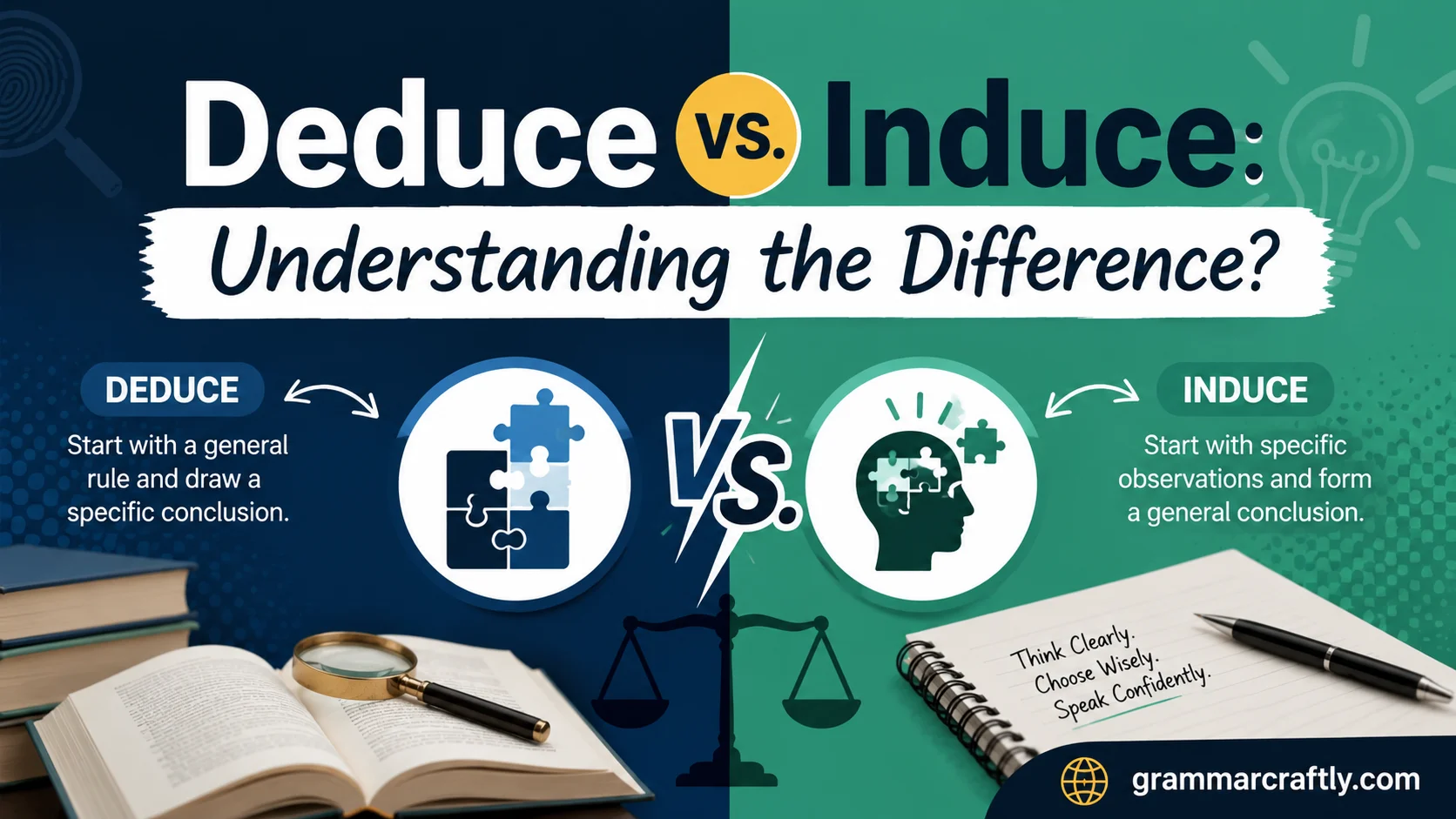
Deduce vs. Induce: Understanding the Difference Between Two Powerful Ways of Thinking builds clear, logical thinking skills for everyday use and better understanding.
From studying Sherlock Holmes, the fictional sleuth of Baker Street, I’ve found that logical reasoning, deductive reasoning, and inductive reasoning become easier when you connect them to real situations. A skilled detective or fictional detective studies a crime scene, makes a visual sweep, gathers observations, follows clues, and uses evidence to deduce facts or induce broader meanings. Through deduction, induction, logical inference, and critical thinking, we develop stronger logical conclusions, reasoning skills, and analytical thinking.
The study of Deduce vs Induce helps students, writers, researchers, and professionals improve problem solving, decision-making, and communication. It teaches us to think logically, understand the difference between deduce and induce, and apply these methods in daily life, research, academic reasoning, and everyday language. These forms of reasoning support clear thinking, structured thinking, analytical reasoning, and meaningful interpretation while helping us form specific conclusions from specific observations, build broader generalizations from information and experience, and strengthen knowledge and practical thinking.
My experience with grammar and logic topics has shown that learning these methods improves understanding, language learning, and effective communication. Whether you’re working on academic writing, professional communication, or language usage, these powerful ways of thinking make it easier to interpret ideas, compare meanings, and communicate with greater confidence.
Deduce vs. Induce: The Quick Answer
If you’re looking for the fastest explanation, here it is:
WordMeaningReasoning DirectionDeduceReach a conclusion based on facts, evidence, or rulesGeneral → SpecificInduceForm a general conclusion from specific observationsSpecific → General
Simple Example
Deduce
- All birds have feathers.
- A sparrow is a bird.
- Therefore, a sparrow has feathers.
You deduced the conclusion from a known rule.
Induce
- Sparrow A has feathers.
- Sparrow B has feathers.
- Sparrow C has feathers.
- Therefore, birds probably have feathers.
You induced a general rule from observations.
The difference seems small. In reality, it shapes how humans learn, reason, and make decisions.
What Does Deduce Mean?
The verb deduce means to arrive at a conclusion through logical reasoning and available evidence.
When you deduce something, you start with information that is already accepted as true. Then you use logic to determine what must also be true.
Definition
Deduce: To reach a conclusion by reasoning from known facts or principles.
Everyday Examples
- A detective finds muddy footprints leading to a broken window and deduces that someone entered through the window.
- You see dark clouds and hear thunder. You deduce that rain is likely coming.
- A teacher notices several students absent after a holiday and deduces that travel delays may be involved.
Deduction in Action
Imagine you’re walking into a room.
You notice:
- The floor is wet.
- There is an open umbrella.
- Water droplets are near the door.
You might deduce that someone recently came inside during rain.
You didn’t witness the event directly. Instead, you used evidence and logic.
Understanding Deductive Reasoning
Deductive reasoning is the thinking process behind deduction.
It follows a top-down approach.
Basic Structure
- Start with a general rule.
- Apply the rule to a specific case.
- Reach a logical conclusion.
Example
Premise 1: All mammals are warm-blooded.
Premise 2: Dolphins are mammals.
Conclusion: Dolphins are warm-blooded.
If the premises are true, the conclusion must be true.
That’s what makes deductive reasoning powerful.
Characteristics of Deductive Reasoning
- Logical
- Structured
- Reliable
- Evidence-based
- Often used in mathematics and law
Deductive Reasoning Formula
General Rule ↓ Specific Case ↓ Certain Conclusion
What Does Induce Mean?
The verb induce has several meanings in English.
In reasoning and logic, it means to form a general conclusion based on observations or evidence.
Definition
Induce: To derive a general principle or conclusion from specific examples or observations.
Everyday Examples
- A scientist studies hundreds of plants and induces a growth pattern.
- A marketer analyzes customer behavior and induces purchasing trends.
- A teacher notices students perform better after group discussions and induces that collaboration improves learning.
Unlike deduction, induction does not guarantee certainty.
Instead, it suggests probability.
Understanding Inductive Reasoning
Inductive reasoning works from the bottom up.
Instead of beginning with a rule, it begins with observations.
Basic Structure
- Observe specific cases.
- Identify patterns.
- Form a general conclusion.
Example
Observation:
- The sun rose yesterday.
- The sun rose today.
- The sun rose every day this year.
Conclusion:
- The sun will likely rise tomorrow.
This conclusion seems obvious. Yet it remains a prediction rather than a logical certainty.
Characteristics of Inductive Reasoning
- Exploratory
- Pattern-based
- Probabilistic
- Flexible
- Common in scientific research
Inductive Reasoning Formula
Specific Observations ↓ Pattern Recognition ↓ General Conclusion
Deduce vs. Induce: Side-by-Side Comparison
Understanding the distinction becomes easier when viewed in a comparison table.
FeatureDeduceInducePurposeReach a conclusionForm a general ruleReasoning TypeDeductiveInductiveDirectionGeneral to specificSpecific to generalCertainty LevelHigh if premises are trueProbable but not guaranteedCommon UseLogic, law, mathematicsScience, research, forecastingStarting PointEstablished factsObservationsOutcomeSpecific conclusionBroad theory
This table highlights the heart of the deduce vs. induce debate.
One narrows down.
The other builds up.
The Science Behind Deductive and Inductive Thinking
Human progress depends on both reasoning styles.
Scientists rarely rely on just one.
Instead, they move back and forth between deduction and induction.
How Scientists Use Induction
Researchers gather data.
For example:
- Observe weather patterns
- Analyze climate records
- Measure temperatures
From these observations, they develop theories.
This process uses induction.
How Scientists Use Deduction
After developing a theory, they test predictions.
For example:
“If this climate theory is correct, temperature X should increase under condition Y.”
Testing these predictions requires deduction.
Why Science Needs Both
InductionDeductionCreates theoriesTests theoriesFinds patternsVerifies predictionsGenerates ideasConfirms ideas
Without induction, there would be no theories.
Without deduction, theories could not be tested.
Sherlock Holmes and the Myth of Pure Deduction
People often describe Sherlock Holmes as the master of deduction.
Interestingly, many experts argue that Holmes frequently used induction as well.
Example
Holmes notices:
- Cigarette ash type
- Shoe prints
- Clothing fibers
He then develops a likely explanation.
Some of this reasoning involves pattern recognition rather than strict deduction.
This illustrates an important point:
Real-world reasoning often combines both methods.
How Professionals Use Deduce and Induce Every Day
The concepts aren’t limited to textbooks.
Many careers rely on them daily.
Lawyers
Lawyers use deduction when applying laws to specific cases.
Example:
- Law states theft is illegal.
- Evidence shows theft occurred.
- Therefore, the defendant violated the law.
Doctors
Doctors frequently use induction.
They observe:
- Symptoms
- Medical history
- Test results
Then they identify probable diagnoses.
Business Analysts
Analysts examine:
- Customer data
- Market trends
- Sales patterns
They induce broader market insights.
Engineers
Engineers often combine both approaches.
They identify patterns through observation and then apply known principles to solve problems.
Real-Life Examples of Deduce vs. Induce
Let’s look at practical examples.
Example 1: Weather
Deduce
Weather forecast predicts rain.
Dark clouds appear overhead.
You deduce rain is imminent.
Induce
You notice it rains after similar cloud formations every week.
You induce a weather pattern.
Example 2: School
Deduce
School policy states attendance affects grades.
A student missed many classes.
You deduce attendance contributed to lower performance.
Induce
Several students improve after attending tutoring sessions.
You induce that tutoring helps academic achievement.
Example 3: Business
Deduce
A company policy guarantees free shipping over $50.
Customer spends $60.
You deduce shipping will be free.
Induce
Sales rise every holiday season.
Management induces a seasonal demand trend.
Read More:Relate To vs. Relate With: Why One Phrase Dominates?
Common Mistakes People Make
Many writers misuse these words because their meanings overlap slightly.
Here are the most common errors.
Mistake: Using Deduce When You Mean Infer
People often confuse deduction and inference.
Correct Usage
- You infer information from evidence.
- You deduce a conclusion through logical reasoning.
Although they overlap, deduction typically emphasizes logic.
Mistake: Confusing Induce with Persuade
Induce also has another meaning.
Example
- The advertisement induced customers to buy the product.
Here, induce means to cause or persuade.
This meaning differs from inductive reasoning.
Context matters.
Mistake: Assuming Induction Guarantees Truth
Induction creates likely conclusions.
It does not guarantee them.
For example:
- Every swan you’ve seen is white.
You might induce all swans are white.
However, black swans exist.
The conclusion seemed reasonable but wasn’t universally true.
Deduce vs. Infer vs. Conclude
Many readers also confuse these three words.
WordMeaningDeduceReach a conclusion through logicInferInterpret information from evidenceConcludeArrive at a final judgment
Example
A detective examines clues.
- He infers a suspect’s behavior.
- He deduces who committed the crime.
- He concludes the investigation.
The distinctions are subtle but useful.
Deduce vs. Induce in Academic Writing
Professors frequently expect students to understand these concepts.
Deductive Essay Structure
A deductive essay begins with a thesis.
Then it presents evidence supporting that thesis.
Structure:
Claim ↓ Evidence ↓ Conclusion
Inductive Essay Structure
An inductive essay presents evidence first.
Then it builds toward a conclusion.
Structure:
Evidence ↓ Patterns ↓ Claim
Both methods appear in research papers and scholarly writing.
Case Study: How Netflix Uses Inductive Thinking
Streaming companies analyze massive amounts of data.
Netflix examines:
- Viewing habits
- Search behavior
- Watch times
- Completion rates
From millions of observations, analysts identify trends.
This is induction at scale.
For example, if viewers who enjoy one series consistently watch another, Netflix may recommend both.
The recommendation system develops patterns from data rather than fixed rules.
Case Study: How Courts Use Deductive Reasoning
Court systems rely heavily on deduction.
A judge begins with:
- Existing laws
- Legal precedents
- Constitutional principles
Then applies those rules to a specific case.
The reasoning process resembles a logical framework.
While human judgment remains involved, deduction provides consistency.
Why Critical Thinkers Need Both Skills
Strong thinkers don’t choose between deduction and induction.
They master both.
Deduction Helps You
- Verify claims
- Spot logical flaws
- Evaluate arguments
- Make accurate decisions
Induction Helps You
- Discover trends
- Learn from experience
- Predict outcomes
- Generate ideas
Together they create balanced reasoning.
Memory Tricks for Remembering the Difference
Sometimes a simple memory aid works best.
Deduce = Downward
Think:
D = Down
General rule moves downward toward a specific conclusion.
Induce = Increase
Think:
I = Increase
Many observations increase into a broader theory.
Detective vs. Inventor
Deduce
A detective solves a case.
Induce
An inventor discovers a pattern.
This comparison helps many learners remember the distinction.
Quick Reference Cheat Sheet
If You Want To…UseReach a logical conclusionDeduceDevelop a theory from evidenceInduceApply a rule to a situationDeduceIdentify patterns in dataInduceSolve a mysteryDeduceConduct exploratory researchInduce
Bookmark this table if you often confuse the two terms.
Practice Quiz: Can You Choose the Correct Word?
Question 1
A researcher studies hundreds of customer surveys and identifies a trend.
A. Deduce
B. Induce
Answer: B. Induce
Question 2
A lawyer applies a law to a specific case and reaches a conclusion.
A. Deduce
B. Induce
Answer: A. Deduce
Question 3
A scientist develops a theory after observing thousands of experiments.
A. Deduce
B. Induce
Answer: B. Induce
Question 4
A detective uses evidence to identify a suspect.
A. Deduce
B. Induce
Answer: A. Deduce
FAQs:
What is the main difference between deduce and induce?
To deduce means to reach a specific conclusion based on facts or evidence. To induce means to form a general idea or rule by observing patterns or examples. Deduction moves from general principles to specific conclusions, while induction moves from specific observations to broader generalizations.
Is deductive reasoning always more accurate than inductive reasoning?
Not necessarily. Deductive reasoning is reliable when its premises are true. Inductive reasoning is valuable because it helps us make predictions and develop new ideas, although its conclusions are usually probable rather than certain.
Why do people confuse deduce and induce?
The words sound similar and both involve logical thinking. However, they describe different reasoning processes. Remember that deduce narrows information down to a conclusion, whereas induce expands observations into broader understanding.
How are deduce and induce used in everyday life?
You use deductive reasoning when solving problems with known facts, such as identifying why a device isn’t working. You use inductive reasoning when noticing patterns, such as predicting traffic based on your daily commute or recognizing study habits that improve learning.
Why is understanding deductive and inductive reasoning important?
Understanding both forms of reasoning improves communication, problem-solving, critical thinking, and decision-making. They are useful in education, science, research, writing, and many real-world situations.
Conclusion:
Understanding the difference between deduce and induce can make you a clearer thinker and a better communicator. Deductive reasoning helps you draw precise conclusions from established facts, while inductive reasoning allows you to discover patterns and build broader ideas from experience. Together, these powerful ways of thinking shape how we learn, solve problems, and interpret the world around us. Knowing when to use each approach will help you reason more confidently in both academic and everyday situations.