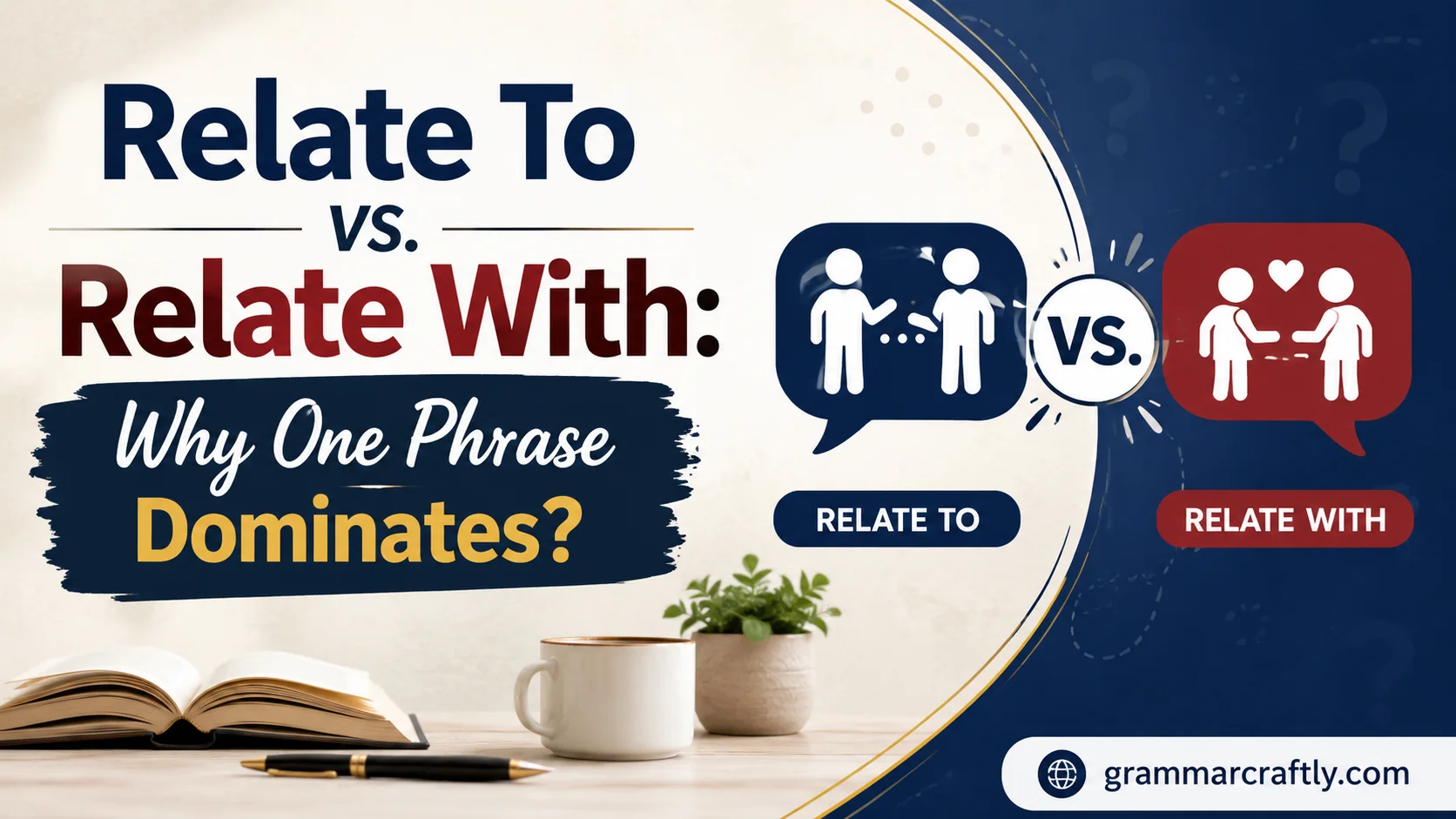
Relate To vs. Relate With: Why One Phrase Dominates? helps English learners understand why these phrases have different meanings and usage. Many English learners and fluent speakers become confused because relate to and relate with seem similar and are often used the same way. However, their meanings, usage, and acceptance are not identical. In modern English grammar, relate to is the more common phrase because it is widely accepted in American English, British English, business English, and academic writing. Understanding the difference, contexts, and grammar rules behind each expression helps improve your communication and avoid unnatural writing or speech.
From my experience, many people wonder how to say these words naturally because they hear both forms in different places. The relate to phrase describes a personal connection or emotional connection with ideas, stories, and experiences. When someone shares a personal story about failure, self-doubt, or unexpected success, you may think, “I know exactly how that feels.” This shows empathy, deep personal connection, and relating. It works well in daily professional communication, casual conversations, storytelling, and discussing relationships because it improves clarity, communication flow, and English fluency.
The relate with expression appears less frequently and is only appropriate in specific situations. Although some native speakers may use it, standard usage shows a lower level of acceptance compared with relate to. Both expressions involve interaction, relationship, and understanding, but they are not exactly same in every situation. Many writers confuse them because they use them interchangeably during real communication, which affects accuracy. Learning the correct form, following practical tips, and studying sentence examples helps you avoid common mistakes. This article explores the nuances, examples, practical applications, and noticeable difference so you can communicate confidently and choose the right phrase in any situation.
Relate To vs. Relate With: Quick Answer
If you’re looking for the short answer:
PhraseMost Common MeaningFrequencyRelate ToUnderstand, identify with, connect emotionally to someone or somethingVery CommonRelate WithShare a mutual relationship or interaction with someoneLess Common
Quick Examples
✅ I can relate to your experience.
✅ Many readers relate to the main character.
✅ She finds it easy to relate to children.
Less common:
✅ He can relate with people from different cultures.
✅ The counselor relates well with patients.
In modern English, “relate to” is usually the safer and more natural choice.
Understanding the Verb “Relate”
Before comparing the two phrases, it helps to understand the verb itself.
The word relate comes from the Latin relatus, meaning “to bring back” or “to connect.”
Over time, English speakers developed several meanings for the verb:
- To tell a story
- To establish a connection
- To understand someone’s feelings
- To identify with an experience
- To create a relationship between ideas
For example:
- The witness related what happened.
- Scientists relate climate patterns to ocean temperatures.
- I relate to her struggles.
Although these meanings differ, they all involve some form of connection.
What Does “Relate To” Mean?
Today, relate to primarily means:
- To understand
- To identify with
- To connect emotionally
- To see similarities between yourself and someone else
When people say they “relate to” something, they usually mean they understand it through personal experience.
Examples
- I can relate to the stress of starting a new job.
- Teenagers often relate to stories about identity.
- Many parents relate to the challenges shown in the article.
- She relates to the character’s journey.
Notice something important.
The connection is often emotional rather than physical.
You don’t simply understand the information. You feel connected to it.
Common Situations Where “Relate To” Appears
Entertainment
People often discuss movies, books, and television shows using “relate to.”
Example:
“I relate to that character because we faced similar challenges.”
Work
Professionals use it when discussing shared experiences.
Example:
“Employees relate to leaders who communicate honestly.”
Education
Teachers use relatable examples to help students learn.
Example:
“Students relate to real-life situations more easily than abstract theories.”
What Does “Relate With” Mean?
The phrase relate with exists, but it appears much less frequently in modern English.
It often refers to:
- Interacting successfully with someone
- Building a mutual connection
- Establishing rapport
Examples
- The therapist relates well with patients.
- He relates with people from different backgrounds.
- Managers should relate effectively with their teams.
In these examples, the emphasis is on interaction rather than emotional identification.
Relate To vs. Relate With: The Core Difference
Many learners confuse these phrases because both involve connection.
However, the type of connection differs.
FeatureRelate ToRelate WithEmotional understandingYesSometimesPersonal identificationYesRarelyMutual interactionSometimesYesCommon in modern EnglishVery commonLess commonPreferred in writingYesUsually noPreferred in conversationYesSometimes
Think of It This Way
Imagine watching a movie about a struggling college student.
You might say:
“I relate to that character.”
Why?
Because you’ve experienced something similar.
Now imagine a counselor speaking with a client.
You might say:
“The counselor relates well with clients.”
Here the focus is on interaction between two people.
That’s the key distinction.
Why “Relate To” Dominates Modern English
Language evolves constantly.
Over the last century, “relate to” has become the dominant phrase in everyday English.
Several factors explain this shift.
Simplicity
Language naturally favors forms that are easy to understand.
“Relate to” clearly communicates emotional connection.
Media Influence
Movies, books, podcasts, and social media frequently use “relate to.”
Examples include:
- “Can anyone relate to this?”
- “I totally relate to that.”
- “Millions of viewers relate to the story.”
These phrases have become part of everyday speech.
Broader Meaning
“Relate to” works in more situations.
It can express:
- Empathy
- Similar experiences
- Understanding
- Connection
- Identification
Because it serves multiple purposes, speakers naturally choose it more often.
How Usage Has Changed Over Time
Language historians have noticed interesting shifts in usage patterns.
Older English texts sometimes used “relate with” more frequently.
Over time, “relate to” expanded its meaning and became dominant.
Historical Trend
Time PeriodPreferred Form1800sMixed usageEarly 1900sRelate to gaining popularityMid-1900sRelate to becomes dominantTodayRelate to strongly preferred
This change reflects a broader trend toward clearer and more efficient communication.
Relate To vs. Relate With in Real-Life Situations
Understanding theory helps.
Seeing real examples helps even more.
Workplace Communication
Natural
- Employees relate to leaders who listen.
- Customers relate to authentic brands.
- Teams relate to clear goals.
Less Common
- Employees relate with leaders effectively.
While grammatically possible, it sounds less natural.
Relationships
Natural
- I relate to my sister’s experiences.
- She relates to her friend’s struggles.
Possible but Less Common
- He relates well with his neighbors.
Notice the shift.
The second sentence emphasizes interaction.
Education
Teachers often seek relatable examples.
Example:
Students relate to stories that mirror real life.
This emotional connection improves learning and retention.
Research consistently shows that people remember information better when they can connect it to personal experiences.
Marketing
Successful brands create messages audiences can relate to.
Consider campaigns featuring:
- Family moments
- Everyday challenges
- Personal achievements
People respond because they relate to the experiences shown.
A marketing slogan that feels familiar often performs better than one that feels distant.
Read More: Alternative Of, For, or To? The Complete Grammar,
Case Study: Why Certain Characters Feel Relatable
One reason some movies become cultural phenomena is that audiences relate to the characters.
Example: Harry Potter
Millions of readers relate to Harry because he experiences:
- Friendship
- Fear
- Growth
- Belonging
- Loss
Even though most people have never attended a wizard school, they understand those emotions.
That’s the power of relatability.
Lesson
People don’t need identical experiences.
They only need emotional similarities.
Common Mistakes People Make
Even advanced English users make mistakes with these phrases.
Let’s examine some common errors.
Mistake 1: Using “Relate With” When You Mean Understanding
❌ I relate with your frustration.
✅ I relate to your frustration.
Why?
You’re expressing emotional identification.
Mistake 2: Using “Relate To” for Active Relationship Building
Sometimes interaction matters more.
Example:
❌ The counselor relates to patients effectively.
✅ The counselor relates well with patients.
Although both may work, the second emphasizes interaction.
Mistake 3: Assuming Both Phrases Are Always Interchangeable
They’re not.
Context determines the better choice.
Always ask:
Am I talking about understanding or interaction?
American English vs. British English
Regional differences influence language choices.
American English
American speakers overwhelmingly prefer:
- Relate to
Examples:
- I relate to that.
- Can you relate to this situation?
British English
British English also favors “relate to.”
However, occasional uses of “relate with” appear in professional or interpersonal contexts.
Even so, “relate to” remains more common.
Which Phrase Sounds More Natural Today?
If naturalness is your goal, choose “relate to” most of the time.
Modern Examples
Natural:
- I relate to that.
- Readers relate to the story.
- She relates to his experience.
Less Natural:
- I relate with that.
- Readers relate with the story.
Native speakers generally prefer the first set.
Professional Writing Recommendations
Business writing values clarity.
Most editors recommend using “relate to” unless there’s a specific reason to emphasize interaction.
Professional Examples
- Customers relate to authentic messaging.
- Employees relate to transparent leadership.
- Audiences relate to compelling stories.
These constructions sound polished and natural.
Related Expressions Often Confused With Relate To
Several phrases share similar meanings.
Understanding them improves your vocabulary.
Identify With
Meaning:
To see yourself in someone else’s experience.
Example:
Many readers identify with the protagonist.
Connect With
Meaning:
To build rapport or understanding.
Example:
Great speakers connect with their audiences.
Empathize With
Meaning:
To understand another person’s feelings.
Example:
I empathize with your situation.
Associate With
Meaning:
To connect something mentally with another thing.
Example:
Many people associate summer with vacations.
Better Alternatives Depending on Context
Sometimes another phrase works better than either “relate to” or “relate with.”
SituationBetter AlternativeUnderstanding feelingsEmpathize withSeeing similaritiesIdentify withBuilding relationshipsConnect withEstablishing rapportEngage withUnderstanding experiencesRelate to
Choosing the right phrase adds precision to your writing.
Memory Trick for Choosing the Correct Phrase
Here’s an easy trick.
Use “Relate To” When:
You can replace it with:
- Understand
- Identify with
- Connect emotionally
Example:
I relate to your experience.
↓
I understand your experience.
Works perfectly.
Use “Relate With” When:
You can replace it with:
- Interact with
- Build rapport with
Example:
She relates well with clients.
↓
She interacts well with clients.
Also works.
Quick Reference Cheat Sheet
If You Mean…UseI understand your experienceRelate toI identify with that characterRelate toI connect emotionally with the storyRelate toI interact effectively with clientsRelate withI build rapport with patientsRelate withI share similar feelingsRelate to
Practice Quiz
Choose the best phrase.
Question 1
I can ______ your concerns.
Answer:
✅ Relate to
Question 2
The coach relates well ______ players.
Answer:
✅ With
Question 3
Many readers ______ the author’s personal story.
Answer:
✅ Relate to
Question 4
The counselor relates effectively ______ families.
Answer:
✅ With
Question 5
Teenagers often ______ characters facing similar challenges.
Answer:
✅ Relate to
Expert Writing Tips
Professional writers often follow these guidelines:
Use Relate To
When discussing:
- Experiences
- Emotions
- Stories
- Challenges
- Personal growth
Use Relate With
When discussing:
- Communication
- Relationships
- Counseling
- Leadership
- Team interactions
This distinction creates clearer and more precise writing.
FAQs:
What is the difference between “relate to” and “relate with”?
Relate to is the more common and widely accepted phrase in English. It means to understand, connect with, or identify with a person, feeling, idea, or experience. Relate with is less common and is usually used only in specific situations where interaction or association is being emphasized.
Is “relate to” more correct than “relate with”?
Yes, in most situations, relate to is considered the natural choice in standard English. Native speakers commonly use it in everyday conversations, professional communication, storytelling, and academic writing. Relate with is not always incorrect, but it has a much narrower usage.
Can I use “relate with” in everyday conversations?
You can use relate with in some contexts, but it may sound unusual to many English speakers. When you want to express emotional understanding or a personal connection, relate to is usually the better option.
Why do English learners confuse “relate to” and “relate with”?
Many English learners confuse these phrases because both include the idea of connection, relationship, and interaction. Their meanings appear similar, but their usage depends on context. Learning common sentence patterns can help you choose the correct phrase naturally.
How can I remember when to use “relate to”?
Think of relate to as a phrase connected with feelings, experiences, and understanding. If you can say, “I understand this because I have experienced something similar,” relate to is usually the right choice.
Conclusion:
Understanding the difference between relate to and relate with helps you communicate more naturally and confidently. While both phrases involve connection and relationships, relate to dominates modern English because it is widely accepted across conversations, professional settings, and academic writing.
When you want to describe empathy, shared experiences, or emotional understanding, choose relate to. Although relate with may appear in certain situations, it is far less common and requires careful use. By practicing correct usage and paying attention to context, you can make your English clearer, smoother, and more effective.