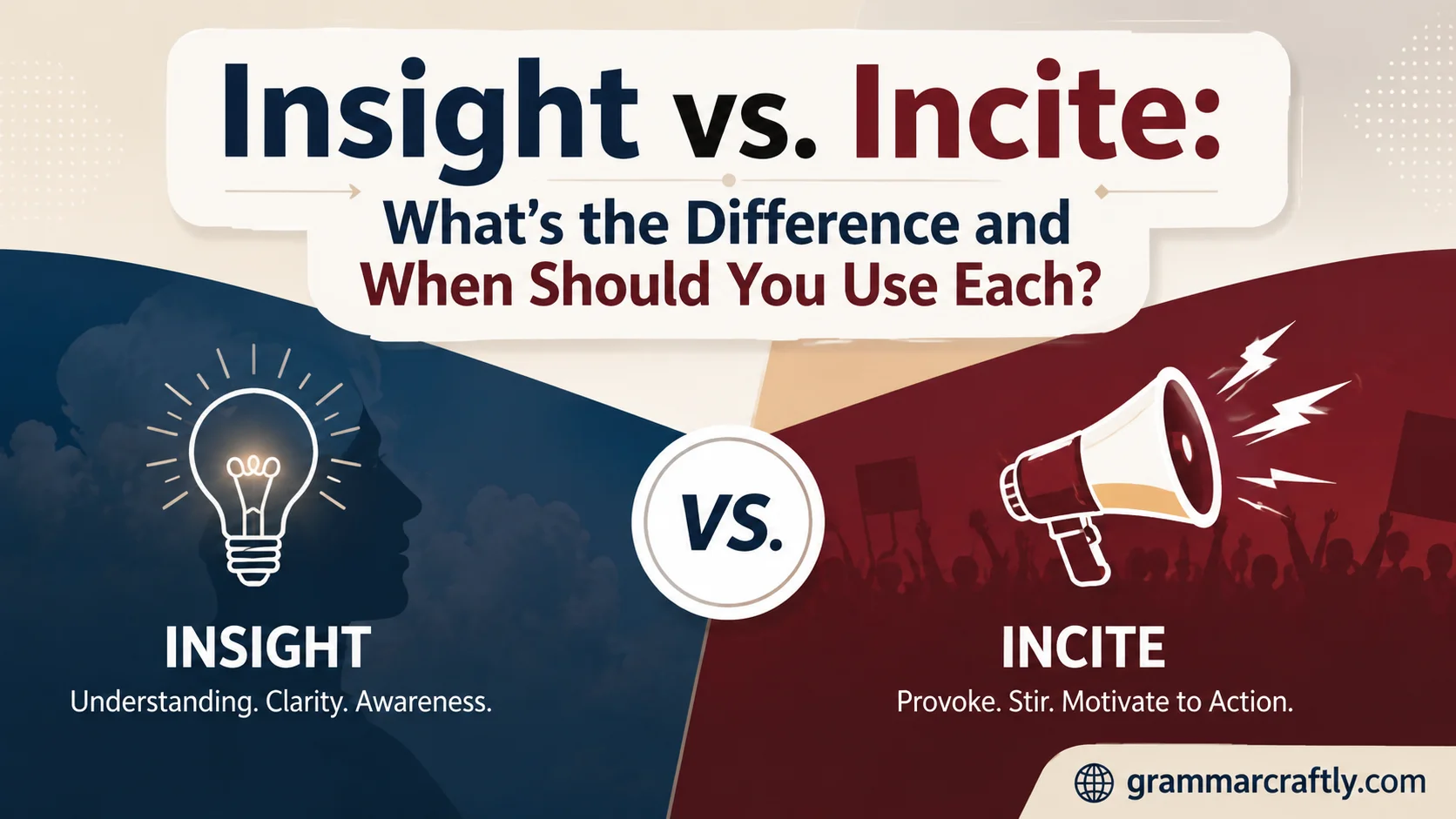
Insight vs. Incite: What’s the Difference and When Should You Use Each? clears confusion by showing different meanings with confidence.
Many people feel confused because Insight and Incite are similar words with a similar sound, similar pronunciation, and look alike. Their Difference, or difference, becomes clear when you know the meaning, meanings, word meaning, grammar, grammatical functions, and whether a term refers to a noun or a verb. In English, English grammar, and English vocabulary, Insight is a noun linked to deep understanding, wisdom, and perception, while Incite is a verb that can provoke, stir up, encourage, stimulate, or provoke behavior through action. This knowledge helps writers, readers, students, marketers, professionals, and native English speakers choose the correct term for everyday writing and effective writing.
From my own experience, I once paused mid-sentence, wondered which word to write, and saw how one mistake could change a message, message tone, or even an entire sentence. A manager reading a report expects valuable insight, not valuable incite, because the wrong word can damage credibility and create conflict. Careful analysis, observation, attention, and knowing when to use each word improve word choice, context, context awareness, linguistic context, clear communication, communication, communication clarity, communication skills, language, language skills, writing, writing skills, writing improvement, vocabulary improvement, stronger writing, trustworthy writing, greater accuracy, accuracy, and clarity.
Insight vs. Incite at a Glance
If you’re in a hurry, this table gives you the essential difference.
WordMeaningPart of SpeechPronunciationExampleInsightDeep understanding or awarenessNounIN-syteThe survey provided valuable insight into customer behavior.InciteTo encourage or provoke someone to actVerbin-SYTEThe speech incited the crowd to protest.
Quick Rule
- Insight = Understanding
- Incite = Encourage Action
Think of it this way:
Insight helps people think. Incite helps people act.
That simple distinction will solve most confusion.
What Does “Insight” Mean?
The word insight refers to a deep understanding of a person, situation, idea, or problem.
When someone has insight, they can see beyond surface-level information. They recognize patterns, understand motivations, and grasp important details that others may overlook.
Definition of Insight
Insight (noun): The ability to gain an accurate and deep understanding of something.
Examples of Insight
- The research provided valuable insight into consumer habits.
- Her years of experience gave her insight into the industry.
- The psychologist offered insight into human behavior.
- Customer feedback revealed important insights about the product.
Notice how insight always relates to knowledge, understanding, or awareness.
The Origin of Insight
The word combines:
- In
- Sight
Originally, it referred to seeing inward or looking beneath the surface.
Over time, it evolved to mean mental clarity and deeper understanding rather than physical vision.
Common Contexts Where Insight Appears
You’ll often encounter the word in:
- Business reports
- Market research
- Psychology
- Education
- Leadership
- Data analytics
- Consulting
- Journalism
For example, companies spend millions each year collecting customer insights because understanding customers helps improve products and increase revenue.
What Does “Incite” Mean?
Unlike insight, incite is a verb.
It means to encourage, urge, provoke, or stimulate someone into taking action.
The action can be positive, neutral, or negative depending on context.
Definition of Incite
Incite (verb): To encourage or persuade someone to act in a particular way.
Examples of Incite
- The coach’s speech incited the team to give their best effort.
- False rumors can incite panic.
- Leaders often incite change through powerful communication.
- The campaign sought to incite voter participation.
Notice that incite always involves influencing behavior.
The Origin of Incite
The word comes from the Latin term incitare, meaning:
- To spur on
- To stimulate
- To urge forward
This origin perfectly reflects its modern meaning.
Common Contexts Where Incite Appears
You frequently see incite in:
- News reports
- Politics
- Law
- Social movements
- Public speaking
- Marketing campaigns
Because of its association with provoking action, the word often appears in discussions about influence and persuasion.
Key Differences Between Insight and Incite
Although the words differ by only one letter, their meanings are worlds apart.
CategoryInsightIncitePart of SpeechNounVerbMeaningUnderstandingEncourage actionFocusKnowledgeBehaviorFunctionReveals informationTriggers responseTypical ContextAnalysisMotivationExampleGain insightIncite action
The Core Difference
Insight deals with what people know.
Incite deals with what people do.
This distinction makes choosing the correct word much easier.
Consider these examples:
✅ The survey provided valuable insight.
✅ The speaker incited the audience to participate.
❌ The survey provided valuable incite.
❌ The speaker insighted the audience.
The incorrect versions immediately sound unnatural because the words serve entirely different grammatical functions.
Insight vs. Incite: Side-by-Side Examples
Comparing examples is often the fastest way to understand word differences.
Insight ExamplesIncite ExamplesThe report gave us insight into customer needs.The advertisement incited customers to buy immediately.Her insight helped solve the problem.The speech incited public debate.Market insight improved sales strategy.The campaign incited voter turnout.The study offered insight into learning patterns.The announcement incited excitement among fans.Data insights revealed new opportunities.The article incited discussion online.
A useful observation emerges from these examples.
Insight usually follows words like:
- Gain
- Provide
- Offer
- Reveal
- Develop
Incite often follows words like:
- Encourage
- Motivate
- Trigger
- Provoke
- Inspire action
Why People Confuse Insight and Incite
Several factors contribute to this common mistake.
Similar Spelling
Both words contain:
- In-
- -ite/-ight sounds
At a glance, they appear nearly identical.
Similar Pronunciation
Their pronunciations are close enough that listeners may mishear them in conversation.
Spell Check Limitations
Many spelling tools won’t catch the mistake because both words are correctly spelled English words.
For example:
The report provided valuable incite.
No spelling error exists.
However, the sentence is still wrong because the incorrect word was chosen.
Lack of Familiarity
Many people encounter insight frequently but rarely use incite.
That imbalance makes confusion more likely.
How to Remember the Difference Between Insight and Incite
Memory tricks can help you avoid mistakes forever.
Memory Trick #1: Sight Means Seeing
The word insight contains sight.
Seeing leads to understanding.
Therefore:
Insight = Seeing deeply = Understanding
Memory Trick #2: Incite Contains “Cite”
Think of a speaker citing evidence to persuade people.
Persuasion often encourages action.
Therefore:
Incite = Encourage action
Memory Trick #3: Think vs. Act
This is perhaps the easiest rule.
WordAssociated IdeaInsightThinkInciteAct
If the sentence concerns understanding, choose insight.
If the sentence concerns action, choose incite.
Insight in Business Writing
Business professionals use insight constantly.
In fact, many organizations consider insights among their most valuable assets.
Why Business Insights Matter
Companies rely on insights to:
- Understand customer behavior
- Improve products
- Reduce costs
- Increase revenue
- Predict trends
- Make informed decisions
Example
A retailer notices customers abandon shopping carts during checkout.
The discovery itself is data.
Understanding why customers abandon carts becomes an insight.
That insight may reveal:
- High shipping costs
- Slow checkout process
- Limited payment methods
Each insight helps improve performance.
Real-World Case Study
Netflix and Viewer Insights
Netflix analyzes viewing behavior across hundreds of millions of subscribers.
The company studies:
- Viewing duration
- Genre preferences
- Search behavior
- Completion rates
These insights help determine:
- Which shows to produce
- Which content to recommend
- How to personalize experiences
As a result, Netflix saves significant resources while increasing user engagement.
Read More: Anastrophe Explained: Definition, Examples, Purpose?
Incite in Public Speaking and Leadership
Great leaders often know how to incite action.
However, they do so responsibly.
How Leaders Incite Action
Effective leaders:
- Create urgency
- Inspire commitment
- Encourage participation
- Motivate teams
Consider famous speeches throughout history.
Many did more than inform people.
They moved people to act.
Example
A manager might say:
“We have the talent and resources to achieve this goal. Let’s make it happen.”
That statement seeks to incite effort.
The manager isn’t providing insight.
The manager is encouraging action.
Insight vs. Incite in Marketing
Marketing professionals regularly use both concepts.
Insight in Marketing
Marketers gather insights to understand:
- Consumer needs
- Buying behavior
- Customer pain points
- Product preferences
Example:
A company learns customers want eco-friendly packaging.
That’s an insight.
Incite in Marketing
Marketers use campaigns to incite action.
Examples include:
- Buying
- Subscribing
- Registering
- Downloading
- Sharing content
A call-to-action such as:
“Sign up today and save 25%.”
is designed to incite immediate action.
Marketing Formula
Insight → Strategy → Incite Action
The sequence matters.
First, understand customers.
Then, motivate them.
Insight vs. Incite in Academic Writing
Academic writing generally favors insight.
Researchers aim to:
- Discover truths
- Explain findings
- Interpret evidence
- Generate knowledge
Example
“The study provides insight into climate adaptation strategies.”
This sentence is correct because the study generates understanding.
When Incite Appears in Academic Writing
Incite often appears when discussing social behavior.
Example:
“The misinformation campaign incited public distrust.”
In this case, the word describes behavioral influence.
Insight vs. Incite in Journalism
Journalists use both terms regularly.
Insight in Journalism
Reporters provide insight when they:
- Analyze events
- Explain trends
- Interpret developments
Example:
“The investigation offered insight into government spending.”
Incite in Journalism
Incite often appears in legal or political stories.
Example:
“Officials accused the speaker of attempting to incite violence.”
Because the word can carry legal implications, journalists use it carefully.
Common Mistakes Writers Make
Understanding common errors helps prevent them.
Mistake: Using Incite Instead of Insight
Incorrect:
The report gave valuable incite.
Correct:
The report gave valuable insight.
Mistake: Using Insight as a Verb
Incorrect:
The presentation insighted the audience.
Correct:
The presentation provided insight to the audience.
Mistake: Assuming They Are Interchangeable
They aren’t.
Each word serves a completely different purpose.
Synonyms and Antonyms
Understanding related words helps strengthen vocabulary.
Insight Synonyms
- Understanding
- Awareness
- Perception
- Wisdom
- Discernment
- Knowledge
- Comprehension
Insight Antonyms
- Ignorance
- Confusion
- Misunderstanding
- Blindness
Incite Synonyms
- Encourage
- Motivate
- Stimulate
- Provoke
- Inspire
- Spur
- Trigger
Incite Antonyms
- Discourage
- Deter
- Prevent
- Restrain
- Suppress
Insight vs. Incite vs. Inspire
Many writers confuse these words.
Let’s separate them clearly.
WordMeaningInsightUnderstandingInciteEncourage actionInspireFill someone with motivation
Example
- The report gave insight.
- The speech incited action.
- The leader inspired confidence.
They often work together but mean different things.
Insight vs. Incite vs. Invite
Another common source of confusion.
WordMeaningInsightUnderstandingInciteEncourage actionInviteRequest someone’s presence
Examples:
- The analysis offered insight.
- The article incited discussion.
- The host invited guests.
Quick Quiz: Can You Choose the Right Word?
Question 1
The survey provided valuable ______ into customer satisfaction.
Answer:
Insight
Question 2
The speech sought to ______ voters to participate.
Answer:
Incite
Question 3
The data revealed an important ______ about shopping habits.
Answer:
Insight
Question 4
Officials worried the message could ______ unrest.
Answer:
Incite
Real-Life Sentences You Can Learn From
Insight Examples
- The consultant offered insight into market trends.
- Customer feedback provided valuable insight.
- Her insight improved decision-making.
- The analysis revealed unexpected insights.
- Years of experience gave him unique insight.
Incite Examples
- The campaign incited public interest.
- The announcement incited excitement.
- The article incited debate.
- The coach incited determination.
- False information can incite panic.
A Simple Formula for Choosing the Correct Word
When deciding between insight and incite, ask one question:
Is the sentence about understanding or action?
If it’s about understanding:
➡ Use insight
If it’s about action:
➡ Use incite
Examples
Understanding?
The research offered valuable insight.
Action?
The advertisement incited customers to buy.
This quick test works almost every time.
FAQs:
What is the main difference between Insight and Incite?
Insight is a noun that means deep understanding or clear perception. Incite is a verb that means to encourage or provoke someone to take action, often in a negative way.
Is Insight a noun and Incite a verb?
Yes. Insight functions as a noun, while Incite functions as a verb. Knowing their grammatical roles helps you use them correctly.
Why do people confuse Insight and Incite?
People often confuse them because they have similar spelling and pronunciation. However, their meanings and usage are completely different.
How can I remember when to use Insight or Incite?
Think of Insight as being connected to ideas, understanding, and wisdom. Remember Incite as encouraging or provoking action. Reading examples and practicing regularly can make the difference easier to remember.
Can using the wrong word change the meaning of a sentence?
Absolutely. Writing valuable incite instead of valuable insight changes the meaning and can make your writing seem less accurate and less professional.
Conclusion:
Understanding Insight vs. Incite: What’s the Difference and When Should You Use Each? is important for anyone who wants to write clearly and confidently. Although the two words sound similar, they serve different purposes. Insight refers to deep understanding, while Incite means to encourage or provoke action. Learning this distinction, practicing with real examples, and paying attention to context will improve your grammar, vocabulary, and overall communication, helping you avoid common mistakes in both everyday and professional writing.