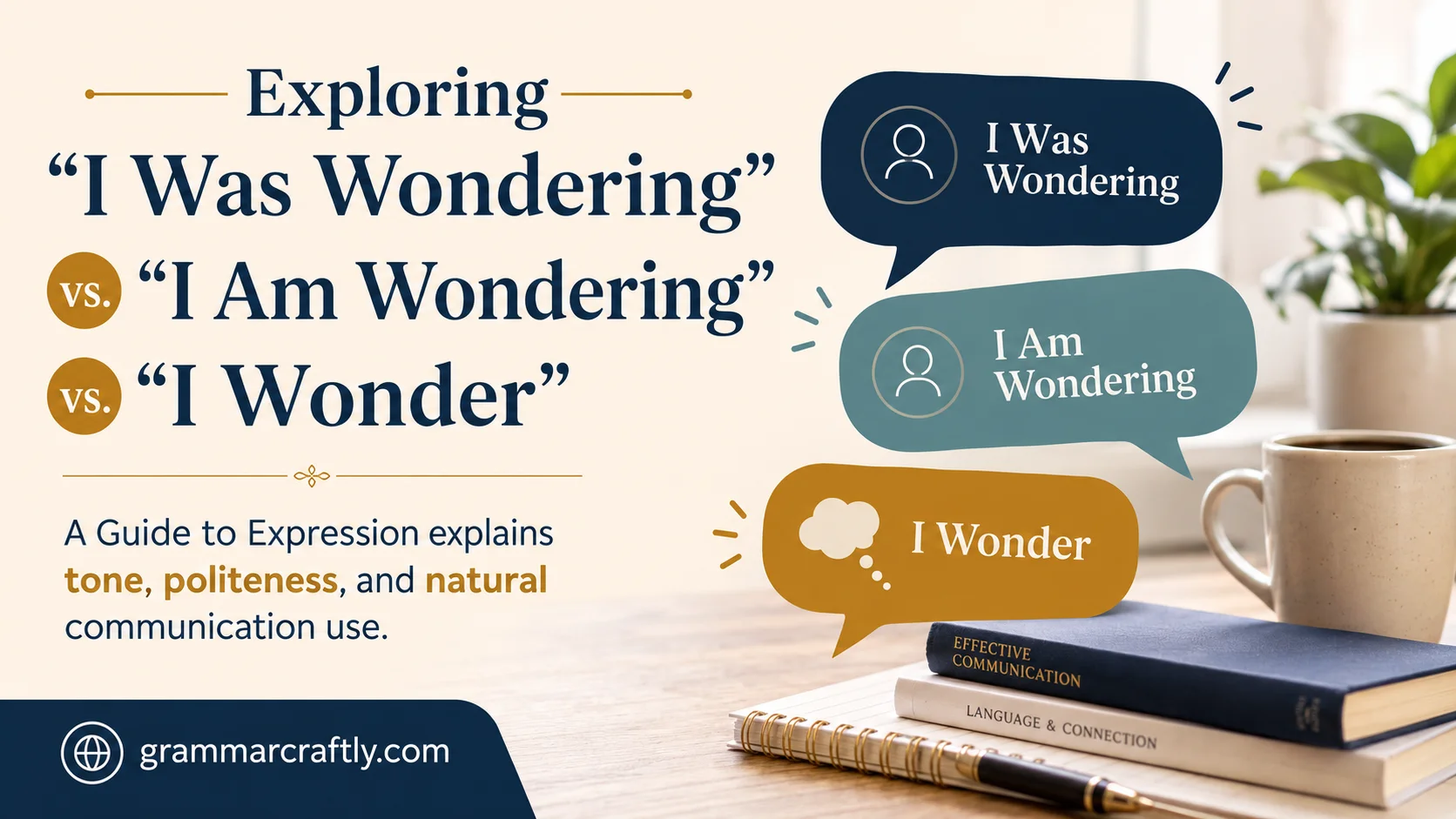
Exploring “I Was Wondering” vs. “I Am Wondering” vs. “I Wonder”: A Guide to Expression explains tone, politeness, and natural communication use.
In Exploring “I Was Wondering”, “I Am Wondering”, “I Wonder”, I focus on how choosing right words English changes tone and level politeness in a conversation, where I was wondering, I am wondering, and I wonder guide how people express curiosity, request, and present thoughts. From my experience, learners notice these small differences, tone changes, and emotional meaning, especially when a phrase like I was wondering helps introduce question, request, and gently start sentence without discomfort, unease, or sounding too urgent or hesitant, while I am wondering feels direct, polite, and actively seeking answer, and I wonder shows general curiosity and pondering.
I once sent email and made a mistake by ignored softer wording, which affected importance politeness, tone context, and writing, showing how expressions similar can carry subtle differences that affect emotional feeling, right choice words, and how language improves human connection in both professional emails and personal conversations, where people are more reflective, interested, and thoughtful. These practical ways of using language appear in daily conversations, whether chatting, casually talking, or reflecting quietly, shaping how we understand expressions, influence communication, and create more genuine and meaningful interactions, especially when handling using word wonder, indirect request, and ask permission in natural speech.
What “Wonder” Really Does in English
Before comparing the three phrases, it helps to understand the verb wonder itself.
At its core, wonder means to think about something with curiosity, uncertainty, or gentle interest. It often appears when you are not making a hard statement. You are exploring a thought.
That is why these phrases feel so different from direct questions.
- What time is the meeting? sounds direct.
- I wonder what time the meeting is sounds reflective.
- I was wondering if the meeting starts at 2 sounds polite and softened.
The word wonder often works like a small cushion. It softens the edge of a request or thought. Sometimes it expresses real curiosity. Other times it becomes a social tool that helps you sound more considerate.
That is the big idea to keep in mind as you read the rest of this article.
I Wonder: Direct, Natural, and Immediate
I wonder what is happening right now. It feels immediate, natural, and very human. You are not stepping back. You are not cushioning the message. You are simply thinking out loud.
What I wonder sounds like
This phrase sounds curious and spontaneous. It often appears when someone is reacting to a situation in the moment.
For example:
- I wonder why the bus is late.
- I wonder what she meant by that comment.
- I wonder if he is coming tonight.
These sentences feel alive. They sound like thoughts passing through your mind.
When I wonder works best
Use I wonder when you want to:
- express curiosity
- sound natural in speech
- think out loud
- introduce a reflective point
- speculate casually
It works especially well in conversation, storytelling, journaling, and internal reflection.
Examples of I wonder in context
- I wonder why the sky looks so strange today.
- I wonder if they already left.
- I wonder what happened after the meeting ended.
- I wonder how long this project will take.
Each sentence feels present and alive. Nothing about it sounds forced.
The subtle impact of I wonder
This phrase often feels direct without sounding rude. It does not ask permission. It does not soften too much. It simply opens a thought.
That makes it great for casual speech and personal writing. However, in professional emails, it can sound a little too blunt if you are actually making a request.
I Am Wondering: Thought in Progress
I am wondering if the thought is still unfolding. The idea is not finished yet. You are in the middle of considering something.
That makes this phrase feel more dynamic than I wonder. It has motion. It suggests that your mind is actively working.
What I am wondering sounds like
This phrase sounds thoughtful and open. It often appears when you want to show that you are still processing information.
Examples:
- I am wondering whether we should wait a little longer.
- I am wondering if this plan will work.
- I am wondering what your opinion is.
The feeling here is slightly more extended than I wonder. It carries a sense of active thinking.
When I am wondering works best
Use I am wondering when you want to:
- show ongoing thought
- sound reflective
- keep a discussion open
- invite another person’s input
- express uncertainty without sounding stiff
It works well in conversation, collaborative work, and situations where you want to sound engaged rather than final.
Examples of I am wondering
- I am wondering if we should adjust the deadline.
- I am wondering what the client will say.
- I am wondering whether this version is clearer.
- I am wondering how much detail we should include.
Why it feels different from I wonder
The difference is subtle, but it matters.
- I wonder if it feels like a completed thought in the moment.
- I am wondering if it feels like a thought still in motion.
Think of it this way:
I wonder if it is a snapshot.
I am wondering if it is a live video.
A practical note
In everyday speech, many native speakers prefer shorter, smoother phrasing. Still, I am wondering if it remains useful when you want to show that your thinking is active and open-ended.
I Was Wondering: The Polite Power Phrase
If English had a quiet little power move, this would be it. I was wondering often sounds more polite than the present tense versions. It is one of the most useful softening phrases in English.
Why I was wondering feels polite
This phrase creates a small distance between you and the request. That distance lowers pressure. It makes the listener feel less cornered.
Compare these two:
- Can you send me the file?
- I was wondering if you could send me the file.
The second one feels gentler. It still gets the point across, but it does not shove the request into the listener’s face.
That is why people use it in:
- business emails
- customer service
- academic communication
- formal or semi-formal messages
- polite requests to colleagues or clients
Examples of I was wondering
- I was wondering if you had time for a quick call.
- I was wondering whether you received my email.
- I was wondering if you could share your feedback.
- I was wondering if the meeting could move to Thursday.
These sentences are not weak. They are tactful. There is a difference.
Where I was wondering shines
This phrase works best when you want to:
- make a request politely
- avoid sounding pushy
- keep the tone warm and respectful
- soften follow-up messages
- ask for help without creating pressure
The real-world effect
In a work setting, I was wondering often sounds professional and considerate. It tells the other person, “I respect your time.”
That is a big deal. People respond better when they do not feel trapped by the tone of a message.
How I Was Wondering vs I Am Wondering vs I Wonder Changes Tone
These three phrases are close in meaning, but they do not sound the same.
Here is the simplest way to think about them:
- I wonder = direct, immediate, curious
- I am wondering = active, ongoing, reflective
- I was wondering = polite, softened, request-friendly
Tone comparison table
| Phrase | Main Tone | Best Use | How It Feels |
| I wonder | Direct and natural | Casual thought or curiosity | Immediate and honest |
| I am wondering | Thoughtful and ongoing | Open discussion or active consideration | Reflective and collaborative |
| I was wondering | Polite and softened | Requests, follow-ups, formal messages | Respectful and careful |
Emotional tone and subtle signals
A tiny tense shift can change how your listener feels.
I wonder
This sounds like a thought that just came to mind. It feels immediate. It can also sound slightly more assertive.
I am wondering
This feels thoughtful and somewhat unresolved. It suggests that you are exploring the idea rather than landing on a conclusion.
I was wondering
This feels cautious and polite. It often works like a social softener. You are not demanding attention. You are asking gently.
A useful way to think about the three
Imagine three people standing at different distances from a door:
- I wonder knocks right away.
- I am wondering stands near the door and looks around.
- I was wondering knocks lightly and waits patiently.
That metaphor is not perfect, but it captures the tone difference well.
Real-Life Workplace Scenarios for I Was Wondering vs I Am Wondering vs I Wonder
This is where the phrases really come alive. Grammar makes more sense once you see how people use it in real communication.
Asking for help
If you need something from a coworker, I was wondering usually sounds best.
- I was wondering if you could help me with this report.
- I was wondering whether you had time to review my draft.
Why it works:
It sounds polite and professional. It also leaves room for the other person to say yes without feeling pressured.
Making suggestions
When you are thinking through an idea with a team, I am wondering often fits well.
- I am wondering if we should test a smaller version first.
- I am wondering whether this approach will save time.
Why it works:
It shows that the idea is still in development. You are not forcing a decision. You are inviting discussion.
Following up
For reminders, I was wondering can soften the message nicely.
- I was wondering if you had a chance to look at my email.
- I was wondering whether there was any update on the proposal.
Why it works:
It keeps the tone friendly. Nobody enjoys feeling chased. This phrase helps you follow up without sounding impatient.
Requesting clarification
If you want to understand something better, I wonder or I am wondering can work depending on the setting.
- I wonder what you meant by that point.
- I am wondering if you could clarify the second step.
Why it works:
These forms sound thoughtful. They show interest rather than conflict.
Common Mistakes and Misunderstandings
Learners often understand the grammar but miss the social meaning. That is where mistakes start.
Mistaking polite distance for past time
A lot of people think I was wondering only refers to the past. Not always.
In many cases, the phrase sounds like a present request with a polite cushion.
For example:
- I was wondering if you could help me.
This does not mean you wondered in the past and stopped. It usually means you are asking now, but softly.
Using I wonder when a softer request would work better
If you are writing to a professor, client, or manager, I wonder may sound too direct.
For example:
- I wonder if you can send me the file.
This is understandable, but it can feel a bit abrupt.
A softer version would be:
- I was wondering if you could send me the file.
Overusing I am wondering
This phrase can sound fine, but it may feel wordy if you use it too often. In spoken English, native speakers often prefer something shorter when they can.
Instead of always saying:
- I am wondering if we should…
you can also say:
- Do you think we should…
- Should we…
- Would it make sense to…
Using indirect language when directness is better
Politeness is useful. Too much politeness can become muddy.
If urgency matters, be clear.
- Please send the file now.
- We need this by 3 p.m.
- Can you confirm this today?
Sometimes the cleanest sentence is also the strongest sentence.
Cultural Influence on I Was Wondering vs I Am Wondering vs I Wonder
English does not exist in a vacuum. Culture shapes how people use these phrases.
In many English-speaking workplaces, indirect requests are common because they sound respectful and low-pressure. That is especially true in customer service, academic settings, and professional emails.
But communication style varies by region, industry, and personality.
Some people value:
- directness
- speed
- clarity
Others value:
- politeness
- warmth
- diplomacy
That is why one phrase can sound perfectly natural in one setting and too soft in another.
For example, a project manager may prefer:
- Can you send the update by noon?
A professor may prefer:
- I was wondering if you could share your notes.
A teammate may prefer:
- I am wondering if this version is better.
The best choice depends on relationship, context, and the level of formality.
Other Useful Variations Similar to I Was Wondering vs I Am Wondering vs I Wonder
Sometimes you do not need these exact phrases. English gives you lots of ways to soften or shape a message.
More polite options
- Could you…
- Would you mind…
- I’d appreciate it if…
- Might you be able to…
More direct options
- Can you…
- Please…
- Let’s…
- Do you think…
More reflective options
- I’m curious whether…
- I’m thinking about…
- I’m not sure if…
- I’d like to know whether…
These alternatives help you avoid repeating the same structure all the time. They also give you more control over tone.
Mini Case Studies: What Each Phrase Sounds Like in Practice
Sometimes the fastest way to understand a phrase is to see it inside a real message.
Case study: Email to a client
Message:
I was wondering if you had a chance to review the proposal.
Why it works:
It feels professional, calm, and respectful. It does not sound impatient.
Case study: Talking to a friend
Message:
I wonder if we should try that new café.
Why it works:
It feels casual and spontaneous. No extra softness needed.
Case study: Team discussion
Message:
I am wondering if we should split the task into smaller parts.
Why it works:
It shows active thinking. It invites feedback rather than forcing a decision.
Case study: Asking a teacher for feedback
Message:
I was wondering if you could take a look at my draft when you have a moment.
Why it works:
It is polite, considerate, and appropriately soft.
When Not to Use These Phrases
These expressions are useful, but they are not always the best choice.
Avoid indirect phrasing when speed matters
If a situation is urgent, do not wrap the message in too much softness.
- Please call me now.
- Send the updated file immediately.
- We need a decision today.
Avoid softening when the message needs authority
Leaders often need to be clear. A message that is too gentle can weaken the point.
- Please submit the report by 4 p.m.
- This version needs revision.
- We are moving forward with option B.
Avoid unnecessary softness in casual talk
With close friends, extra politeness can sound strange.
Instead of:
- I was wondering if you might possibly want to grab coffee…
Just say:
- Want to grab coffee?
Simple usually wins.
Choosing the Right Phrase: A Practical Guide
Here is a quick shortcut you can keep in mind.
Use I wonder when you want to sound natural and immediate
Best for:
- casual speech
- personal reflection
- spontaneous curiosity
Use I am wondering when you want to show active consideration
Best for:
- brainstorming
- collaborative conversation
- thoughts still in progress
Use I was wondering when you want to sound polite or make a request
Best for:
- emails
- follow-ups
- professional communication
- sensitive requests
A simple shortcut
Ask yourself one question:
Am I thinking, discussing, or requesting?
- Thinking → I wonder
- Discussing → I am wondering
- Requesting → I was wondering
That shortcut will save you a lot of hesitation.
Read More: ‘Complaint’ vs ‘Complain’: Unveiling the Distinct Differences
Communication Tips for Sounding More Natural
If you want your English to sound smoother, pay attention to the whole sentence, not just the phrase.
Keep the sentence short when possible
Long, tangled requests can sound stiff.
Better:
- I was wondering if you could help me.
Too heavy:
- I was wondering whether there might be any possibility that you could potentially help me with this.
Match the tone to the relationship
You would not speak to a friend the same way you speak to a client. That is normal.
Use contractions naturally
These make English sound more human.
- I’m wondering
- I was wondering
- I’d like to know
Don’t over-polish casual speech
Real English often sounds simple. That is not a weakness. It is a strength.
FAQ
What is the main difference between “I was wondering”, “I am wondering”, and “I wonder”?
The main difference is tone. I wonder sounds immediate, I am wondering sounds ongoing, and I was wondering sounds polite and softened.
Why do native English speakers use “I was wondering” in professional emails?
Because it makes requests feel less direct. It shows respect and lowers pressure.
Is “I am wondering” common in everyday English?
Yes. It is common when people are thinking aloud or sharing a developing idea.
Why do many learners find these expressions confusing?
Because the tense does not always show time. Sometimes it shows tone, distance, or politeness instead.
How can I learn when to use these expressions correctly?
Focus on your purpose. If you are expressing curiosity, use I wonder. If you are thinking through an idea, use I am wondering. If you are asking politely, use I was wondering.
Conclusion
The difference between I was wondering vs I am wondering vs I wonder is not just grammar. It is a communication strategy.
I wonder if it sounds direct and immediate.
I am wondering if it sounds open and in progress.
I was wondering if it sounds polite and tactful.
Once you understand that, these phrases stop feeling confusing. They start feeling useful.
And that is the real goal. Not just to know which form is “correct,” but to know which one fits the moment, the message, and the relationship. That is how English becomes less like a school subject and more like a living tool you can actually use.
If you use these phrases with care, your English will sound smoother, more natural, and more confident.