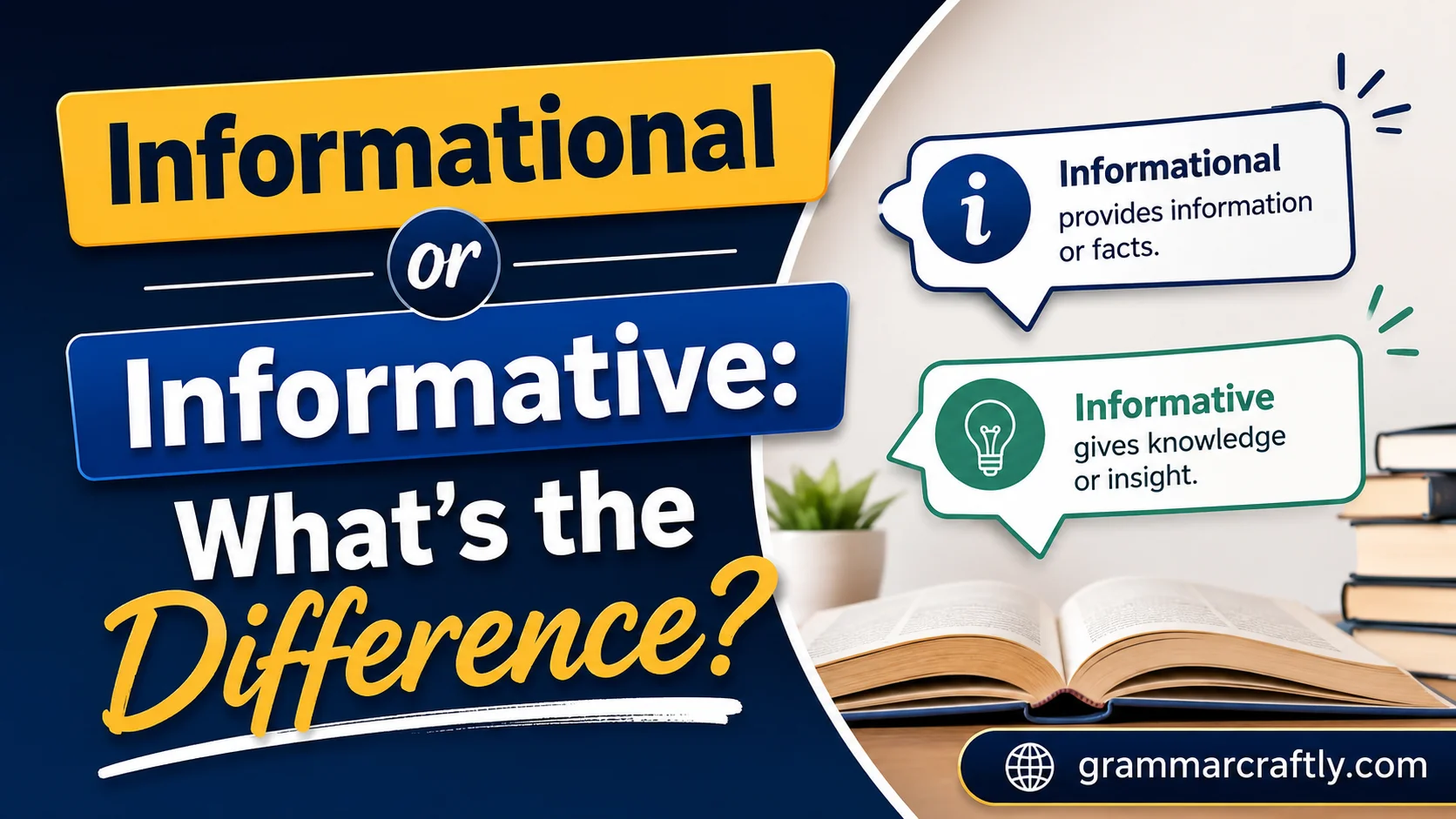
The Informational or Informative: What’s the Difference? question causes confusion because both terms share the same root, inform, yet differ in usage, meaning, context, and communication.
In my experience, informational content focuses on data, facts, information, tables, examples, headings, paragraphs, patterns, relationships, and content structure, while informative writing aims to teach, guide, and explain concepts through a simple, human, and practical approach. This distinction supports reader understanding, reader comprehension, language learning, vocabulary development, writing skills, communication skills, sentence clarity, and writing accuracy across academic writing, professional writing, everyday writing, business content, educational content, and social media.
Modern , natural language processing, text mining, semantic analysis, content analysis, information processing, AI, machine learning, algorithms, and knowledge representation help analyze, interpret, and represent information using tokenization, tagging, entity recognition, clustering, summarization, classification, embedding models, and labeling systems. These methods reveal semantic patterns, semantic relations, contextual associations, linguistic structures, contextual insights, and contextual relevance, helping learners, students, writers, professionals, and experienced writers make better word choice, improve grammar, avoid language mistakes, strengthen communication effectiveness, and choose the correct term instead of making a second guess when deciding between informational instead of informative.
Quick Answer: Informational vs. Informative in Simple Terms
Let’s make this simple right away.
- Informational describes something that contains or relates to information.
- Informative describes something that gives useful, valuable, or enlightening information.
That sounds subtle. However, the difference becomes clear when you see it in action.
| Word | Meaning | Example |
| Informational | Related to information or intended to provide information | An informational brochure |
| Informative | Gives useful, insightful, or valuable information | An informative lecture |
Quick shortcut:
- Informational = about information
- Informative = useful in teaching or explaining
Here’s an easy comparison:
A pamphlet at a hospital may be informational because it contains facts.
A doctor’s explanation may be informative because it helps you understand those facts.
That distinction is the heart of the informational vs. informative debate.
What Does “Informational” Mean?
The word informational is an adjective. It refers to something that exists to present, organize, or deliver information.
It does not automatically mean the information is useful, engaging, or deeply educational. It simply means the content contains information or is meant to provide it.
Simple definition
Informational = relating to or containing information
Think of it as a category word.
Examples of informational in sentences
- The company created an informational website for new customers.
- The museum handed out informational brochures.
- The university released an informational packet for applicants.
- The government posted informational materials about tax changes.
Notice something?
These examples tell us the materials contain information. They don’t tell us whether the information is excellent, useful, or memorable.
Key characteristics of informational content
Informational content usually:
- Presents facts
- Shares data
- Explains topics
- Organizes knowledge
- Answers questions
- Supports learning
- Delivers objective content
Examples of informational materials
Common informational resources include:
- Manuals
- Brochures
- Reports
- Fact sheets
- Educational articles
- Research papers
- FAQs
- Government notices
- User guides
- Infographics
Informational in
In digital marketing, informational search intent is one of the most important uses of this word.
An informational search happens when someone wants to learn something.
Examples:
- What is climate change?
- How does work?
- Informational vs. informative meaning
- How to cook rice
- Why do cats purr?
The user is seeking knowledge. They are not trying to buy something.
This is why experts often talk about informational keywords.
What Does “Informative” Mean?
Now let’s look at the second word.
Informative is also an adjective, but its meaning goes a step further.
It doesn’t simply mean something contains information.
It means the content is useful, enlightening, educational, or genuinely helpful.
Simple definition
Informative = providing useful and meaningful information
This word often carries a positive tone.
Examples of informative in sentences
- The documentary was highly informative.
- Her presentation was short but very informative.
- The article offered an informative explanation of the issue.
- The teacher gave an informative lecture on history.
Here, the speaker is not just saying information exists.
They are saying the information helped people understand something.
Key characteristics of informative content
Informative content usually:
- Explains clearly
- Teaches effectively
- Adds insight
- Increases understanding
- Answers questions deeply
- Provides useful context
- Helps readers learn something meaningful
Informative vs simply informational
Here’s the easiest way to think about it:
A page full of facts may be informational.
A page full of facts explained clearly in a useful way may be informative.
That’s the difference.
Informational vs. Informative: Side-by-Side Comparison Table
Here’s a deeper comparison.
| Feature | Informational | Informative |
| Core meaning | Related to information | Gives useful information |
| Focus | Presence of information | Quality and usefulness of information |
| Tone | Neutral | Often positive |
| Purpose | To provide information | To educate or enlighten |
| Reader impact | May or may not help deeply | Usually improves understanding |
| Common use | , brochures, fact sheets | Lectures, articles, discussions |
| Example | Informational guide | Informative guide |
Is Informational the Same as Informative? Why People Confuse Them
This confusion happens because both words come from the same root:
Information
That makes them look interchangeable.
However, English often creates related words that mean different things.
Think about these:
| Word Pair | Difference |
| Historic / Historical | One is significant, one relates to history |
| Economic / Economical | One relates to economy, one means cost-efficient |
| Effective / Efficient | One works well, one works with minimal waste |
The same thing happens with informational vs. informative.
Why writers confuse them
People mix these words because:
- Both involve information
- Both are adjectives
- They appear in educational contexts
- Their meanings overlap slightly
- Everyday speech often ignores subtle distinctions
Real-world confusion example
Incorrect:
This lecture was informational.
Possible, but awkward.
Better:
This lecture was informative.
Why?
Because lectures are judged by how useful they are, not just by whether they contain information.
Informational vs. Informative in Real Sentences
Examples make this much easier.
Using “Informational” correctly
Correct examples:
- The hospital created an informational flyer.
- This website offers informational resources.
- The campaign includes informational content for parents.
- The company released an informational PDF.
Why this works:
The focus is on the existence of information.
Using “Informative” correctly
Correct examples:
- The webinar was very informative.
- I found the book surprisingly informative.
- Her explanation was clear and informative.
- The interview was both entertaining and informative.
Why this works:
The focus is on usefulness and insight.
Wrong or awkward examples
Incorrect or awkward:
❌ The teacher gave an informational lecture.
✔ The teacher gave an informative lecture.
❌ That discussion was informational.
✔ That discussion was informative.
❌ The brochure was informative about policy updates.
✔ The brochure was informational about policy updates.
When to Use Informational vs. Informative in Writing
This is where writers often struggle.
Here’s a simple rule.
Use “informational” when referring to content categories
Examples:
- Informational article
- Informational brochure
- Informational packet
- Informational keyword
- Informational website
This works because you’re labeling something as information-based.
Use “informative” when judging usefulness
Examples:
- Informative article
- Informative lecture
- Informative presentation
- Informative explanation
- Informative discussion
This works because you’re evaluating quality.
Quick comparison
| Situation | Best Word |
| keyword type | Informational |
| Educational lecture quality | Informative |
| User guide category | Informational |
| Helpful explanation | Informative |
| Search intent | Informational |
| Insightful documentary | Informative |
Common Mistakes Writers Make
Even skilled writers get this wrong.
Here are the most common mistakes.
Using them as exact synonyms
This is the biggest mistake.
Not all informational content is informative.
A badly written brochure may contain facts yet fail to help the reader.
Choosing informative for neutral categories
Wrong:
Informative search intent
Correct:
Informational search intent
uses informational because it refers to a search category.
Using informational to praise content
Wrong:
Her speech was informational.
Correct:
Her speech was informative.
If you are praising quality, informative is usually the better word.
Ignoring context
Context decides everything.
The same noun may take different adjectives depending on meaning.
Example:
- An informational article = category
- An informative article = quality
That’s subtle but important.
Read More: ‘Deactivate’ or ‘Inactivate’: Understanding Context and Usage
Informational vs. Informative in Marketing, Education, and
This difference becomes especially important in professional writing.
Informational vs. Informative in
professionals use informational in a technical way.
Informational search intent
This refers to searches where users want answers.
Examples:
- What is inflation?
- How to boil eggs
- Why is the sky blue?
- Informational vs informative
This search intent differs from:
| Search Intent | Purpose |
| Informational | Learn |
| Navigational | Find a website |
| Transactional | Buy something |
| Commercial | Research before purchase |
Informative content in
writers aim to make informational pages informative.
That means:
- Clear explanations
- Strong examples
- Helpful visuals
- Useful facts
- Better user experience
- Deep answers
So:
The search intent is informational.
The content should be informative.
That distinction is brilliant once you notice it.
Informational vs. Informative in Education
Teachers use both ideas in different ways.
Informational text
This refers to nonfiction content designed to teach facts.
Examples:
- Textbooks
- Science articles
- Encyclopedias
- Reports
Informative teaching
This refers to the quality of instruction.
Examples:
- An informative lesson
- An informative classroom discussion
- An informative explanation
A textbook can be informational.
A teacher can make it informative.
Informational vs. Informative in Marketing
Marketers use these words carefully because they affect tone.
Informational marketing content
This includes:
- Product FAQs
- Help center articles
- Policy pages
- Tutorials
- Resource guides
Informative marketing content
This describes how valuable the content is.
Examples:
- “This webinar was informative.”
- “The article provided informative insights.”
Case study: Content marketing example
A SaaS company creates a page called:
What Is Cloud Storage?
This is informational content because it answers a question.
If the article includes:
- Simple examples
- Clear definitions
- Real-world use cases
- Helpful visuals
- Actionable tips
Then readers may call it informative.
This shows how both words can apply differently.
Quick Grammar Rule to Remember
Here’s a shortcut you can use forever.
Ask yourself this question:
Am I describing a category or usefulness?
If the answer is:
- Category → informational
- Usefulness → informative
Memory trick
Think of it this way:
Informational = contains information
Informative = informs well
That tiny trick makes the difference much easier.
Sentence Practice Quiz
Test yourself.
Choose the correct word.
Sentence 1
The museum handed out an ______ brochure.
Answer: informational
Why? It describes a type of brochure.
Sentence 2
The speaker gave an incredibly ______ presentation.
Answer: informative
Why? You are judging quality.
Sentence 3
This keyword has ______ search intent.
Answer: informational
Why? category.
Sentence 4
Her explanation was clear and ______.
Answer: informative
Why? Helpfulness.
Informational vs. Informative Cheat Sheet
Here’s a quick summary table.
| If you mean… | Use |
| Related to information | Informational |
| Helpful and educational | Informative |
| Search intent category | Informational |
| Useful lecture | Informative |
| Fact-based resource | Informational |
| Insightful explanation | Informative |
Quotes From Writing Experts
“Word choice shapes meaning more than most people realize.”
That idea applies perfectly here.
“Precision in language improves clarity.”
Choosing between informational vs. informative is a small example of that principle.
FAQs
What is the main difference between informational and informative?
Informational describes content that provides facts, data, or reference material, while informative describes content that explains information in a helpful and easy-to-understand way.
Can informational and informative be used interchangeably?
Sometimes they appear in similar contexts, but they are not always interchangeable. Informational focuses on delivering information, whereas informative focuses on how useful and enlightening that information is.
Is informational content always informative?
Not necessarily. A document may contain plenty of facts and data, making it informational, but it may not be informative if readers struggle to understand or apply the information.
Which word is more common in education and business writing?
Both are common. Educational materials, reports, and manuals are often called informational, while articles, presentations, and guides that clearly explain concepts are usually described as informative.
How can I remember the difference easily?
Think of informational as “containing information” and informative as “helping people learn from that information.” This simple rule works in most writing situations.
Conclusion
Understanding Informational or Informative: What’s the Difference? can make your writing clearer and more precise. While both words relate to sharing information, informational emphasizes facts, data, and reference material, whereas informative highlights explanation, understanding, and practical value for readers. Choosing the right term improves communication, strengthens word choice, and helps your content sound more natural in academic, professional, and everyday English. Once you recognize this distinction, selecting the correct word becomes much easier.