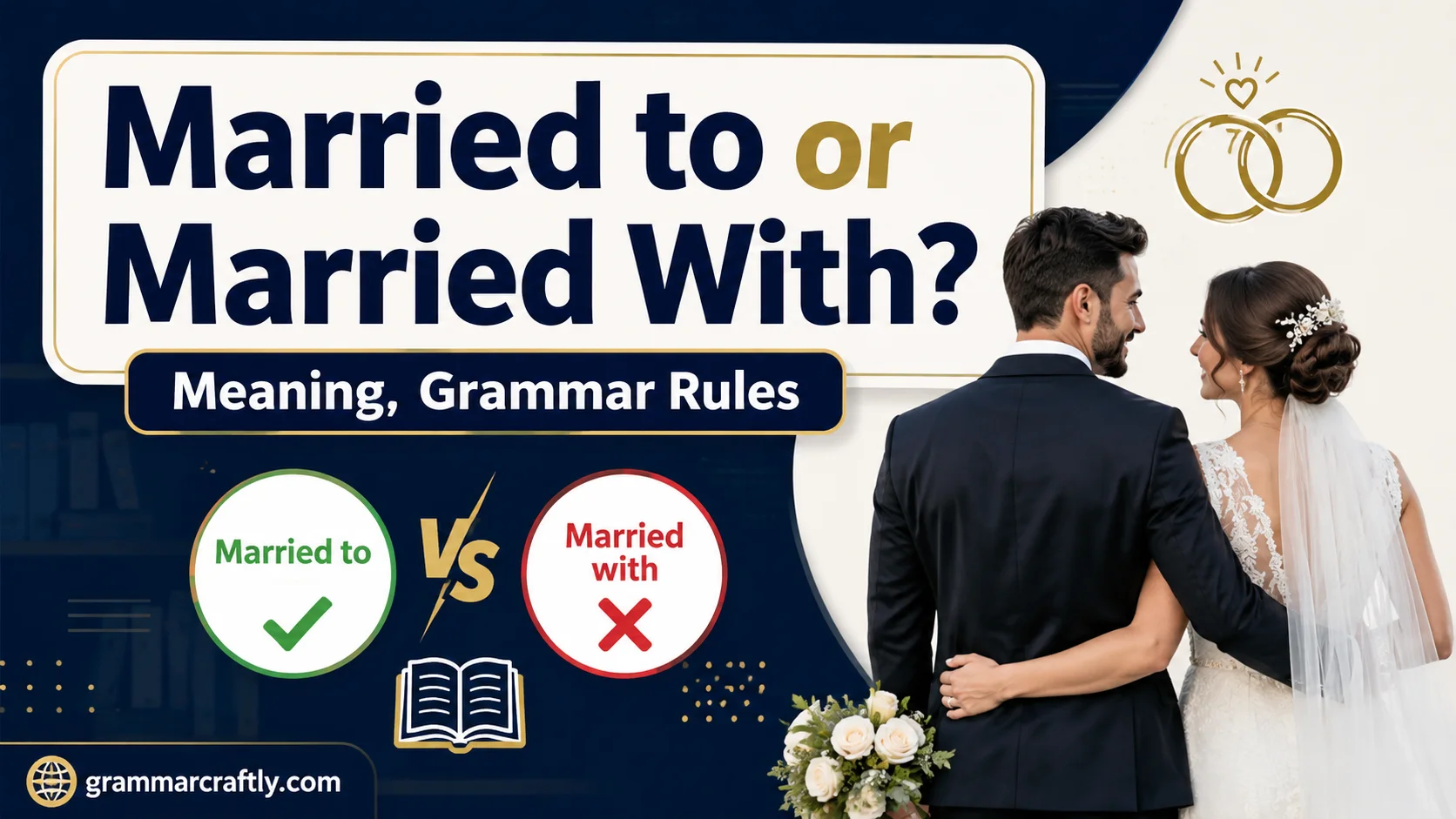
Married to or Married With? Meaning, Grammar Rules explains why these phrases can confuse people in English writing and daily conversations.
The married to phrase is correct, widely used, and grammatically accepted when talking about a spouse, partner, or relationship. Married with is less common for identifying a spouse, but it can appear when mentioning children or other responsibilities. This difference helps learners speak and write more naturally, while proper preposition usage improves clarity, accuracy, and communication.
Real examples, grammar rules, and contextual differences can help you avoid common mistakes and gain confidence in formal, casual, academic, and informal English. Sarah and Tom can provide simple examples that demonstrate how context clues, sentence structure, and semantic meaning affect correctness. These small words may create big differences, so understanding their traditional usage makes your English clearer and more precise.
“Let’s dive in”
Married to or Married With? The Quick Answer
The short answer is simple.
| Expression | Correct? | Meaning |
| Married to someone | Yes | Refers to a husband or wife |
| Married with someone | No | Incorrect in standard English |
| Married with children | Yes | Refers to having children |
| Married with two sons | Yes | Refers to family circumstances |
| Get married to someone | Yes | Becoming someone’s spouse |
| Happily married to someone | Yes | Describes a marriage relationship |
Examples
- I am married to James.
- She’s been married to Michael for fifteen years.
- They’re married with three children.
- We got married to each other in 2018.
- Incorrect: I’m married with Sarah.
- Incorrect: He’s married with his wife.
A simple rule will help you remember everything:
Married TO = a person
Married WITH = something connected to the marriage
Keep that distinction in mind and you’ll avoid most mistakes.
What Does “Married To” Mean?
The expression married to refers to your husband, wife, or spouse. It is by far the most common and natural construction in English.
Whenever you’re identifying the person you’re married to, use to.
Examples
- I’m married to Lisa.
- She’s married to Daniel.
- They’re married to each other.
- He has been married to his wife for twenty years.
- Emma is happily married to Robert.
Native speakers use this pattern constantly in both formal and informal English.
Common Sentence Patterns
- Be + married + to
- Get + married + to
- Happily + married + to
- Legally + married + to
For example:
We’ve been married to each other since college.
She’s happily married to her childhood sweetheart.
He got married to his best friend last summer.
The preposition to expresses connection or relationship. That’s why English also uses it in expressions like:
- Related to
- Connected to
- Engaged to
- Married to
These expressions describe relationships between people or things.
Why Native Speakers Prefer “Married To”
English has followed this grammatical pattern for centuries. Native speakers naturally say:
- Married to my husband
- Married to my wife
- Married to my partner
They almost never say:
- Married with my husband
- Married with my wife
- Married with Sarah
Although learners sometimes assume that with sounds more logical because marriage involves two people, standard English simply doesn’t work that way.
Grammar isn’t always about logic. Often, it’s about usage.
That’s why native speakers say:
- Married to
- Engaged to
- Related to
Instead of:
- Married with
- Engaged with
- Related with
Learning these common patterns will make your English sound much more natural.
What Does “Married With” Mean?
This is where many learners become confused.
The phrase married with does exist. However, it has a completely different meaning.
Instead of referring to your spouse, it describes something that accompanies the marriage.
For example:
- Married with children
- Married with four sons
- Married with a large family
Notice something important.
The word following with isn’t your spouse. It’s additional information about family circumstances.
Examples
- They’re married with three children.
- She’s married with two daughters.
- He’s married with a large extended family.
- We’re happily married with one child.
The emphasis isn’t on who the person married. Instead, it’s describing their family situation.
Think of it this way:
| Expression | Focus |
| Married to Emma | Who you married |
| Married with children | What your family includes |
| Married to John | Your spouse |
| Married with two sons | Your children |
The meaning changes entirely when the preposition changes.
Married With Someone Is Incorrect
One of the most common grammar mistakes involves sentences like these:
- I’m married with Jessica.
- She’s married with Thomas.
- He’s married with his wife.
These constructions aren’t considered standard English.
Incorrect Examples
- I’m married with Emily.
- She’s married with her husband.
- They’re married with each other.
- He got married with Sarah.
Correct Versions
- I’m married to Emily.
- She’s married to her husband.
- They’re married to each other.
- He got married to Sarah.
When referring to people, always use to.
A useful memory trick is this:
If you can replace the word with “my husband” or “my wife,” you should use to.
For example:
- Married to my wife
- Married to my husband
- Married to Emma
The rule remains the same every time.
Married With Children: Why It’s Correct
Many people wonder why married with children is acceptable when married with someone isn’t.
The answer lies in the meaning of the preposition.
In this expression, with means:
accompanied by
including
together with
For example:
- Married with children
- Married with two sons
- Married with one daughter and a grandson
The phrase simply tells readers that the married couple has children.
Examples
- They’re married with four children.
- She’s happily married with two daughters.
- We’ve been married with three wonderful children for twenty years.
Notice that children aren’t the object of marriage.
They’re additional information.
That’s why the expression works grammatically.
Read More: Sell or Sale: The Complete Guide to Understanding the Difference:
Get Married To or Get Married With?
Another common question involves the verb phrase get married.
Correct Usage
- She got married to Jacob.
- We got married in New York.
- They got married last June.
- He got married to his college sweetheart.
Incorrect Usage
- She got married with Jacob.
- They’re getting married with each other.
English almost always uses:
Get married to + person
or
Get married + place/time
Examples include:
- We got married in California.
- They got married last year.
- She got married to Michael in 2024.
Understanding this pattern will immediately improve both spoken and written English.
Married To vs. Married With at a Glance
| Grammar Pattern | Correct? |
| Married to my wife | Yes |
| Married to my husband | Yes |
| Married to Sarah | Yes |
| Married with Sarah | No |
| Married with children | Yes |
| Married with twins | Yes |
| Got married to Emma | Yes |
| Got married with Emma | No |
| Happily married to Jack | Yes |
| Married with a large family | Yes |
This table covers the vast majority of situations you’ll encounter.
American and British English Usage
Both American and British English overwhelmingly prefer married to when referring to spouses.
Examples include:
- She’s married to a doctor.
- He’s married to his childhood friend.
- They’re married to each other.
The expression married with children is also accepted in both varieties of English.
However, American English frequently uses:
- Married and has two children.
instead of:
- Married with two children.
Compare the following:
| American English | British English |
| Married and has two children | Married with two children |
| Married to James | Married to James |
| Happily married to Lisa | Happily married to Lisa |
Both versions are perfectly natural.
Common Grammar Patterns You Should Know
English uses several common structures involving marriage.
Pattern One
Be + married + to + person
Examples:
- She’s married to John.
- He’s married to Anna.
Pattern Two
Get + married + to + person
Examples:
- We got married to our partners in 2022.
- She got married to Daniel last year.
Pattern Three
Married + with + children
Examples:
- They’re married with four children.
- He’s married with twins.
Pattern Four
Married + for + period of time
Examples:
- We’ve been married for twenty years.
- She’s been married for six months.
Pattern Five
Married + in + place
Examples:
- They were married in Chicago.
- We got married in Italy.
Learning these patterns together makes them easier to remember.
More Than 25 Everyday Examples
Married To
- I’m married to Olivia.
- He’s married to Jennifer.
- They’re married to each other.
- She’s happily married to Michael.
- We’ve been married to our spouses for decades.
- Emma is married to an architect.
- Sarah got married to Jacob.
- They’re legally married.
- She’s newly married to Thomas.
- He’s proudly married to his college sweetheart.
Married With
- They’re married with two children.
- She’s married with twin boys.
- We’re married with a large family.
- They’re happily married with three daughters.
- He’s married with grandchildren now.
Get Married
- They got married last year.
- She got married in Paris.
- We got married on Saturday.
- He’s getting married next month.
- They got married after graduating from college.
Time Expressions
- We’ve been married for fifteen years.
- She’s been married since 2019.
- They’re celebrating twenty years of marriage.
- He has remained happily married throughout his career.
- They’ve enjoyed a wonderful married life together.
These expressions appear frequently in newspapers, interviews, biographies, and everyday conversations.
Common Mistakes English Learners Make
English learners often transfer grammatical patterns from their first language into English. That creates several recurring mistakes.
Mistake One
Incorrect: I’m married with my wife.
Correct: I’m married to my wife.
Mistake Two
Incorrect: She got married with John.
Correct: She got married to John.
Mistake Three
Incorrect: He’s married with Emma for ten years.
Correct: He’s been married to Emma for ten years.
Mistake Four
Incorrect: We’re married since five years.
Correct: We’ve been married for five years.
Mistake Five
Incorrect: They married with children.
Correct: They’re married with children.
Small grammar changes can significantly improve naturalness and accuracy.
Memory Tricks You’ll Never Forget
Remembering prepositions doesn’t have to feel difficult.
Trick One
Think of this formula:
TO = PERSON
Examples:
- Married to James
- Married to Anna
- Married to my husband
Trick Two
Remember this one:
WITH = EXTRA INFORMATION
Examples:
- Married with children
- Married with twins
- Married with a large family
Trick Three
Ask yourself one simple question:
Am I talking about a person?
If the answer is yes, use to.
If you’re describing family circumstances, with may be appropriate.
This shortcut solves almost every grammar problem involving these expressions.
Native Speaker Usage Explained
Native speakers overwhelmingly prefer simple constructions.
Instead of saying:
She’s married with Robert.
They naturally say:
She’s married to Robert.
Instead of writing:
He’s married with one daughter.
Some speakers may also say:
He’s married and has one daughter.
Both are natural English expressions.
Native usage usually favors clarity and simplicity. Paying attention to these patterns will make your writing sound more fluent.
Formal and Informal Usage
The phrase married to works equally well in:
- Academic writing
- Business writing
- Journalism
- Everyday conversation
- Legal documents
Examples include:
She is legally married to Mr. Harris.
They’ve been happily married to one another for thirty years.
The expression married with children is slightly less common in formal writing because many writers prefer:
Married and has three children.
However, both constructions remain grammatically acceptable.
A Simple Grammar Diagram
MARRIED
|
————————-
| |
TO + PERSON WITH + DETAILS
| |
Husband Children
Wife Twins
Partner Family
Emma Grandchildren
| |
Married to Emma Married with two children
Keeping this diagram in mind makes the distinction remarkably easy.
Mini Case Study
Imagine you’re introducing yourself.
Incorrect
I’m Daniel. I’m married with Sophia and we have two children.
Correct
I’m Daniel. I’m married to Sophia and we have two children.
Another possibility is:
I’m Daniel. I’m married to Sophia. We’re married with two children.
Notice how the meaning changes naturally.
The first sentence identifies your spouse.
The second provides information about your family.
Each preposition has its own grammatical purpose.
FAQs:
Is “married to” grammatically correct?
Yes, married to is the standard and grammatically correct expression when you identify the person someone has as a spouse. For example, “She is married to John.”
Is “married with” incorrect?
Not always, but married with is not normally used to identify a spouse. It can describe someone’s marriage together with another detail, such as children: “He is married with two kids.”
Should I say “married to” or “married with” someone?
Use married to when referring to a person. For example, “Tom is married to Sarah.” This is the natural choice in standard English.
What is the difference between “married to” and “married with”?
Married to focuses on the spouse or partner, while married with can add information about children or other circumstances. The correct choice depends on the context.
Can “married with children” be used in English?
Yes. Married with children is understandable and can be used to describe a person’s family situation. However, when naming the spouse, use married to, such as “She is married to David and has two children.”
Conclusion:
Married to is the safest and most natural choice when you’re talking about the person someone married. Married with can work when you’re adding information about children or other circumstances, but it doesn’t normally replace married to. Once you understand this simple grammar difference, you can write and speak with greater clarity, accuracy, and confidence.