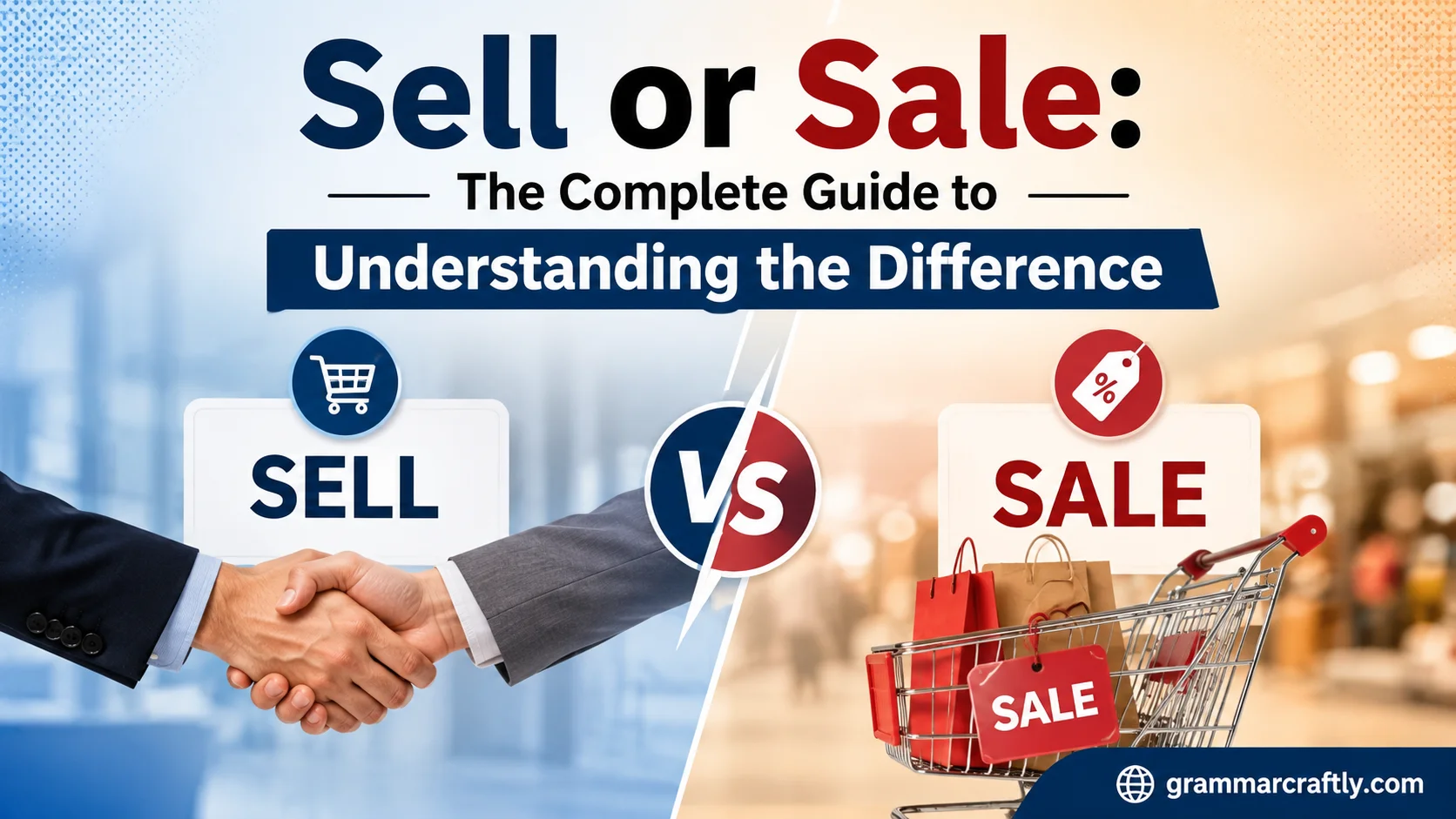
Sell or Sale: The Complete Guide to Understanding the Difference: helps you use sell vs sale correctly in English, writing, and communication.
If you’re wondering whether to use sell or sale, remember that sell is a verb describing an action, while sale is a noun for an event, transaction, or opportunity where something is sold. Both words relate to buying and business, but their roles in sentences differ. You may sell an item by giving something to someone for money, while a sale can involve items at reduced prices. This distinction makes your sentences clearer and strengthens your grammar skills and vocabulary. From my experience, linking sell with selling and sale with an event is an easy way to remember the difference.
The tricky part is that the words can sound alike and appear similar at a glance, although they have different meanings. Even native speakers may slip, so context is crucial. Learners can avoid confusion by exploring useful terms, twists, examples, and practical tips. Always use for sale, rather than for sell, because sale is a noun. If you’re ready for a GREAT deal, you may find a Black Friday sale coming up soon, download a sale preview catalog, and prepare a wish list for English lessons or another course. Fluency Coaching can help you grasp proper usage, develop stronger vocabulary, improve grammar, and confidently handle language in conversations, professional communication, and language learning. These simple explanations help you choose the right word with confidence.
“Let’s dive in”
Sell vs Sale: Quick Difference Explained
Before diving deeper, here is a simple comparison that shows the main difference between sell and sale.
| Word | Part of Speech | Meaning | Example |
| Sell | Verb | To give something to someone in exchange for money | I want to sell my bicycle. |
| Sale | Noun | The act or event of selling something | The store is having a winter sale. |
Think of it this way:
Sell = the action you do.
Sale = the event or result of that action.
Imagine a bakery. The baker sells cakes. The weekend discount event is a sale.
The baker performs the action. The customers experience the event.
What Does Sell Mean?
The word sell means to exchange a product, service, or item for money. It describes the action performed by a person, company, or organization.
In grammar, sell is most commonly used as a verb.
Basic definition of sell:
Sell means to transfer ownership of something to another person in return for payment.
Examples:
- Sarah wants to sell her old laptop.
- The company sells handmade furniture.
- They are selling tickets for the concert.
- He sold his car last month.
In each example, someone is performing an action.
The person is not talking about an event. They are talking about the act of exchanging something.
Different Uses of Sell
Although selling often involves money, the word has several meanings depending on the context.
Selling a Product or Item
This is the most common meaning.
Examples:
- The store sells fresh vegetables.
- My neighbor is selling his house.
- They sold thousands of smartphones last year.
Businesses use this meaning every day because selling products keeps commerce moving.
Selling an Idea or Belief
You can also sell something that is not physical.
For example:
- The manager tried to sell his idea to the team.
- The politician worked hard to sell his message to voters.
- She successfully sold the benefits of the new plan.
Here, selling means persuading someone to accept or support something.
Selling Yourself Professionally
In careers and interviews, people often talk about “selling yourself.”
This does not mean putting a price on yourself. Instead, it means showing your skills and value.
Example:
During a job interview, you need to sell yourself by explaining your experience and strengths.
What Does Sale Mean?
The word sale refers to the act of selling something or an event where products are offered to customers.
Unlike sell, sale is usually a noun.
Basic definition of sale:
A sale is an exchange of goods or services for money or a special event where items are offered for purchase.
Examples:
- The store is having a holiday sale.
- The house is available for sale.
- The company completed the sale of the property.
Notice that sale names the situation or event.
Common Types of Sales
Businesses use different kinds of sales to attract customers.
| Type of Sale | Meaning | Example |
| Clearance sale | Selling remaining products at lower prices | The store held a clearance sale. |
| Holiday sale | Discounts during holidays | The company offered a Christmas sale. |
| Flash sale | Short-term discount event | The website launched a two-hour flash sale. |
| Private sale | Sale available to selected buyers | Members received access to a private sale. |
| Real estate sale | Transfer of property ownership | The home sale closed last week. |
A sale can describe both a discount event and a legal transaction.
The Grammar Rule Behind Sell and Sale
The biggest difference between sell and sale comes down to grammar.
Sell Is a Verb
A verb shows an action.
Examples:
- I sell handmade candles.
- She sells artwork online.
- They sold their business.
- We are selling our old furniture.
The word changes depending on tense.
| Verb Form | Example |
| Sell | I sell products online. |
| Sells | He sells cars. |
| Selling | They are selling tickets. |
| Sold | She sold her house. |
Sale Is a Noun
A noun names a person, place, thing, or idea.
Examples:
- The store announced a big sale.
- The sale of the property took three months.
- Customers love holiday sales.
You cannot usually replace sale with sell because the sentence structure changes.
Incorrect:
❌ The store has a big sell.
Correct:
✅ The store has a big sale.
Sell vs Sale Examples in Sentences
Seeing these words in real situations makes the difference easier to remember.
Example 1: Online Marketplace
Incorrect:
❌ I want to put my phone on sell.
Correct:
✅ I want to put my phone up for sale.
Why?
You are making the phone available to buyers. You are not performing the selling action yet.
Example 2: Business
Sentence:
The company sells organic coffee.
Here, sells is correct because the company performs the action.
Sentence:
The company announced a coffee sale.
Here, sale is correct because it refers to a promotional event.
Example 3: Real Estate
Correct:
- They want to sell their house.
- Their house is for sale.
- The house sale was completed yesterday.
Each sentence uses the word differently.
For Sale vs For Sell: Which One Is Correct?
One of the most common English mistakes is writing:
❌ For sell
The correct phrase is:
✅ For sale
Why?
“For sale” means something is available to buy.
Examples:
- This car is for sale.
- The apartment is for sale.
- My old books are for sale.
You use sale because you are describing the availability of an item.
You are not describing someone doing the action of selling.
Why Is “For Sell” Wrong?
The phrase “for sell” does not follow normal English grammar.
The word sell is an action word, so it needs a subject.
Example:
✅ John wants to sell his bike.
John is the person performing the action.
However:
❌ Bike for sell.
The bike cannot perform the action.
Read More:A oAn MA Degree? The Complete Grammar Guide:
On Sale vs For Sale: Are They the Same?
Many people confuse these two phrases because they both appear in stores and advertisements.
However, they have different meanings.
| Phrase | Meaning | Example |
| For sale | Available to purchase | This painting is for sale. |
| On sale | Available at a discounted price | These shoes are on sale. |
A product can be for sale without being discounted.
Example:
The laptop is for sale.
This only means someone can buy it.
But:
The laptop is on sale.
This means the price has been reduced.
Sell, Sale, Sold, and Selling: Understanding the Word Family
English often creates related words from the same root.
The sell word family includes:
| Word | Meaning | Example |
| Sell | Present action | I sell books online. |
| Sells | Third-person form | She sells jewelry. |
| Selling | Continuous action | They are selling tickets. |
| Sold | Past action | He sold his car. |
| Sale | Noun form | The store has a sale. |
| Seller | Person who sells | The seller shipped the item. |
| Salesperson | Someone who sells products | The salesperson helped me. |
Learning the entire word family helps you recognize these words faster.
Common Sell and Sale Mistakes
Many English learners and even native speakers make mistakes with these words.
Here are the most common ones.
Mistake: Using “Sell” as a Noun
Incorrect:
❌ The company had a huge sell.
Correct:
✅ The company had a huge sale.
Why?
A company has a sale. It does not have a “sell.”
Mistake: Saying “For Sell”
Incorrect:
❌ House for sell.
Correct:
✅ House for sale.
This mistake happens because people connect “selling” with the word “sell.”
Mistake: Confusing Seller and Salesperson
A seller is anyone who sells something.
Example:
- The online seller shipped my order.
A salesperson usually refers to someone whose job involves selling.
Example:
- The salesperson explained the product features.
Sell vs Sale in Business and Marketing
Businesses use both words frequently, but they serve different purposes.
A company might say:
We sell premium coffee.
This explains what the company does.
The same company might say:
We are offering a weekend sale.
This promotes a special event.
Marketing teams often use “sale” because customers associate it with discounts and opportunities.
Common marketing phrases include:
- Big sale
- Limited-time sale
- Annual sale
- Clearance sale
- Exclusive sale
Common selling phrases include:
- Sell products
- Sell services
- Sell solutions
- Sell ideas
Common Expressions With Sell and Sale
English speakers use these words in many expressions.
Sell Like Hotcakes
Meaning: Something sells very quickly.
Example:
The new gaming console sold like hotcakes after release.
Hard Sell
Meaning: A strong or aggressive attempt to persuade someone.
Example:
The salesperson used a hard sell approach.
Best Seller
Meaning: A product or book that sells extremely well.
Example:
The novel became a bestseller within weeks.
Close a Sale
Meaning: Successfully complete a business transaction.
Example:
Good communication skills help salespeople close a sale.
How to Remember the Difference Between Sell and Sale
A simple trick can help you remember:
Ask yourself:
“Is someone doing something?”
If yes, use sell.
Example:
- I want to sell my car.
Someone is performing an action.
“Is it an event, opportunity, or thing?”
If yes, use sale.
Example:
- The car is for sale.
You are describing the situation.
Practice: Choose Sell or Sale
Test your knowledge.
Fill in the blanks:
- The store is having a weekend ______.
- I want to ______ my old computer.
- This house is for ______.
- She ______ handmade jewelry online.
- The company completed the ______ yesterday.
Answers:
- Sale
- Sell
- Sale
- Sells
- Sale
FAQs:
Is “sell” a noun or a verb?
Sell is usually a verb. It describes the action of exchanging something for money. For example, “They sell English lessons online.”
Is “sale” a noun or a verb?
Sale is a noun. It refers to an event or transaction in which something is sold. For example, “The store is having a big sale.”
Is it “for sell” or “for sale”?
The correct phrase is “for sale.” You use it when something is available for someone to buy. For example, “This house is for sale.”
What is the difference between sell and sale?
Sell describes the action of selling something, while sale describes the event or transaction. You sell an item, but you can offer that item in a sale.
How can I remember the difference between sell and sale?
A simple trick is to connect sell with an action and sale with an event. If you can replace the word with “selling,” you probably need sell. If you mean a special event with items available to buy, use sale.
Conclusion:
Understanding sell vs sale becomes much easier once you remember their grammatical roles. Sell is a verb for the action of exchanging something for money, while sale is a noun for an event or transaction involving something being sold. When writing or speaking, choosing the correct word makes your English clearer and more professional. Most importantly, remember that the correct expression is “for sale,” not “for sell.” With regular practice and attention to context, you can confidently use both words in everyday conversations, business situations, and professional communication.