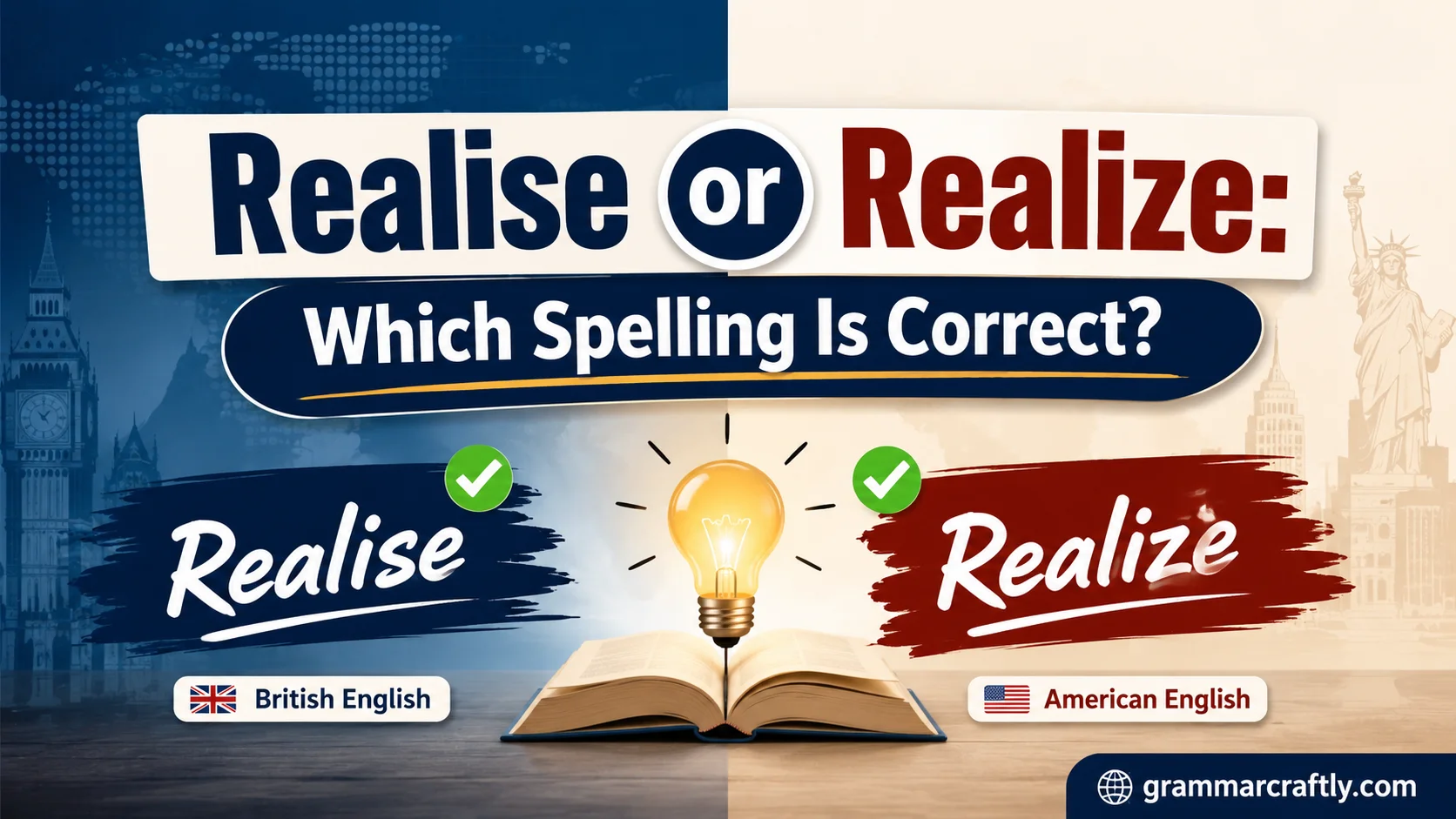
Realise or Realize are accepted English spellings used worldwide, helping writers choose clear and correct language with confidence. Both forms are correct, interchangeable, and common across the English-speaking world.
While realize preferred is standard in American English, Canadian English, the United States, and North America, realise preferred remains popular in British English, Australian English, New Zealand English, the United Kingdom, the U.K., and Australasia. Their spelling distinction, spelling variant, regional spelling, and British vs American spelling differences reflect the rich history of the English language. As a verb, its derivatives include realised, realized, realising, realizing, realisation, and realization.
Historical evidence from Google Books, ngram, and major dictionaries such as Oxford, Cambridge, and Collins highlights changing usage, popularity, and language preferences from 1800 through the 21st century. For professional writing, email writing, essays, blogging, and social media, choosing one spelling and using it consistently improves grammatical accuracy, communication, and writing skills. Fixed spellings like surmise, improvisation, televise, and surprise also remind readers that English spelling follows historical and etymological patterns rooted in Ancient Greek, Greek, and Latin traditions.
The Quick Answer: Realise or Realize?
Both realise and realize mean exactly the same thing.
They share the same pronunciation, definition, and grammatical function.
SpellingPrimary UsageRealizeAmerican EnglishRealiseBritish English (most common)RealizeAlso accepted in some British English style guides
In simple terms:
- If you’re writing for an American audience, use realize.
- If you’re writing for a British audience, realise is usually preferred.
- Both spellings are considered correct English.
Example Sentences
- I didn’t realize how difficult the project would be.
- She suddenly realised she had left her keys at home.
The meaning remains identical.
Why This Question Confuses So Many Writers
Many spelling differences between British and American English follow clear patterns.
For example:
British EnglishAmerican EnglishColourColorFavouriteFavoriteCentreCenterTheatreTheater
The confusion begins because realize doesn’t fit neatly into these patterns.
Many people assume:
“Words ending in -ize are American and words ending in -ise are British.”
That isn’t entirely true.
In fact, many British publishers, universities, and dictionaries accept realize as perfectly correct British English.
This surprises a lot of writers.
The result is widespread confusion across blogs, websites, academic papers, and business communications.
The Surprising History Behind Realise and Realize
To understand why both spellings exist, it helps to look at the word’s origins.
The word realize traces its roots through French and Medieval Latin to Greek linguistic structures.
Historically, the suffix -ize comes from the Greek ending -izein, meaning:
- To make
- To become
- To cause
Because of this Greek influence, many language scholars argue that -ize is actually the older spelling.
Interestingly, Oxford English Dictionary traditionally favors -ize endings.
That means words such as:
- Realize
- Organize
- Recognize
- Civilize
have long historical support within British English itself.
The spelling -ise became increasingly popular over time because of French influence and changing publishing preferences.
Today, both forms coexist.
Is Realize Actually Wrong in British English?
This is one of the biggest myths surrounding the debate.
The answer is simple:
No. Realize is not wrong in British English.
Many people mistakenly believe that British English exclusively uses realise.
However, respected British sources often accept both spellings.
Oxford English Preference
Oxford University Press traditionally prefers:
- Realize
- Organize
- Recognize
rather than:
- Realise
- Organise
- Recognise
This convention is sometimes called Oxford spelling.
Why Many British Publications Still Use Realise
Despite Oxford’s preference, numerous British newspapers, schools, businesses, and publishers choose -ise endings because they align with modern British conventions.
As a result, British readers tend to encounter realise more often than realize.
Both remain correct.
Consistency matters more than choosing one over the other.
Realise vs Realize Around the World
English is a global language spoken by hundreds of millions of people.
Different regions favor different spellings.
Global Usage Table
CountryPreferred FormUnited StatesRealizeCanadaMostly RealizeUnited KingdomMostly RealiseAustraliaRealiseNew ZealandRealiseIrelandRealiseSouth AfricaRealise
Although preferences vary, readers generally understand both spellings without difficulty.
Meaning and Definition of Realise and Realize
The verb means:
- To become aware of something
- To understand something clearly
- To achieve something
- To make something real
Examples
Becoming Aware
“I suddenly realized the meeting had already started.”
Understanding
“He realized the importance of saving money.”
Achieving
“She realized her dream of becoming a doctor.”
Making Real
“The company realized significant profits last year.”
The meaning never changes based on spelling.
Realise vs Realize in Everyday Writing
Most writers encounter this choice in daily communication.
In Emails
American company:
We realize your time is valuable.
British company:
We realise your time is valuable.
In Blog Posts
Consistency creates professionalism.
Switching between spellings can make content appear unedited.
In Social Media
Most audiences don’t notice the difference unless the spelling conflicts with regional expectations.
In Text Messages
Either form works.
People generally focus on meaning rather than spelling preferences.
Real Examples From Professional Publications
Examining real-world usage helps clarify the issue.
American Publications
Commonly use:
- Realize
- Organize
- Recognize
Examples include:
- Major newspapers
- Business publications
- Academic journals
- Government documents
British Publications
Commonly use:
- Realise
- Organise
- Recognise
Examples include:
- Newspapers
- Publishing houses
- Educational materials
Oxford Publications
Often use:
- Realize
- Organize
- Recognize
This distinction highlights why the debate remains active today.
The Hidden Rule Most Writers Never Learn
Many writers assume every -ise word can become -ize.
That isn’t true.
Some words naturally take -ise only.
Words That Can Use -ize or -ise
Variant 1Variant 2RealizeRealirganizeOrganiseRecognizeRecogniseApologizeApologiseCivilizeCivilise
Words That Must Stay -ise
Correct FormSurpriseExerciseAdvertiseReviseSupervise
You cannot write:
- Surprize
- Exercize
- Advertize
Those forms are generally considered incorrect.
This distinction explains why English learners often struggle with spelling conventions.
Related Spelling Pairs You Should Know
If you’re researching realise or realize, you’ll likely encounter other British and American spelling differences.
Common Examples
British EnglishAmerican EnglishOrganirganizeRecogniseRecognizeApologiseApologizeAnalyseAnalyzeDefenceDefenseTravellingTravelingFavouriteFavoriteColourColor
Understanding these patterns helps maintain consistency across your writing.
How Editors Decide Which Version to Use
Professional editors rarely choose a spelling based on personal preference.
Instead, they follow style guides.
Common Editing Principles
Audience First
If the audience is American:
- Use realize.
If the audience is British:
- Use realise.
Follow Brand Guidelines
Many organizations establish spelling standards.
For example:
- International companies often choose one version globally.
- Publishers maintain house styles.
- Universities follow academic style guides.
Maintain Consistency
Consistency matters more than choosing a particular spelling.
Mixing versions creates confusion.
For example:
❌ The company realised it needed to organize resources.
✅ The company realised it needed to organise resources.
✅ The company realized it needed to organize resources.
Read More: Spiel or Schpiel? Origins, Meaning, Pronunciation,
Realise vs Realize in Academic Writing
Academic institutions often establish specific rules.
American Universities
Typically require:
- Realize
- Organize
- Recognize
British Universities
Requirements vary.
Some accept both.
Others prefer:
- Realise
- Organise
- Recognise
Students should always check:
- Department guidelines
- Thesis requirements
- Journal submission standards
A small spelling inconsistency can affect perceived professionalism.
Realise vs Realize in Business Communication
Businesses must communicate clearly across borders.
Consider a software company serving multiple countries.
Scenario
An American customer sees:
We realise your concerns.
Although understandable, it may appear unusual.
Likewise, a British customer reading:
We realize your concerns.
may recognize it as American English.
Neither spelling is wrong.
However, matching audience expectations improves trust.
Best Practice
Choose one style and apply it consistently across:
- Websites
- Emails
- Marketing materials
- Documentation
- Customer support content
Realise vs Realize in and Content Marketing
This is where the spelling choice becomes especially important.
Search behavior varies by region.
Keyword Searches
American users typically search:
- Realize meaning
- Realize definition
- Realize examples
British users often search:
- Realise meaning
- Realise definition
- Realise examples
Strategy
If your audience is primarily American:
Target:
- Realize
- Realize meaning
- Realize definition
If your audience is primarily British:
Target:
- Realise
- Realise meaning
- Realise definition
International Strategy
Many global websites include both variations naturally.
Example:
Whether you spell it “realise” or “realize,” both forms are accepted English spellings.
This approach captures broader search traffic.
Case Study: A Global Brand’s Spelling Challenge
Imagine an international educational platform serving students worldwide.
Originally, the company used American spelling throughout its website.
Traffic reports showed growing audiences from:
- Australia
- United Kingdom
- New Zealand
The marketing team tested localized pages.
Results
The UK-focused pages used:
- Realise
- Organise
- Recognise
User engagement increased because visitors felt the content aligned with local expectations.
Key Lesson
Localization can improve user experience even when meaning remains unchanged.
Common Mistakes Writers Make
Mixing British and American English
This is the most frequent error.
Example:
❌ Realise, organize, favourite, and center.
The styles conflict.
Assuming One Form Is Wrong
Many writers incorrectly believe:
- Realize is American only.
- Realise is British only.
Reality is more nuanced.
Ignoring Audience Expectations
Content feels more polished when spelling matches reader expectations.
Trusting Spellcheck Blindly
Different software programs use different language settings.
Always verify your chosen style.
Common Myths About Realise and Realize
Myth: Realize Is Only American English
False.
Oxford English supports realize.
Myth: Realise Is More Correct
False.
Both forms are correct.
Myth: Dictionaries Disagree
False.
Most major dictionaries recognize both spellings.
Myth: Readers Care Deeply About the Difference
Mostly false.
Readers care more about consistency and clarity.
Memory Tricks to Never Get It Wrong Again
Trick for American English
Think:
Americans usually prefer “-ize.”
Examples:
- Realize
- Organize
- Recognize
Trick for British English
Think:
British publications often favor “-ise.”
Examples:
- Realise
- Organise
- Recognise
The Easiest Rule
Match the spelling style of your audience.
That’s all.
Quick Quiz: Test Your Understanding
Question 1
Which spelling is correct?
- Realise
- Realize
- Both
Answer: Both.
Question 2
Which spelling appears most often in American English?
Answer: Realize.
Question 3
Does Oxford English accept “realize”?
Answer: Yes.
Question 4
Should you mix realize and realise in the same article?
Answer: No.
Consistency is best.
Realise vs Realize Cheat Sheet
QuestionAnswerAre both correct?YesSame meaning?YesSame pronunciation?YesAmerican preference?RealizeBritish preference?Realixford preference?RealizeCan they be mixed?NoWhich matters most?Consistency
Final Verdict on Realise or Realize
The debate over realise or realize often sounds bigger than it really is.
Both spellings are correct. Both appear in respected publications. Both communicate the same meaning. The difference comes down to audience, style guide, and consistency.
If you’re writing for Americans, realize is usually the safest choice. If you’re writing for a British audience, realise will often feel more familiar. For international content, either version can work as long as you remain consistent throughout the piece.
The next time you encounter realise vs realize, you won’t need to wonder which spelling is right. Instead, you’ll know the better question to ask:
FAQs:
Is “realise” or “realize” more correct?
Neither is more correct than the other. Both spellings are accepted in English. “Realize” is preferred in American and Canadian English, while “realise” is more common in British, Australian, and New Zealand English.
Can I use “realize” in British English?
Yes. Although “realise” is more widely used in British publications, “realize” is also acceptable in British English and is supported by several major dictionaries and publishers.
Are “realise” and “realize” different in meaning?
No. They have exactly the same meaning and function as the same verb. The difference is purely regional spelling preference rather than meaning or grammar.
Which spelling should students and professionals use?
Use the spelling that matches your audience or style guide. If you’re writing for American readers, use “realize.” If you’re writing for British readers, “realise” is usually the better choice. Most importantly, stay consistent throughout your writing.
Do the spelling rules apply to related words?
Yes. The same pattern generally applies to related forms such as “realised/realized,” “realising/realizing,” and “realisation/realization.” Match the form to the variety of English you are using.
Conclusion:
The choice between “realise” and “realize” isn’t about right or wrong—it’s about knowing your audience and writing consistently. Both spellings have a long history and remain correct in modern English. Understanding their regional preferences will help you communicate more clearly, whether you’re writing an academic essay, a professional email, or an online post. Once you choose the spelling that fits your readers, use it consistently and confidently throughout your work.