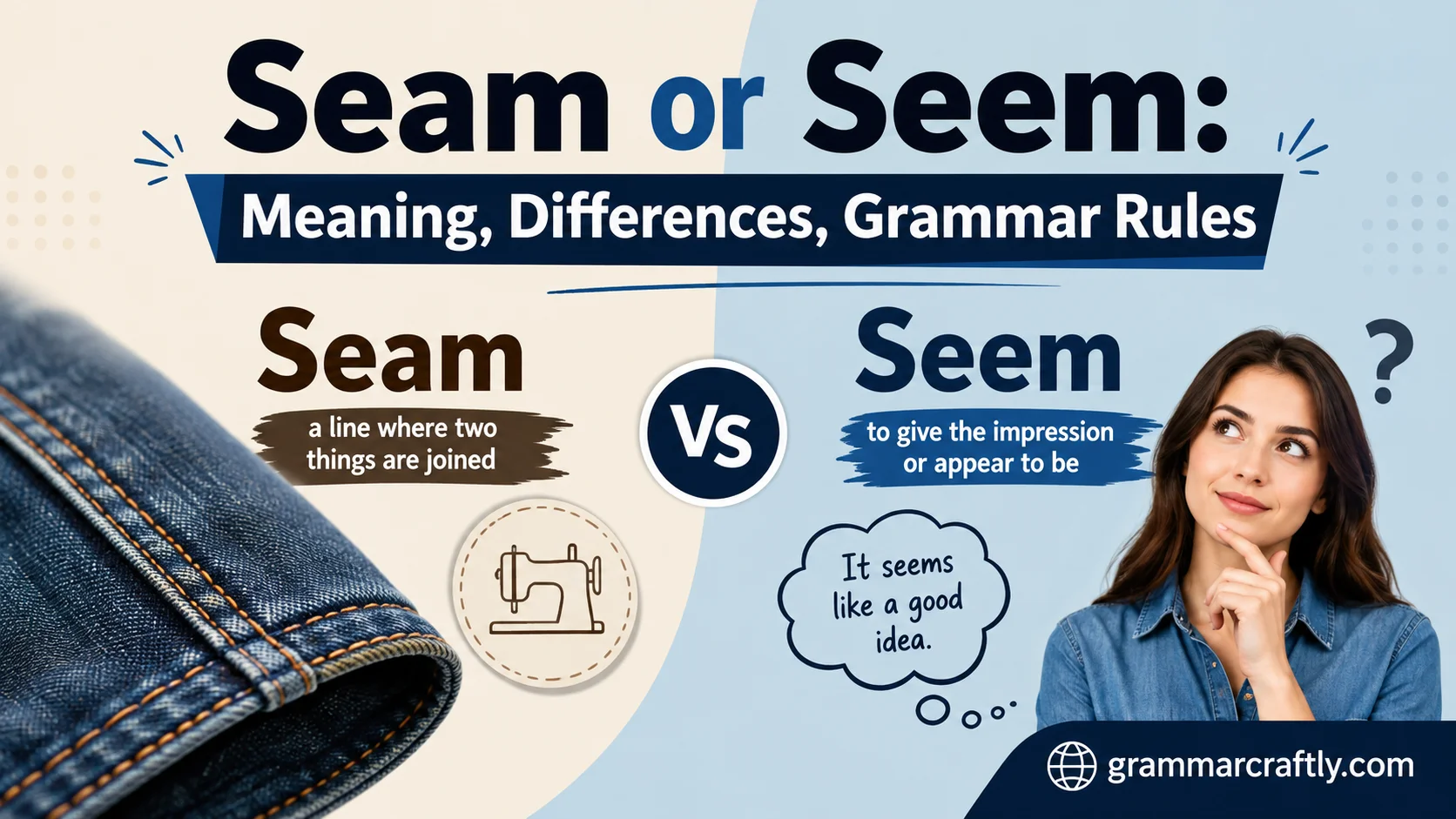
Seam or Seem: Meaning, Differences, Grammar Rules helps explain how a seam joins material, while seem means something appears in English clearly.
When referring to a seam, think of a joint where two pieces of material meet. The term is often associated with fabric, metal, or wood that has been stitched or fused together. In sewing, upholstery, and carpentry, a seam shows where materials connect. It relates to the place where one piece joins another, and stitching may create that connection. Seams can appear in clothing, furniture, and manufactured objects, giving the word a concrete meaning. From my experience, connecting the word with a physical join makes the difference much clearer.
The main confusion comes from the fact that seam and seem sound exactly the same, although they have different meanings and grammatical roles. They are homophones, which means writers can accidentally use one when they mean the other. If you write it seams, you probably mean it seems. Seems means “appears,” as in “It seems easy,” while seams describes joins or stitching. The words sound alike but are completely different in meaning. Fortunately, this distinction is easy to learn when you understand how each word works in an everyday sentence.
“Let’s dive in”
Seam or Seem at a Glance
Before diving deeper, here’s a quick comparison.
| Feature | Seam | Seem |
| Part of Speech | Noun (occasionally a verb) | Verb |
| Pronunciation | /siːm/ | /siːm/ |
| Meaning | A line where two things join together | To appear or give an impression |
| Common Usage | Clothing, construction, sports | Conversation, writing, descriptions |
| Example | The seam ripped open. | You seem happy today. |
Quick Tip
- If you’re talking about something being joined together, use seam.
- If you’re talking about appearance or impressions, use seem.
Are Seam and Seem Homophones?
Yes. Seam and seem are homophones because they have identical pronunciations but different spellings and meanings.
This similarity causes spelling mistakes even among fluent English speakers.
For example:
- The jacket has a loose seam.
- The jacket doesn’t seem expensive.
Although both words sound the same, they belong in completely different contexts.
Why They’re Often Confused
People confuse these words because:
- They sound identical.
- Spell check may not catch the mistake.
- Both frequently appear in everyday writing.
- English learners often rely on pronunciation when spelling words.
Remember this simple fact:
Homophones sound alike but aren’t alike.
What Does Seam Mean?
The word seam refers to a line where two things join together. You’ll commonly encounter it in sewing, fashion, construction, geology, and sports.
Common Definitions of Seam
A seam can mean:
- The stitched line joining two pieces of fabric
- A layer or vein of material underground
- A visible line where two surfaces meet
- The raised stitching on certain sports balls
Examples of Seam
- The seam on my shirt needs repairing.
- Coal miners discovered a large coal seam underground.
- The wallpaper seam is almost invisible.
- The cricket ball’s seam affects how it moves in the air.
Common Collocations
You’ll frequently find these expressions:
- Seam allowance
- Side seam
- Shoulder seam
- Hidden seam
- Coal seam
- Seam line
- Split at the seams
- Burst at the seams
Seam in Different Industries
| Industry | Meaning |
| Fashion | Joining line in clothing |
| Construction | Meeting point of materials |
| Sports | Raised stitching on balls |
| Mining | Underground mineral layer |
| Manufacturing | Connection between surfaces |
Although seam most commonly appears as a noun, it can occasionally function as a verb.
- Workers carefully seamed the material together.
However, noun usage is far more common in modern English.
What Does Seem Mean?
Unlike seam, seem is always a verb. It describes appearances, impressions, assumptions, or perceptions.
Simple Definition
Seem means:
To appear to be something without stating it as absolute fact.
Consider these examples:
- You seem tired today.
- The movie seems interesting.
- Everything seems fine now.
- It seems that we’re early.
Notice something important. The speaker isn’t stating facts with complete certainty. They’re describing impressions.
Common Sentence Patterns
You’ll often see:
- Seem + adjective
- Seem + infinitive
- Seem + clause
Seem + Adjective
- He seems nervous.
- The room seems quiet.
- She seems confident.
Seem + Infinitive
- They seem to understand.
- He seems to agree.
- She seems to enjoy her work.
Seem + Clause
- It seems that everyone arrived early.
- It seems that the weather will improve tomorrow.
These patterns appear frequently in formal and informal English.
Seam vs. Seem: What’s the Difference?
The easiest way to remember their difference is this:
| Question | Use |
| Is something joined together? | Seam |
| Does something appear a certain way? | Seem |
Compare These Examples
| Incorrect | Correct |
| You seam happy today. | You seem happy today. |
| The shirt doesn’t seem properly stitched. | The shirt doesn’t have a proper seam. |
| The dress has a beautiful seem. | The dress has a beautiful seam. |
| It seams impossible. | It seems impossible. |
Although the spelling mistake may look minor, it changes the entire meaning of a sentence.
How Native Speakers Use Seam and Seem
Native speakers use seem far more frequently than seam because it appears naturally in conversations.
Everyday Examples of Seem
- You seem excited.
- That seems reasonable.
- This doesn’t seem right.
- Everything seems under control.
- It seems like a good idea.
Everyday Examples of Seam
- The seam ripped after one wash.
- Check the seam before buying the jacket.
- The baseball’s seam affects its movement.
- This pillow has reinforced seams.
The context immediately tells native speakers which word belongs in the sentence.
Read More: Crier vs. Cryer: Which Is Correct, Why It Matters
Popular Expressions Using Seem
Several common English expressions use seem.
Frequently Used Phrases
- It seems like…
- It seems that…
- Doesn’t seem possible
- You seem familiar
- Things aren’t always what they seem
- That seems fair
- Everything seems fine
Examples
Things aren’t always what they seem.
This expression reminds us that appearances can sometimes be misleading.
You seem happier these days.
Here, the speaker is making an observation rather than stating a proven fact.
It seems impossible at first.
Again, we’re discussing impressions instead of certainty.
Popular Expressions Using Seam
The word seam also appears in many expressions.
Common Examples
- Split at the seams
- Burst at the seams
- Seam allowance
- Hidden seam
- Side seam
- Seam line
- Coal seam
Figurative Expressions
The stadium was bursting at the seams.
This expression means:
Extremely crowded or completely full.
Examples include:
- The concert hall was bursting at the seams.
- The restaurant was split at the seams during the festival.
- Their small office is bursting at the seams after hiring fifty employees.
These figurative uses make English both colorful and memorable.
Grammar Rules You Should Know
Understanding the grammar behind these words prevents most writing mistakes.
Seam Grammar Rules
- Usually functions as a noun.
- Refers to physical joining points.
- Often follows articles like a, an, or the.
Examples:
- The seam is coming apart.
- A seam runs along both sides.
- The hidden seam looks perfect.
Seem Grammar Rules
- Functions only as a verb.
- Describes appearances and perceptions.
- Frequently appears with adjectives and infinitives.
Examples:
- They seem prepared.
- She seems to understand.
- It seems impossible.
Helpful Formula
| Formula | Example |
| Seem + adjective | He seems nervous. |
| Seem + infinitive | She seems to know everyone. |
| It seems + clause | It seems that we were mistaken. |
| The + seam | The seam has opened. |
| A + seam | A small seam is visible. |
Common Mistakes and How to Avoid Them
Many spelling errors happen because writers focus on pronunciation rather than meaning.
Incorrect Usage
- You seam upset.
Correct version:
- You seem upset.
- The jacket has a damaged seem.
Correct version:
- The jacket has a damaged seam.
- It seams difficult.
Correct version:
- It seems difficult.
Why Spell Check Misses These Errors
Spell check programs often fail because:
- Seam is correctly spelled.
- Seem is correctly spelled.
- Both are legitimate English words.
The software cannot determine which meaning you intended.
That’s why proofreading remains essential.
Easy Memory Tricks You’ll Actually Remember
Simple memory techniques make these words much easier to remember.
Trick One
SEEM = SEE
Both begin with “SEE.”
If something seems, you’re describing how it appears or how you see it.
You seem confident.
You’re describing what you observe.
Trick Two
SEAM = SEW
Both words relate to clothing and stitching.
Seam = sewing = stitching.
If something is physically joined together, choose seam.
Trick Three
Ask yourself one question.
Is this sentence talking about appearance or connection?
If it’s about:
- Appearance → Seem
- Connection → Seam
This quick test solves most problems instantly.
Words Commonly Confused With Seam and Seem
English contains many confusing homophones.
Related Words
| Word | Meaning |
| Seam | Joining line |
| Seem | To appear |
| Seen | Past participle of see |
| Scene | Place or setting |
| Sew | To stitch |
| Steam | Water vapor |
| Team | Group of people |
| Beam | Long piece of wood or metal |
Compare these examples:
- I have seen that movie.
- The opening scene was incredible.
- Please sew the button carefully.
- The room filled with steam.
Learning these distinctions improves both spelling and vocabulary.
Real-Life Usage Examples
Workplace Examples
- You seem prepared for the presentation.
- The report seems accurate.
- The chair’s seam needs repairing.
Academic Examples
- The results seem consistent with previous studies.
- Scientists discovered a coal seam beneath the region.
- The findings seem significant.
Everyday Conversations
- You seem busy today.
- This coffee seems unusually strong.
- The bag’s seam has torn again.
Travel Examples
- Everything seems organized.
- The suitcase seam ripped during the flight.
- The hotel seems wonderful.
Notice how naturally both words appear once their meanings become clear.
Mini Case Study: Why Context Matters
Consider these two sentences:
- The dress has a damaged seam.
- The dress seems expensive.
Both involve the same object. Yet each sentence communicates something entirely different.
The first describes:
A physical feature of the dress.
The second describes:
An impression or opinion about the dress.
One small spelling change completely alters the meaning.
This demonstrates why understanding context matters more than memorizing definitions alone.
Practice Quiz
Choose the correct word.
Questions
- The jacket’s ______ has opened.
- You ______ unusually cheerful today.
- The stadium was bursting at the ______.
- It ______ impossible to finish tonight.
- The pillow’s side ______ needs repairing.
Answers
- Seam
- Seem
- Seams
- Seems
- Seam
If you answered all five correctly, you’ve mastered the basics.
FAQs:
What is the difference between seam and seem?
Seam refers to a joint where two pieces of material are joined, often through stitching. Seem is a verb meaning to appear or give a particular impression.
Is “it seams” or “it seems” correct?
“It seems” is correct when you mean “it appears.” For example, “It seems like a good idea.” “It seams” would only make sense when referring to physical seams.
Are seam and seem homophones?
Yes. Seam and seem are homophones because they have the same pronunciation but different spellings and meanings.
How can I remember seam vs. seem?
Think of a seam as something you can physically see in fabric, clothing, or another material. Seem connects to an idea that appears to be true.
What is an example of seam in a sentence?
You could say, “The seam in my jacket started to come apart.” Here, seam refers to the stitched connection between pieces of fabric.
Conclusion:
Seam and seem sound alike, but they have completely different meanings and grammatical functions. Use seam for a physical join between materials, especially in sewing, upholstery, or construction. Use seem when something appears to be true. Once you connect seam with a physical joint and seem with appearance, choosing the correct word becomes much easier.