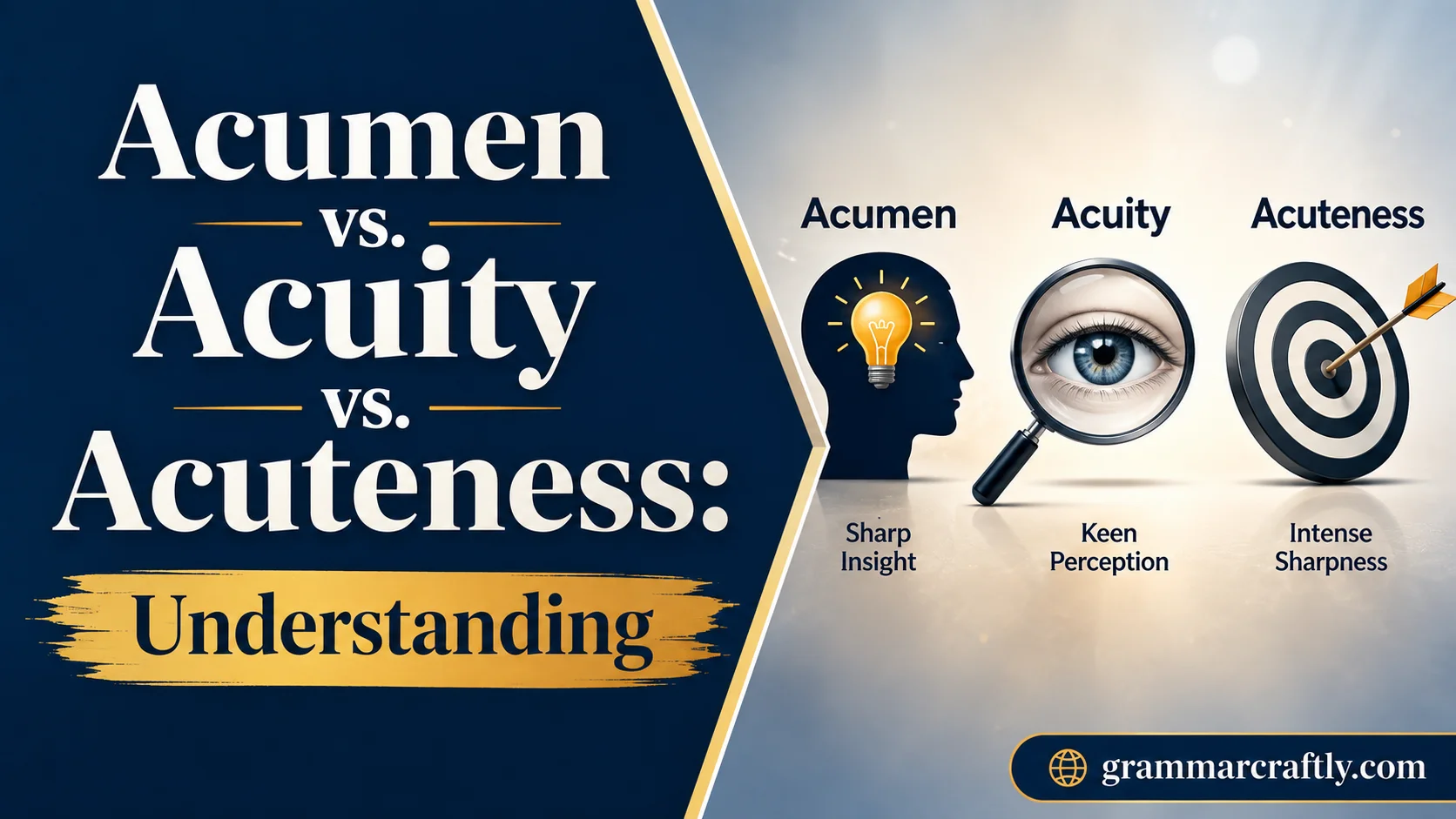
Acumen vs. Acuity vs. Acuteness: Understanding the Three Types of Sharpness clarifies how each term describes a different kind of sharpness.
Acuity means sharpness, keenness, or intensity in a particular sense, perception, or mental ability. In English, the term is defined as a quality of being acute, covering sensory and cognitive capacities. The word has roots in Latin and evolved through English usage, developing general and specialized meanings. In healthcare, its interpretation includes visual acuity, mental acuity, and sensory perception, showing its multifaceted nature. In nursing and other medical contexts, it is an important concept because a patient’s illness and level of care help nurses determine how closely a patient needs monitoring, the urgency of interventions, and the resources required for effective care. A clear definition, useful synonyms, and practical applications help nursing students improve assessment skills, interpret patient conditions accurately, and communicate effectively in clinical settings. A strong article or comprehensive overview can combine English dictionary explanations, medical applications, examples, and tools for measuring and understanding patient care.
Acumen shifts sharpness toward judgment and practical ability. It applies to decisions in business, politics, and life, where judgement, insight, and ability support quick decisions. A person with acumen may show keen perception, cognitive reasoning, clarity, intellect, and mental sharpness. In professional settings, this can support professional success, career advancement, and strategic leadership. A business executive who consistently makes smart decisions demonstrates acumen by combining knowledge, experience, skill, intuition, and capability to reach good judgments and sound decisions. Acumen stands apart from acuity while sharing a common thread of sharp thinking. Different forms of discernment, analytical reasoning, and insight help explain that distinction. Acumen also supports problem-solving, professional development, and effective communication, turning expertise into practical results, growth, performance, and recognition across stories, real-world layers, and intriguing scenarios.
The Concept of Sharpness in English
Many English words share common roots and meanings. The words acumen, acuity, and acuteness all originate from the Latin word acutus, meaning “sharp” or “pointed.”
However, English evolved these words into distinct concepts.
Think of sharpness as a large umbrella:
Sharpness │ ├── Acumen │ └── Judgment │ ├── Acuity │ └── Perception │ └── Acuteness └── Intensity
While each word reflects sharpness, they focus on different mental or physical qualities.
WordPrimary MeaningType of SharpnessAcumenGood judgment and decision-makingIntellectual SharpnessAcuitySharp perception or awarenessSensory or Mental SharpnessAcutenessSharp intensity or precisionObservational or Physical Sharpness
Understanding this framework makes it easier to choose the correct term in different situations.
Acumen: Sharp Judgment and Decision-Making
Acumen refers to the ability to make quick, accurate judgments and decisions. It is most often associated with business, leadership, finance, and strategic thinking.
Someone with strong acumen can analyze information efficiently and identify the best course of action.
Definition of Acumen
Acumen means:
The ability to make good judgments and quick decisions, especially in a particular domain.
Examples of Acumen
- She has remarkable business acumen.
- His financial acumen helped the company grow.
- The CEO’s strategic acumen impressed investors.
- Political acumen enabled her to navigate difficult negotiations.
Common Types of Acumen
- Business acumen
- Financial acumen
- Political acumen
- Leadership acumen
- Marketing acumen
- Entrepreneurial acumen
Characteristics of People with Acumen
People who possess acumen typically:
- Analyze situations quickly
- Recognize opportunities
- Understand risks
- Make informed decisions
- Think strategically
- Solve problems efficiently
Real-World Example
Consider Warren Buffett. His reputation largely stems from exceptional investment acumen. He evaluates companies, predicts long-term value, and makes decisions that consistently outperform many investors.
His success is not merely intelligence. It is the practical application of sound judgment.
Why Acumen Matters
Organizations actively seek individuals with strong acumen because they:
- Improve decision quality
- Reduce costly mistakes
- Increase profitability
- Strengthen leadership
- Support long-term growth
In professional environments, acumen is often more valuable than raw intelligence because it focuses on applying knowledge effectively.
Acuity: Sharp Senses and Mental Awareness
While acumen focuses on judgment, acuity focuses on perception.
A person with high acuity notices details that others miss. The word frequently appears in medicine, psychology, education, and cognitive science.
Definition of Acuity
Acuity means:
Sharpness or keenness of perception, thought, or vision.
Examples of Acuity
- The patient demonstrated excellent visual acuity.
- Her mental acuity remained strong throughout retirement.
- Detectives rely on observational acuity.
- The analyst’s acuity helped uncover market trends.
Common Forms of Acuity
TypeMeaningVisual AcuitySharpness of visionMental AcuitySharpness of thinkingAuditory AcuitySharpness of hearingSensory AcuityAwareness of sensory informationClinical AcuitySeverity of a patient’s condition
Visual Acuity in Medicine
One of the most common uses of acuity occurs in eye care.
Eye doctors measure visual acuity using charts.
Examples include:
- 20/20 vision
- 20/15 vision
- 20/40 vision
A person with 20/20 vision sees clearly at 20 feet what most people should see at that distance.
Mental Acuity
Mental acuity refers to cognitive sharpness.
People with high mental acuity often:
- Learn quickly
- Process information efficiently
- Remember details
- Solve complex problems
- Adapt to new situations
Case Study: Air Traffic Controllers
Air traffic controllers require extraordinary acuity.
Every day they monitor:
- Aircraft positions
- Weather conditions
- Flight paths
- Altitude changes
Their ability to perceive and process information rapidly helps ensure passenger safety.
Without high acuity, critical details could be missed.
Acuteness: Sharp Intensity and Precision
Acuteness is perhaps the least commonly understood of the three words.
It generally refers to intensity, precision, or sharpness of perception and observation.
Definition of Acuteness
Acuteness means:
The quality of being sharp, intense, severe, or highly perceptive.
Examples of Acuteness
- Doctors monitored the acuteness of the patient’s symptoms.
- The acuteness of her observations impressed the research team.
- The acuteness of the pain required immediate treatment.
- Historians praised his acuteness in analyzing documents.
Common Uses of Acuteness
- Acuteness of pain
- Acuteness of observation
- Acuteness of hearing
- Acuteness of intellect
- Acuteness of analysis
Acuteness in Healthcare
Healthcare professionals often discuss acute conditions.
Examples include:
Acute ConditionDescriptionAcute Asthma AttackSudden severe symptomsAcute InfectionRapid onset illnessAcute PainIntense short-term painAcute Stress ReactionImmediate response to trauma
In these situations, acuteness reflects intensity rather than decision-making or perception.
Acuteness in Research
Researchers frequently demonstrate acuteness when identifying subtle patterns.
For example:
A climate scientist may notice a tiny shift in temperature trends. That level of precise observation reflects analytical acuteness.
Read More: On a Call or In a Call? What Native English Speakers Actually Say
Acumen vs. Acuity vs. Acuteness Comparison Table
The easiest way to distinguish these words is through direct comparison.
| Feature | Acumen | Acuity | Acuteness | |——–|——–|——–| | Focus | Judgment | Perception | Intensity | | Common Context | Business | Medicine, Psychology | Observation, Severity | | Describes | Decision-making ability | Awareness and senses | Sharpness and precision | | Example Phrase | Business acumen | Visual acuity | Acuteness of pain | | Associated With | Strategy | Perception | Severity | | Professional Use | Leadership | Healthcare | Analysis |
Quick Memory Rule
- Acumen = Decisions
- Acuity = Perception
- Acuteness = Intensity
How Business Leaders Use Acumen
Business success often depends on sound judgment.
Leaders with strong acumen:
- Spot market opportunities
- Manage resources wisely
- Understand customer behavior
- Evaluate risk effectively
- Develop competitive strategies
Famous Example
Steve Jobs displayed extraordinary business and product acumen.
His ability to anticipate consumer desires helped Apple launch products that transformed entire industries.
Traits Associated with Business Acumen
- Strategic thinking
- Financial literacy
- Market awareness
- Leadership
- Communication skills
Many MBA programs specifically teach business acumen because it directly influences organizational performance.
How Doctors Use Acuity
Healthcare professionals frequently use the word acuity.
Patient Acuity
Hospitals often classify patients according to acuity levels.
Higher acuity patients require:
- More monitoring
- Specialized care
- Additional medical resources
Visual Acuity Testing
Eye examinations assess:
- Distance vision
- Reading vision
- Color recognition
- Depth perception
Visual acuity remains one of the most widely measured health indicators worldwide.
Why Acuity Matters in Healthcare
Strong diagnostic acuity allows physicians to:
- Detect diseases earlier
- Reduce misdiagnoses
- Improve treatment outcomes
- Save lives
A doctor’s success often depends on noticing details others overlook.
How Researchers Use Acuteness
Research requires more than intelligence.
It demands exceptional acuteness.
Scientists often examine:
- Tiny data changes
- Statistical patterns
- Experimental anomalies
- Emerging trends
Example
A researcher studying cancer treatments may identify a small but significant improvement in patient outcomes.
That discovery often stems from observational acuteness.
Skills Linked to Acuteness
- Attention to detail
- Critical thinking
- Pattern recognition
- Analytical reasoning
- Precision
Without acuteness, important discoveries might remain hidden.
Context-Based Examples of Acumen, Acuity, and Acuteness
The best way to learn these words is through context.
Business
✅ Her business acumen helped increase annual revenue.
❌ Her business acuity helped increase annual revenue.
Medicine
✅ The patient’s visual acuity improved after surgery.
❌ The patient’s visual acumen improved after surgery.
Observation
✅ The detective’s acuteness revealed inconsistencies in the testimony.
❌ The detective’s acumen revealed inconsistencies in the testimony.
Pain
✅ The acuteness of the injury required emergency care.
❌ The acuity of the injury required emergency care.
These examples demonstrate why choosing the correct word matters.
Choosing the Correct Word in Sentences
Use this simple guide.
Use Acumen When Talking About:
- Decision-making
- Business
- Leadership
- Finance
- Strategy
Examples:
- Financial acumen
- Political acumen
- Managerial acumen
Use Acuity When Talking About:
- Vision
- Hearing
- Awareness
- Perception
- Cognitive performance
Examples:
- Visual acuity
- Mental acuity
- Sensory acuity
Use Acuteness When Talking About:
- Severity
- Intensity
- Observation
- Precision
Examples:
- Acuteness of pain
- Acuteness of observation
- Acuteness of analysis
Mini Quiz: Test Your Understanding
Choose the correct word.
Question 1
The executive demonstrated remarkable ______ during negotiations.
Answer: Acumen
Question 2
The ophthalmologist tested the patient’s visual ______.
Answer: Acuity
Question 3
The ______ of the pain suggested immediate treatment.
Answer: Acuteness
Question 4
Her mental ______ allowed her to solve the puzzle quickly.
Answer: Acuity
Question 5
The entrepreneur’s ______ helped identify new market opportunities.
Answer: Acumen
Common Mistakes People Make
Many writers confuse these terms because they all relate to sharpness.
Mistake 1: Using Acuity for Business Decisions
Incorrect:
- She has great business acuity.
Correct:
- She has great business acumen.
Mistake 2: Using Acumen for Vision
Incorrect:
- His visual acumen is excellent.
Correct:
- His visual acuity is excellent.
Mistake 3: Ignoring Acuteness
Many writers overlook acuteness entirely.
However, it remains useful when discussing:
- Severe symptoms
- Sharp observations
- Precise analysis
Using it correctly can make your writing more accurate and sophisticated.
Synonyms and Related Terms
Acumen Synonyms
- Insight
- Judgment
- Expertise
- Intelligence
- Wisdom
- Shrewdness
Acuity Synonyms
- Perception
- Awareness
- Sharpness
- Alertness
- Discernment
Acuteness Synonyms
- Severity
- Intensity
- Precision
- Sharpness
- Penetration
Although some overlap exists, none of these synonyms fully replace the original terms in every context.
Expert Writing Tips for Using Acumen, Acuity, and Acuteness
Professional writers often follow a simple rule.
Ask yourself:
What kind of sharpness am I describing?
If the answer involves:
- Decisions → Acumen
- Perception → Acuity
- Intensity → Acuteness
You will almost always choose correctly.
Another Helpful Trick
Remember the keywords:
WordMemory TriggerAcumenActionable JudgmentAcuityAwarenessAcutenessIntensity
These associations make the distinctions much easier to remember.
FAQs:
1. What is the main difference between acumen, acuity, and acuteness?
Acumen usually refers to sharp judgment, practical ability, and good decision-making. Acuity refers to sharp perception, senses, or mental ability. Acuteness generally describes the degree or intensity of something, such as pain, severity, observation, or a problem.
2. Is acumen related to intelligence?
Yes. Acumen can involve intellect, insight, knowledge, and analytical reasoning, but it usually emphasizes the ability to understand situations and make sound judgments. Someone may have strong acumen in business, leadership, politics, or another professional area.
3. How is acuity used in medical contexts?
In healthcare, acuity often describes the seriousness or care needs associated with a patient’s condition. It can also refer to abilities such as visual acuity and mental acuity. Nurses and doctors use these ideas when assessing patients and determining appropriate monitoring and care.
4. What does acuteness mean?
Acuteness refers to the quality or degree of being acute. Depending on context, it can describe the intensity of pain, the severity of a problem, or the sharpness of observation. The exact meaning depends on how the word is used in a sentence.
5. Can acumen, acuity, and acuteness be used interchangeably?
Not usually. Although all three words are connected with the idea of sharpness, they emphasize different qualities. Use acumen for judgment and practical insight, acuity for perception or mental sharpness, and acuteness for intensity, severity, or a high degree of sharpness.
Conclusion:
Acumen, acuity, and acuteness share the basic idea of sharpness, but each word points to a different type. Acumen is most closely connected with judgment, insight, and practical decision-making. Acuity focuses on sharp perception, sensory ability, or mental awareness. Acuteness often describes intensity, severity, or a particularly sharp quality of observation.
Once you understand these differences, choosing the right word becomes much easier. Whether you’re discussing business leadership, medical care, sensory perception, scientific observation, or everyday communication, using acumen, acuity, and acuteness accurately can make your writing clearer and more precise.