Whole vs. Hole: What’s the Difference and Which One Should You Use? explains why these English words have the same sound but different meanings.
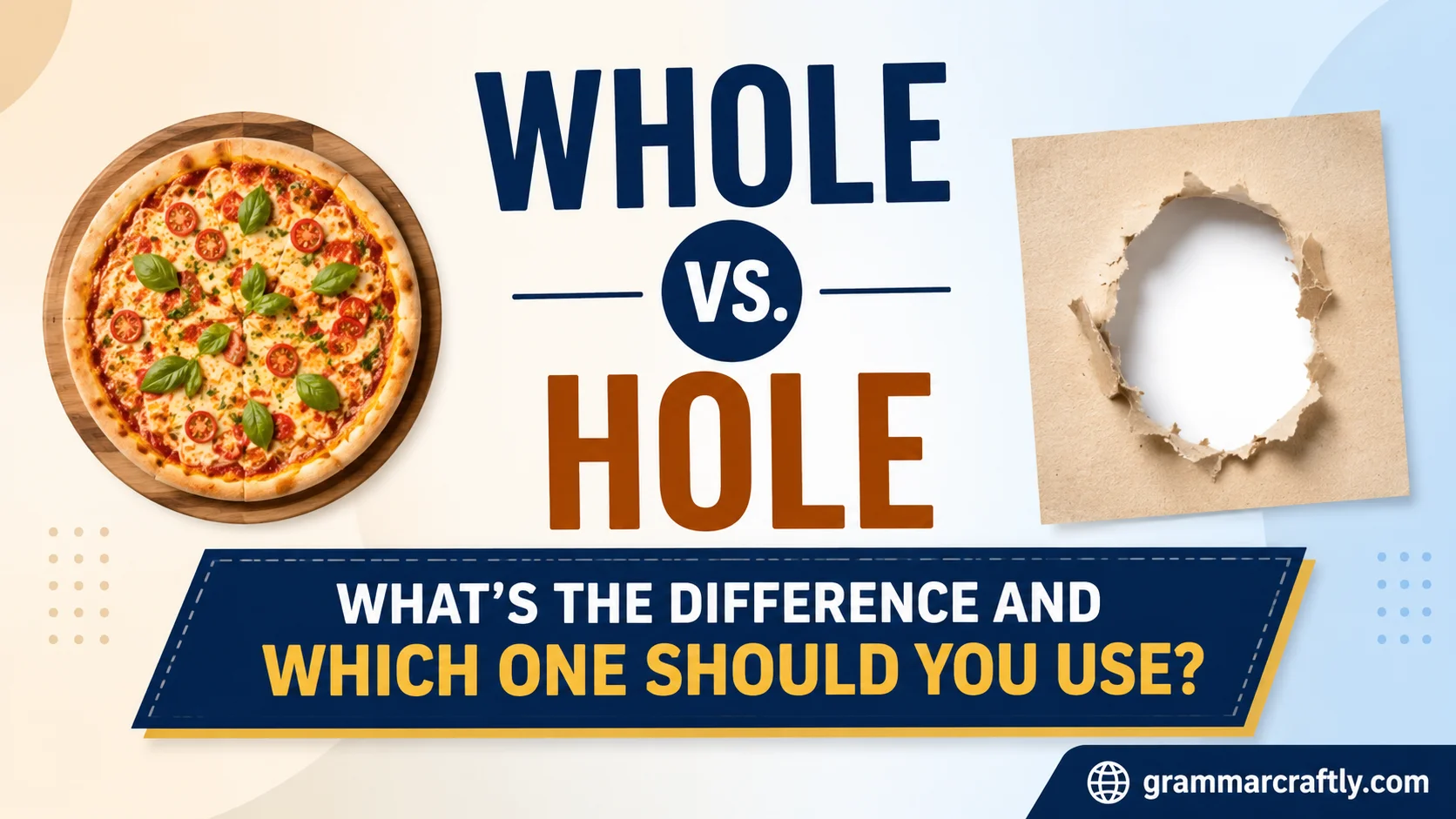
Whole and hole are homophones, so their similar sound can confuse learners worldwide. At first glance, the spelling difference seems small, but it can change the meaning of a sentence. Whole describes completeness, something complete, entire, or entirely together rather than divided into pieces. A whole pizza, for example, remains a single piece until it is shared. Hole, on the other hand, refers to a gap, void, or opening in material or a surface. An empty space caused by a missing part, such as a tear in a sock, is a hole. Their similarity in auditory form can create a linguistic maze of confusion.
From my experience helping seasoned learners, the real challenge begins when using each word in sentences at the right time. Understanding the context of each word helps you ensure you’re picking the correct one. Have you ever stopped mid-sentence and wondered whether to write whole or hole? You’re not alone because writers, students, and native speakers can occasionally mix them up. Imagine writing, “I ate the hole pizza,” instead of “I ate the whole pizza.” One suggests a hole inside the pizza, while the other means you ate it completely. When you think about the things each word describes, the path becomes clearer. Careful remembering can shed light on the difference. A wrong turn may cause a mental trip, but seeing how the two words sound alike makes their uses easier to understand.
Quick Answer: Whole or Hole?
The difference is simple:
WordMeaningExampleWholeComplete, entire, all of somethingI spent the whole day reading.HoleAn opening, gap, hollow space, or cavityThe dog dug a hole in the yard.
Quick Rule
- Use whole when talking about something complete or entire.
- Use hole when talking about an opening, gap, pit, or empty space.
Although they sound identical, their meanings are unrelated.
What Does “Whole” Mean?
The word whole refers to something complete, entire, unbroken, or containing all of its parts.
When you use whole, you’re talking about something that isn’t divided or missing pieces.
Examples of Whole
- She spent the whole afternoon studying.
- We watched the whole movie.
- The whole family attended the reunion.
- He ate a whole watermelon by himself.
- I understand the whole situation now.
In each example, whole means “all” or “complete.”
Common Meanings of Whole
Whole can refer to:
- An entire object
- A complete period of time
- A total group of people
- Something undamaged or intact
- A complete idea or concept
Common Synonyms of Whole
WholeSimilar WordsEntireCompleteTotalFullIntactUndividedUnbrokenComprehensive
Popular Expressions With Whole
Many everyday phrases use the word whole.
Examples include:
- Whole truth
- Whole grain
- Whole number
- Whole life
- Wholeheartedly
- As a whole
Example in Context
“The whole is often greater than the sum of its parts.”
This famous idea suggests that when individual pieces work together, they create something stronger and more valuable.
What Does “Hole” Mean?
A hole is an opening, hollow space, cavity, gap, or depression in a surface or object.
Unlike whole, which means complete, hole usually refers to a missing section.
Examples of Hole
- The rabbit disappeared into a hole.
- There’s a hole in my sock.
- Someone drilled a hole in the wall.
- The golfer hit the ball into the hole.
- Rainwater collected in a small hole near the road.
Common Types of Holes
You encounter holes every day.
Examples include:
- Golf holes
- Potholes
- Black holes
- Button holes
- Sinkholes
- Drill holes
- Animal burrows
Synonyms for Hole
HoleSimilar WordsGapOpeningHollowPitCavityCrackDepressionVoid
Example in Context
The construction crew filled the hole before paving the road.
Here, hole refers to a physical opening in the ground.
Whole vs. Hole: Side-by-Side Comparison
Sometimes the fastest way to learn is through comparison.
FeatureWholeHoleMeaningComplete or entireOpening or gapPart of SpeechAdjective, nounNounPronunciation/hoʊl//hoʊl/Spelling ClueStarts with “wh”Starts with “h”ExampleThe whole class attended.The hole was deep.Opposite MeaningCompleteMissing section
The contrast is clear:
Whole = Complete
Hole = Empty Space
Why Do People Confuse Whole and Hole?
The confusion happens because these words are homophones.
Homophones are words that sound the same but have different meanings and spellings.
Reasons for Confusion
Identical Pronunciation
Both words are pronounced:
/hoʊl/
When speaking, listeners rely on context rather than spelling.
Silent Letters
The W in whole is silent.
Because the W isn’t pronounced, whole sounds exactly like hole.
Fast Typing
People often type quickly and accidentally choose the wrong spelling.
Spellcheck Limitations
Spellcheck may not catch the mistake because both words are valid English words.
For example:
- Incorrect: I ate the hole cake.
- Correct: I ate the whole cake.
Spellcheck sees both words as correct spellings even though one is used incorrectly.
Are Whole and Hole Homophones?
Yes.
Whole and hole are classic examples of homophones.
What Is a Homophone?
A homophone is a word that:
- Sounds the same as another word
- Has a different meaning
- Usually has a different spelling
Other Common Homophones
Word 1Word 2TheirThereFlourFlowerRightWriteSeaSeeSonSunOneWonWholeHole
English contains hundreds of homophones, which is one reason spelling can be challenging.
Pronunciation Guide: Why Do Whole and Hole Sound the Same?
Although the spellings differ, the pronunciation remains identical.
Pronunciation
WordIPAWhole/hoʊl/Hole/hoʊl/
The silent W in whole comes from historical language changes.
Centuries ago, English speakers pronounced many silent letters. Over time, pronunciation evolved while spelling remained largely unchanged.
Similar Silent-Letter Words
- Write
- Wrong
- Wrist
- Wrap
- Whole
English spelling often preserves historical forms even after pronunciation changes.
Read More: Acumen vs. Acuity vs. Acuteness: Understanding
Whole Meaning and Usage in Everyday English
The word whole appears in countless situations.
Time
- The whole week
- The whole month
- The whole year
People
- The whole team
- The whole class
- The whole community
Objects
- A whole pie
- A whole sandwich
- A whole apple
Ideas
- The whole truth
- The whole story
- The whole picture
Example Paragraph
Imagine spending months planning a vacation. You save money, research destinations, and organize every detail. When someone asks about the trip, you might say:
“The whole experience was amazing.”
You’re referring to every part of the journey collectively.
Hole Meaning and Usage in Everyday English
The word hole appears in both literal and figurative contexts.
Physical Openings
- Hole in a wall
- Hole in a fence
- Hole in clothing
Natural Features
- Cave openings
- Animal burrows
- Sinkholes
Sports
- Golf hole
- Pocket in billiards
Scientific Contexts
- Black holes
- Electron holes
Example Paragraph
A gardener preparing a flower bed might dig several holes before planting seeds. Each hole serves a purpose by creating space for roots to grow.
Common Expressions Using Whole
English contains many expressions featuring whole.
Whole Truth
Meaning: Complete honesty.
Example:
Tell me the whole truth.
Whole Grain
Refers to grains containing all edible parts.
Examples:
- Whole wheat
- Whole oats
- Whole barley
Wholeheartedly
Meaning: With complete sincerity.
Example:
She wholeheartedly supported the project.
As a Whole
Meaning: Considering everything together.
Example:
The company performed well as a whole.
Common Expressions Using Hole
The word hole also appears in many idioms.
Hole in One
A golf shot that enters the hole with one stroke.
Hole in the Wall
A small, often hidden business.
Example:
We found a fantastic hole-in-the-wall restaurant.
Dig Yourself Into a Hole
Meaning: Create more problems through your actions.
Ace in the Hole
Meaning: A hidden advantage.
Burn a Hole in Your Pocket
Meaning: Strong desire to spend money.
Memory Tricks to Remember the Difference
Simple memory techniques make learning easier.
Trick #1: Whole Means Complete
Notice the word:
WHOLE
Think:
W = With Everything
If something contains all its parts, use whole.
Trick #2: Hole Looks Like an Opening
The letter O resembles a hole.
Think:
Hole = O = Opening
Trick #3: Missing vs Complete
Ask yourself:
- Is something complete? → Whole
- Is something missing? → Hole
The answer becomes obvious.
Common Mistakes and How to Avoid Them
Mistake #1
Incorrect:
I watched the hole show.
Correct:
I watched the whole show.
Mistake #2
Incorrect:
There is a whole in my shirt.
Correct:
There is a hole in my shirt.
Mistake #3
Incorrect:
The golfer reached the whole.
Correct:
The golfer reached the hole.
Editing Tip
Whenever you write one of these words, quickly ask:
“Am I talking about completeness or an opening?”
That question solves most mistakes instantly.
Real-Life Scenarios: Whole vs. Hole
At School
Correct:
- Read the whole chapter.
- A hole appeared in the science model.
At Work
Correct:
- The whole department attended.
- A hole was found in the budget plan.
At Home
Correct:
- We cleaned the whole house.
- The dog dug a hole in the backyard.
While Traveling
Correct:
- The whole trip was unforgettable.
- We noticed a hole in the road.
Context determines the correct word every time.
Etymology: Where Whole and Hole Came From
Understanding word origins can strengthen memory.
Origin of Whole
The word comes from Old English hal, meaning:
- Uninjured
- Complete
- Healthy
It shares roots with words like:
- Health
- Heal
- Wholesome
Origin of Hole
The word derives from Old English hol.
Its meaning involved:
- Hollow places
- Cavities
- Openings
Despite their similar pronunciation today, their histories developed separately.
Whole vs. Hole Quiz
Test your understanding.
Question 1
I spent the _____ afternoon reading.
A. Whole
B. Hole
Answer: Whole
Question 2
The rabbit ran into a _____.
A. Whole
B. Hole
Answer: Hole
Question 3
The _____ family attended dinner.
A. Whole
B. Hole
Answer: Whole
Question 4
There’s a _____ in my shoe.
A. Whole
B. Hole
Answer: Hole
Question 5
She told the _____ story.
A. Whole
B. Hole
Answer: Whole
Quick Reference Cheat Sheet
If You Mean…UseEntireWholeCompleteWholeTotalWholeOpeningHoleGapHolePitHoleCavityHole
Easy Formula
WHOLE = COMPLETE HOLE = OPENING
Keep this simple formula in mind and you’ll rarely make a mistake.
FAQs:
1. What is the difference between whole and hole?
Whole means complete or entire, while hole means a gap, opening, or empty space in something.
2. Are whole and hole homophones?
Yes. Whole and hole are homophones because they have the same pronunciation but different spellings and meanings.
3. How can I remember the difference between whole and hole?
Think of whole as something complete and hole as an opening. For example, a whole pizza is complete, while a hole can appear in a pizza box.
4. Which is correct: “the whole pizza” or “the hole pizza”?
The correct phrase is “the whole pizza” when you mean the entire pizza. “The hole pizza” would suggest a pizza with a hole.
5. Why do people confuse whole and hole?
People confuse them because they sound exactly alike. Their meanings and spellings are different, so paying attention to context helps you choose the correct word.
Conclusion:
Understanding whole vs. hole becomes much easier once you focus on their meanings instead of their pronunciation. Whole describes something complete, entire, or undivided, while hole refers to a gap, opening, or empty space. Because they are homophones, it’s easy to mix them up, but simple memory tricks and careful attention to context can help. When you’re unsure, ask yourself whether you’re talking about completeness or an opening. That quick check can help you choose the right word and make your writing clearer and more accurate.