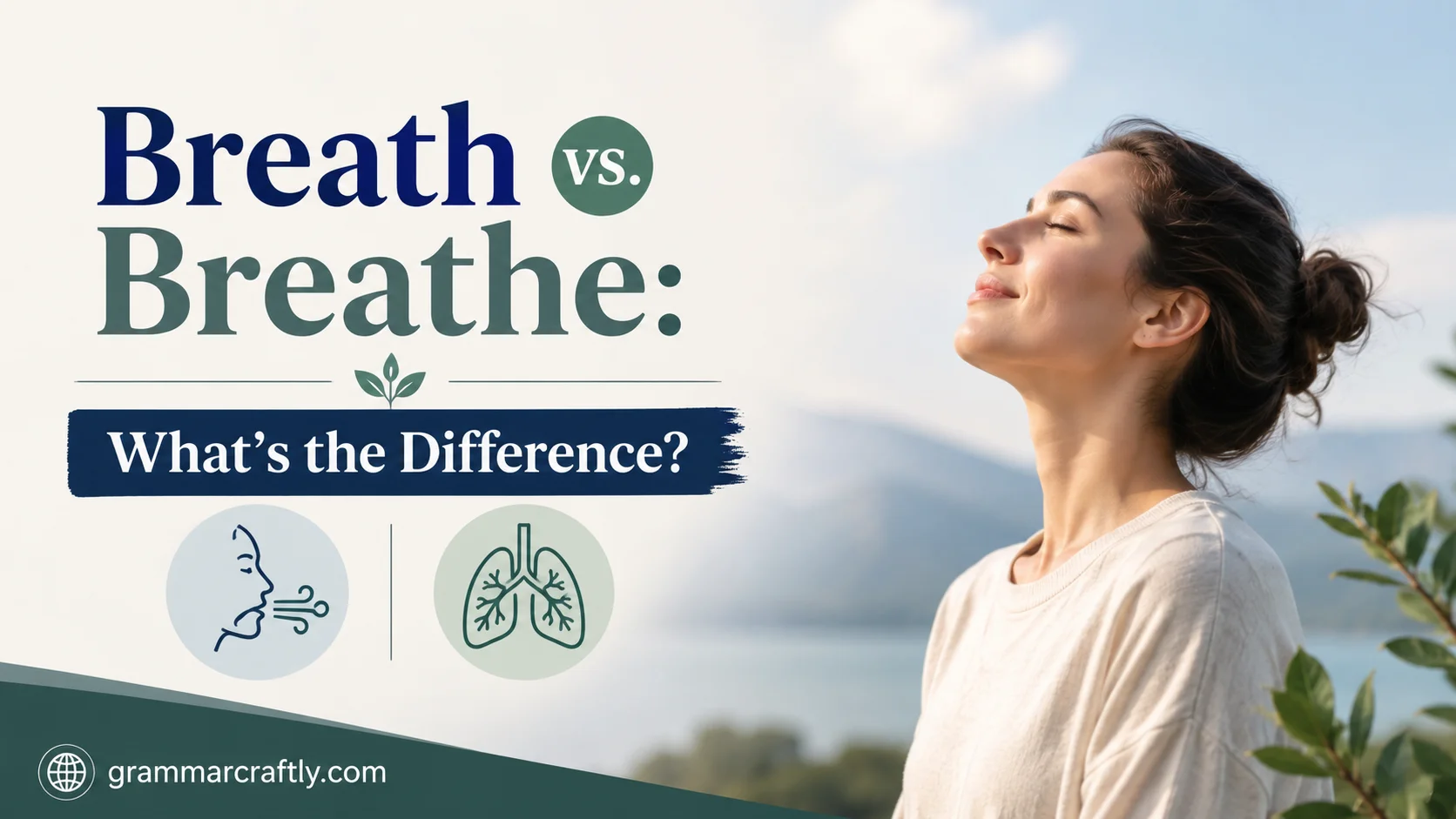
Breath vs. Breathe: What’s the Difference? breath vs breathe dilemma often confuses users; learners see confusion in usage when meaning and spelling look alike often confuses learners in English usage when spelling and meaning look alike in daily writing mistakes.
In real writing and speaking, the words breath and breathe stay similar, with similar spelling patterns, yet they show a clear difference and differences in usage and sentence usage. Many learners try to identify the pattern, but get confused because they are commonly mixed up in an article that defines, explains, and gives explanations of correct usage. The spellings, spelled, identical, and almost identical spellings still change their different roles, and they are pronounced differently in English and English language. This creates a dilemma, but when you focus on understanding and become understood, you improve knowing, correctly choosing words, and producing polished, extra polished, and more accomplished writing. A small tip like taking a deep breath, or take a deep breath, before you get started helps avoid simple spelling mistakes and make errors.
In real life usage, whether wherever you write, tools like Grammarly, grammar, and spelling and grammar check help reduce punctuation mistakes, while proofreads improve your text. This supports better control of idioms and noun/verb pairs such as walk, talk, sleep, dream, drink, cut, scratch, play, race, and smell, giving learners an advantage in progress with infinitive verbs and nouns. The idea of symmetry stays entrenched in our minds, sometimes jargony or new-sounding through functional shift. You might exhale and see steam from your mouth on a cold outside morning, even seeing steam, and still live with the dilemma, but you can settle it once and for all by learning correct use and when to use which word.
Why Breath vs Breathe Confuses So Many People
Let’s be honest. English does not always play fair.
The problem with breath vs breathe comes down to three things:
- A silent “e” that changes pronunciation
- Similar spelling that tricks your brain
- Fast writing habits that skip thinking time
When you speak, both words feel almost identical. That’s where mistakes start showing up in writing.
Here’s the key idea:
Breath is a noun. Breathe is a verb.
Simple. But memory doesn’t always cooperate under pressure.
Think of it like this. You don’t “do a breath.” You “take a breath.” And you don’t “breathe a thing.” You just breathe.
Let’s break it down properly so it sticks for good.
Breath Meaning Explained (The Noun in Breath vs Breathe)
The word breath refers to the air you inhale or exhale. It is a thing, not an action.
You can measure it. You can feel it. You can even hold it.
Simple definition
- Breath = a single amount of air taken into or released from the lungs
Everyday examples
- Take a deep breath before speaking
- Her breath smelled like coffee
- He held his breath underwater
What makes “breath” easy to spot
Ask yourself one question:
Can I touch it or count it?
If yes, you likely need breath.
Common contexts where “breath” appears
- Stress relief: deep breath, calming breath
- Health: short breath, labored breath
- Emotion: breath caught in throat
Quick analogy
Think of breath like a snapshot.
It captures one moment of air.
Like a photo, it freezes a single instance.
Breathe Meaning Explained (The Verb in Breath vs Breathe)
Now let’s switch gears.
Breathe is the action. It describes the process of taking air in and out of your lungs.
It never stops while you are alive.
Simple definition
- Breathe = to take air into and expel it from the lungs
Everyday examples
- I breathe slowly when I feel stressed
- She breathes deeply before yoga
- We breathe fresh air in the mountains
Grammar breakdown made simple
- Present: breathe
- Past: breathed
- Continuous: breathing
Why the “e” matters
The “e” signals action. It tells your brain something is happening.
Without it, the word becomes a noun.
Analogy that sticks
Think of breathe like a movie.
It shows motion, not a frozen moment.
Breath vs Breathe Side-by-Side Comparison
Seeing both words together clears up confusion fast.
| Feature | Breath | Breathe |
| Part of speech | Noun | Verb |
| Meaning | Air taken in or out | The act of taking air in and out |
| Action level | Static | Active |
| Example | Take a breath | I breathe deeply |
| Grammar role | Thing | Action |
| Memory trick | “a thing” | “a doing word” |
Quick rule to remember
- If you can count it → breath
- If you do it → breathe
Common Mistakes in Breath vs Breathe Usage
Even experienced writers slip up here. The mistake usually happens during fast writing or texting.
Mistake patterns
- Writing “I need to breath” ❌
- Writing “Take a deep breathe” ❌
- Mixing forms in casual speech
Why this happens
Your brain predicts words based on sound, not spelling.
Since both words sound similar, your fingers often choose the wrong one.
How to fix it instantly
Pause and ask:
- Is this something I do? → breathe
- Is this something I take or have? → breath
That one-second check solves most errors.
Idioms Using Breath and Breathe (And What They Really Mean)
English loves idioms. And both words appear in many common expressions.
Breath idioms
- Take a breath
- Pause and relax before reacting
- A breath of fresh air
- Something new and refreshing
- Hold your breath
- Wait anxiously for something
Breathe idioms
- Breathe easy
- Feel relief after stress
- Breathe down someone’s neck
- Watch someone too closely or pressure them
- Breathe life into something
- Revive or improve something weak
Real-life insight
Idioms often confuse learners because they don’t translate literally.
For example:
“Breathe easy” does not mean adjusting airflow. It means feeling calm again.
Real-World Examples of Breath vs Breathe
Let’s move from theory to real life. This is where everything clicks.
Casual conversation examples
- “Take a breath before you answer.”
- “I can’t breathe in this heat.”
- “Her breath shook as she spoke.”
Workplace writing examples
- “Let’s take a breath and review the data.”
- “We need to breathe new life into this project.”
- “The report showed shortness of breath in patients under stress.”
Social media usage
- “Deep breath. You got this.”
- “I finally feel like I can breathe again.”
These examples show how both words appear naturally in daily communication.
Memory Tricks for Breath vs Breathe
Here’s where things get fun and practical.
The “E = Action” trick
- breathe = verb = action = extra “e”
The counting trick
- breath = one thing you take
The sound trick
Say both aloud:
- breath = short, clipped sound
- breathe = longer sound with airflow
Visual trick
Imagine:
- breath = single bubble of air
- breathe = flowing stream of air
Mini Case Study: How Writers Fix Breath vs Breathe Errors
Let’s look at a real writing scenario.
Before correction
“I need to breath slowly when I feel nervous.”
After correction
“I need to breathe slowly when I feel nervous.”
What changed
The sentence shifted from noun confusion to correct action usage.
Why it matters
Small errors like this can:
- Reduce writing clarity
- Hurt credibility in professional content
- Confuse readers in instructions or health content
Key takeaway
One letter can change meaning completely. That is why precision matters.
SEO Insight: Why Breath vs Breathe Matters in Writing
Search engines reward clarity. When content uses grammar correctly, it improves:
- Readability score
- User engagement
- Keyword relevance
- Trust signals
People often search:
- “breath vs breathe difference”
- “how to use breath and breathe correctly”
- “breath or breathe grammar rule”
That means content targeting this topic must be crystal clear.
Quick Practice Section (Test Yourself)
Try filling in the blanks:
- Take a deep ___ before you speak
- I can’t ___ properly after running
- Her ___ was steady and calm
- We must ___ slowly during meditation
Answers
- breath
- breathe
- breath
- breathe
If you got all correct, the pattern is sticking.
Read More: Someday vs. Some Day – What’s the Difference?
Frequently Asked Questions About Breath vs Breathe
Why do people confuse breath and breathe so often?
Because both words sound almost identical. The silent “e” also tricks visual memory.
Is it “take a breath” or “take a breathe”?
It is take a breath. You take a thing, not perform an action on it.
What is the easiest way to remember the difference?
Think like this:
- breath = thing (noun)
- breathe = action (verb)
Can breath and breathe be used interchangeably?
No. They serve different grammatical roles. Swapping them changes meaning or breaks the sentence.
Is “breathe” always an action word?
Yes. It always describes the act of inhaling and exhaling air.
Final Summary: Mastering Breath vs Breathe Once and for All
The confusion between breath vs breathe fades once you lock in one idea:
- Breath = a thing you take
- Breathe = something you do
That small distinction carries big weight in writing, speech, and clarity.
Once you start noticing it in real life, you’ll see it everywhere. In conversations. In books. In social media posts.
And here’s the interesting part. Most people never fully master it until they consciously slow down and connect meaning to usage.
So next time you hesitate, pause for a second.
Ask yourself:
Am I talking about a thing or an action?
That single question keeps your writing sharp, natural, and confident.