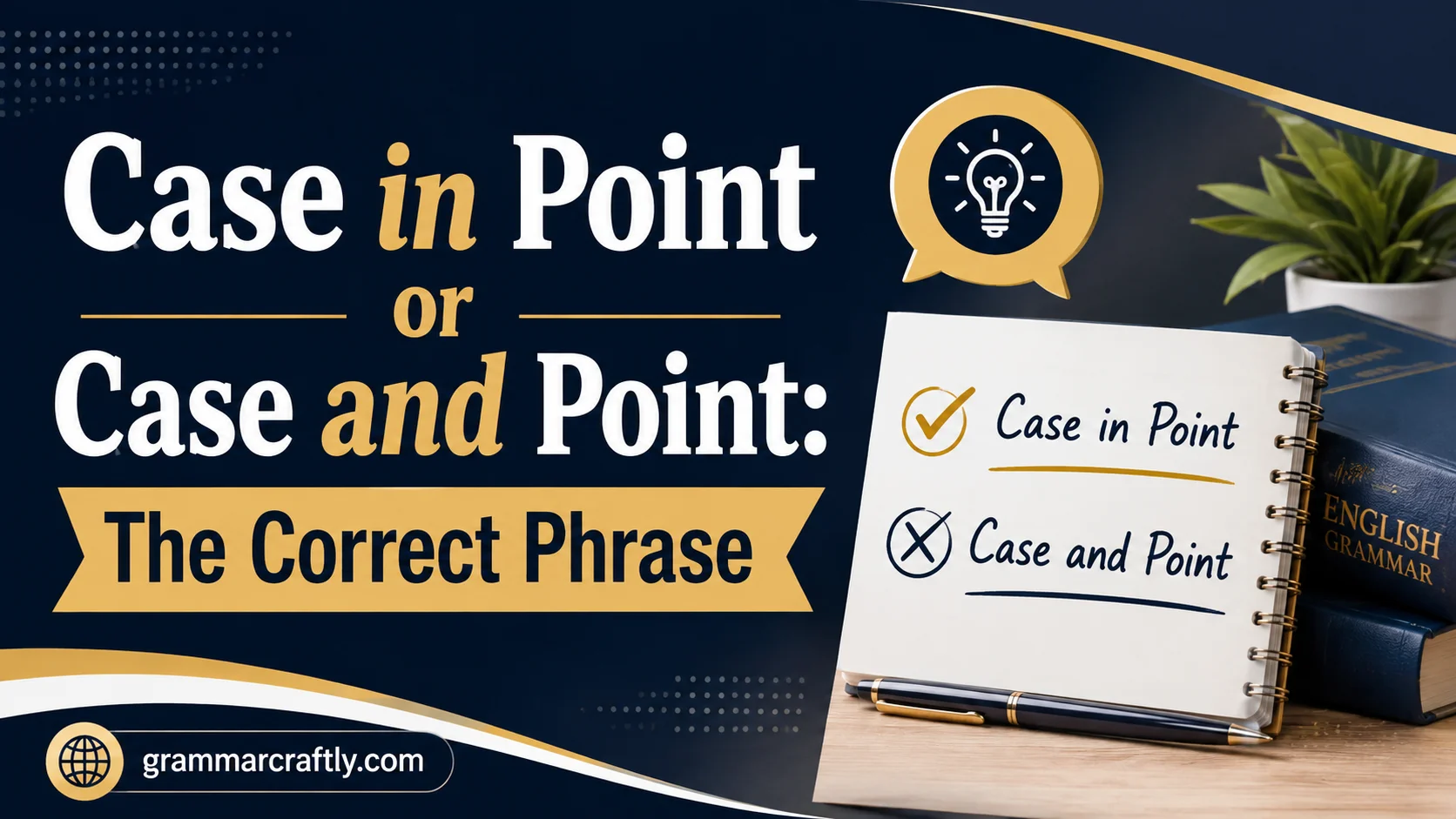
Case in Point or Case and Point: The Correct Phrase is easy to remember: use Case in Point when introducing a specific example that supports an idea or proves a point.
In my experience, many English speakers, students, and writers trip up because Case and Point sounds natural in spoken English, yet Case in Point is the correct phrase and accepted form. This small difference matters in professional writing, essays, presentations, news articles, and everyday conversations, where clear communication, proper usage, and strong phrase choice improve your English language skills.
A real-life instance makes the meaning easy to see: a local bakery that closed after six months because it underestimated operating costs is a case in point for the struggles faced by small businesses. This supporting example strengthens the larger statement and makes the argument clearer. Language experts recognize Case in Point as the correct expression, while Case and Point is a common mistake or misheard expression. Learning its origin, alternatives, and memory tricks can help you use it confidently in spoken communication and written communication.
“Let’s dive in”
Case in Point or Case and Point: Which Phrase Is Correct?
The correct phrase is:
✅ Case in point
The phrase “case and point” is incorrect in standard English. Although many native speakers mistakenly use it, dictionaries and style guides recognize “case in point” as the proper expression.
Here is a quick comparison:
| Phrase | Correct or Incorrect | Meaning |
| Case in point | ✅ Correct | A specific example that proves or supports an argument |
| Case and point | ❌ Incorrect | A commonly misheard version with no accepted meaning |
The confusion happens because the words “in” and “and” can sound similar during fast speech. When people hear the phrase repeatedly without seeing it written, they may assume the wrong spelling.
This type of mistake happens often in English. Similar examples include:
- For all intents and purposes (not “for all intensive purposes”)
- Couldn’t care less (not “could care less”)
- Should have (not “should of”)
Language is not always learned through textbooks. Many phrases spread through conversation first, which makes misunderstandings common.
What Does “Case in Point” Mean?
The phrase “case in point” means a specific example that clearly demonstrates or supports something being discussed.
In simple words, it means:
“Here is an example that proves what I’m talking about.”
The phrase connects a general idea with a particular situation.
For example:
Regular exercise improves mental health. Case in point: Many people report feeling less stressed after adding daily walks to their routines.
The first sentence makes a broad claim. The second sentence provides evidence through an example.
Breaking Down the Meaning of “Case in Point”
Each word contributes to the expression’s meaning:
| Word | Meaning in the Phrase |
| Case | A situation, example, or instance |
| In | Shows a connection between the example and the idea |
| Point | The argument, claim, or idea being explained |
Together, “case in point” describes a situation that illustrates a particular argument.
Think of it like a spotlight. Your main idea is standing on a stage, and the example shines a light on it so everyone can understand it better.
Why Do People Say “Case and Point”?
The incorrect phrase “case and point” exists because English speakers often rely on sound rather than spelling.
When someone says:
“Case in point…”
the word “in” can blend with surrounding sounds. In casual speech, it may sound closer to:
“Case ’n point…”
Over time, some listeners interpret the sound as “case and point.”
This mistake is known as a phonetic misunderstanding, where people write a word based on how it sounds rather than how it is actually spelled.
Common Reasons Behind the Mistake
People confuse case in point with case and point because:
- They learned the phrase through conversation instead of reading.
- The pronunciation makes “in” less noticeable.
- They connect the phrase with “point,” assuming two things are being joined.
- They confuse it with similar expressions.
However, the phrase does not mean a “case” and a “point.” It means a “case that is directly connected to a point.”
The Origin and History of “Case in Point”
The phrase “case in point” comes from older legal and academic language. Historically, the word “case” often referred to a legal situation or example presented as evidence.
Lawyers frequently used specific cases to support arguments. A relevant case could demonstrate why a particular claim was valid.
Over time, the phrase moved beyond legal settings and entered everyday English.
Today, people use “case in point” in many areas, including:
- Business discussions
- Academic writing
- Journalism
- Public speaking
- Everyday conversations
The phrase has remained popular because humans naturally understand ideas better when they have examples.
A person may forget a statistic, but a memorable example often stays in their mind.
How to Use “Case in Point” Correctly
Using “case in point” is simple once you understand its purpose. The phrase should introduce an example that supports the statement before it.
A common structure looks like this:
General statement + Case in point + Specific example
Example:
Technology has changed how people learn. Case in point: Online courses now allow students from around the world to access education without attending traditional classrooms.
The phrase works because the example directly supports the main idea.
Examples of “Case in Point” in Everyday Conversations
You can use “case in point” in casual conversations when you want to highlight proof or evidence.
Example 1: Discussing Health
Eating enough vegetables can improve overall health. Case in point: My friend lowered his cholesterol after changing his diet.
Example 2: Discussing Learning
Practice makes people better at almost anything. Case in point: Professional musicians spend years improving their skills.
Example 3: Discussing Technology
Smartphones have changed communication. Case in point: Many people now use messaging apps instead of traditional phone calls.
The phrase makes your explanation stronger because it moves from theory to reality.
Using “Case in Point” in Professional Writing
In professional environments, examples help readers understand complicated ideas quickly. That is why “case in point” appears often in reports, presentations, and articles.
For example:
Customer satisfaction directly affects business growth. Case in point: Companies with strong customer service often receive more repeat purchases.
The phrase works especially well when:
- Explaining a business strategy
- Supporting an argument
- Presenting research findings
- Introducing evidence
However, professional writers should avoid overusing it. If every paragraph begins with “case in point,” the phrase loses its impact.
Read More: Apportion vs. Portion vs. Proportion:
Case in Point vs. Example: What Is the Difference?
Many people wonder whether “case in point” is simply another way to say “example.” The two expressions are related, but they are not exactly the same.
| Expression | Meaning | Usage |
| Example | Any illustration or instance | General situations |
| Case in point | A specific example that proves a point | Supporting an argument |
Compare these sentences:
Example:
Dogs are popular pets. For example, many families own Labradors.
This gives information.
Case in point:
Dogs provide emotional support for many people. Case in point: Therapy dogs help patients in hospitals.
This example proves or strengthens the statement.
The key difference is purpose. A normal example simply explains something. A case in point reinforces an idea.
Case in Point vs. Point in Case: Are They the Same?
Another phrase that causes confusion is “point in case.”
Although some people use it, the standard expression is still:
✅ Case in point
The phrase “point in case” is generally considered incorrect or a mistaken reversal.
Here is the difference:
| Phrase | Status | Example |
| Case in point | ✅ Standard English | “The company’s success is a case in point.” |
| Point in case | ⚠️ Rare and usually incorrect | Avoid using it in formal writing |
| Case and point | ❌ Incorrect | Common misunderstanding |
When writing professionally, stick with “case in point.”
Common Mistakes People Make With “Case in Point”
Even though “case in point” is a simple phrase, many writers and speakers use it incorrectly. Most mistakes happen because people learn expressions through listening rather than reading.
Understanding these mistakes will help you use the phrase naturally and accurately.
Mistake: Writing “Case and Point”
The biggest mistake is replacing “in” with “and.”
Incorrect:
The company failed because it ignored customer feedback, case and point, its declining sales.
Correct:
The company failed because it ignored customer feedback. Case in point: Its declining sales showed the consequences.
The word “in” creates the connection between the example and the argument. The word “and” changes the meaning completely because it suggests two separate things are being connected.
Mistake: Using “Case in Point” Without Making a Point
The phrase should introduce an example that supports a previous idea. It should not appear randomly.
Weak usage:
I enjoy coffee. Case in point: My brother owns a bicycle.
The example has no connection to the statement. It does not prove anything.
Better:
I enjoy coffee because it helps me stay focused during work. Case in point: I finish my most difficult tasks after my morning cup.
The example strengthens the original idea.
Mistake: Using It When “For Example” Works Better
Sometimes writers use “case in point” when they simply need to provide a basic example.
For instance:
Many fruits contain vitamins. Case in point: Apples contain fiber.
This sentence sounds slightly unnatural because the second statement does not strongly prove the first one.
A better choice:
Many fruits contain vitamins. For example: Apples provide fiber and vitamin C.
Use “case in point” when the example carries more weight or demonstrates a bigger argument.
Mistake: Overusing the Expression
A strong phrase can become weak when repeated too often.
Imagine reading an article where every paragraph says:
- Case in point…
- Case in point…
- Case in point…
The phrase quickly loses its effect.
Professional writers usually mix it with alternatives such as:
- For example
- A clear illustration is
- This can be seen in
- Consider
- One example is
- This is demonstrated by
Variety keeps your writing fresh and natural.
Case in Point Examples in Business
Businesses often use examples to support claims about performance, customer behavior, and market trends.
Example:
Customer loyalty plays a major role in long-term success. Case in point: Companies that focus on customer experience often develop stronger relationships with buyers.
Another example:
Small changes can create major improvements in business operations. Case in point: A restaurant increased sales by simplifying its menu and reducing waste.
The phrase works well because the example demonstrates a larger business principle.
Case in Point Examples in Academic Writing
Students and researchers often use examples to support arguments. However, formal academic writing may require more precise transitions depending on the style guide.
Example:
Social media has transformed communication patterns. Case in point: Many businesses now use social platforms as their primary customer service channels.
Another example:
Historical events often influence modern society. Case in point: The invention of the internet changed how people access and share information.
Case in Point Examples in Everyday Speech
You do not need to use this phrase only in formal writing. It also works in regular conversations.
Example:
Learning a new skill takes patience. Case in point: My sister practiced the piano every day for a year before performing publicly.
Example:
Technology makes daily tasks easier. Case in point: Online banking allows people to manage money without visiting a branch.
Case in Point Examples in Essays and Articles
Writers often use this phrase when moving from a general discussion to a specific situation.
Example:
Climate change affects communities around the world. Case in point: Rising sea levels have forced some coastal areas to rethink future development.
Example:
Good leadership requires adaptability. Case in point: Successful companies often adjust their strategies during economic changes.
The phrase creates a smooth bridge between an idea and evidence.
FAQs:
Is “Case in Point” or “Case and Point” correct?
Case in Point is the correct phrase. It means a specific example that clearly supports or illustrates a statement. Case and Point is a common misheard expression, but it isn’t the standard form.
What does “Case in Point” mean?
Case in Point means an example that proves, supports, or demonstrates the idea you just mentioned. For example, “Many students struggle with time management. Case in point, Sara missed three deadlines this month.”
Why do people say “Case and Point”?
People often say Case and Point because the phrase sounds natural when spoken quickly. The words in and and can sound similar in casual speech, which makes this a common English mistake.
How do you use “Case in Point” in a sentence?
You can place Case in Point before a specific example: “Small businesses face many challenges. Case in point, the local bakery closed after six months because of rising costs.”
Is “Case in Point” appropriate for formal writing?
Yes. Case in Point works well in professional writing, essays, presentations, reports, and other formal contexts. It helps you introduce a relevant example without adding unnecessary explanation.
Conclusion:
Case in Point is the correct expression, while Case and Point is a common mistake caused by how the phrase sounds in everyday speech. When you want to introduce an example that supports your argument or illustrates an idea, choose Case in Point.
Once you understand the meaning and usage, the distinction becomes easy to remember. Think of it as a case “in” the point—an example contained within or directly connected to the point you’re making. Using the correct phrase will make your English writing and communication clearer and more polished.