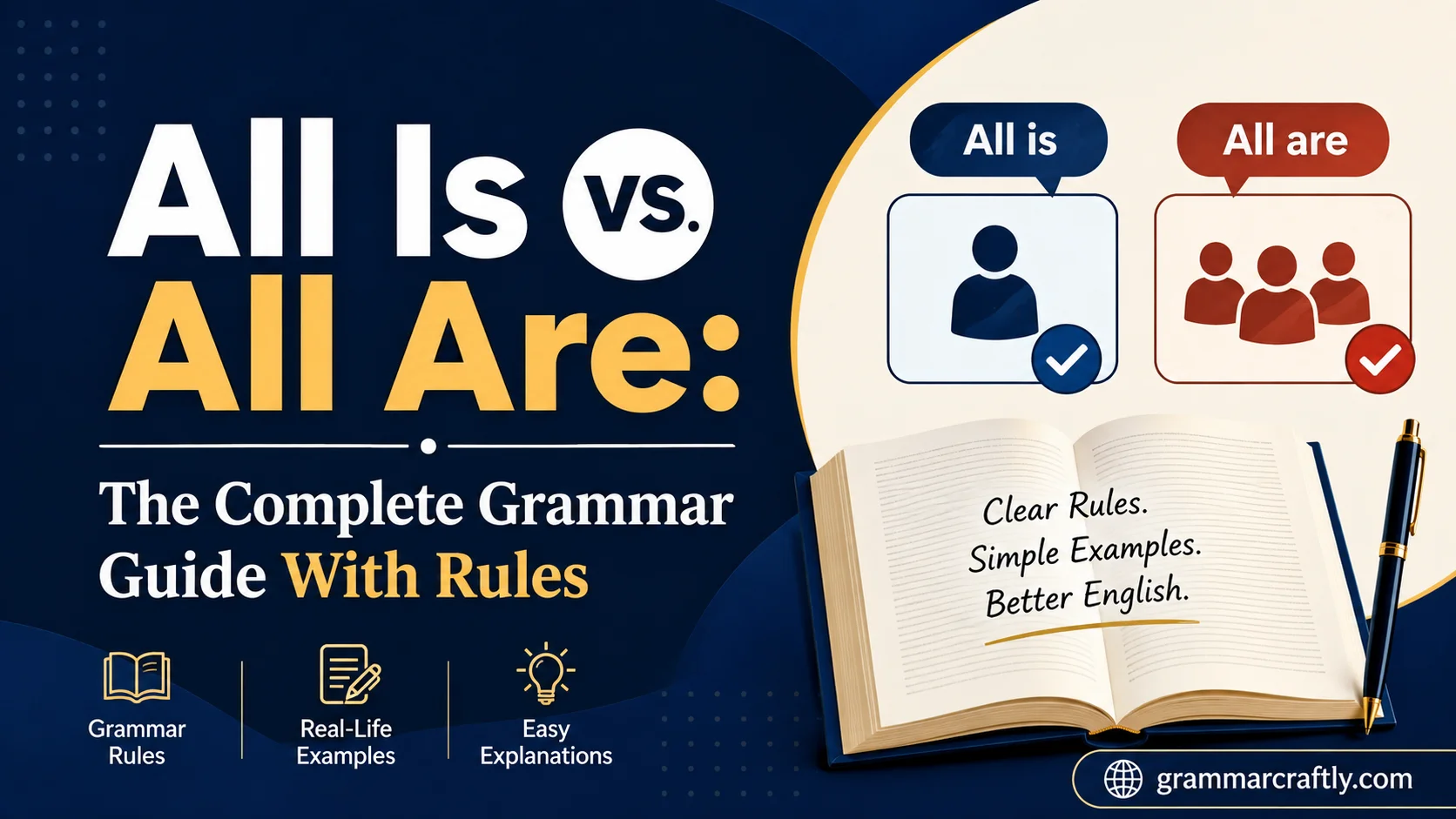
All Is vs. All Are: The Complete Grammar Guide With Rules, explains why this common grammar confusion depends on the subject and meaning of all.
For many people, all is and all are can cause a common grammar confusion because these words may sound similar, but their meanings and uses in the English language differ. The difference depends on the subject. When all points to one singular idea, single unit, group, or whole situation, all is can fit. When it refers to multiple subjects or multiple things, all are is usually the correct choice. The verb to be has conjugations such as is and are, showing existence, condition, state, or identity in simple sentences and complex sentences. English can feel like a tricky beast that throws a curveball, but once you know which form to use, you can avoid a simple mistake or glaring mistake. This matters to native speakers and English learners alike, because grammar, context, and verb tense form the backbone of effective communication.
When choosing between these expressions, pay attention to what follows all and what you are talking about. For example, all is well refers to a general sense or entirety, while all are welcome refers to multiple items or people, making are the correct choice because each individual person matters. Collective nouns describe a group, but the word itself may be treated as singular; in American English, this typically prefers is. Mass nouns represent something difficult to count, such as water or sand, so they commonly take is. The phrase a number of generally takes are, while a group of and a pair of take is, with the choice depending on the idea being conveying. These grammar rules, examples, and simple tricks make the two forms easier to understand, while subject-verb agreement helps you choose the right verb.
“Let’s dive in”
What Does “All” Mean in English?
Before learning the difference between all is vs. all are, it helps to understand how the word “all” functions.
The word “all” is a quantifier. A quantifier is a word that tells us about the amount or number of something. Other common quantifiers include:
- Some
- Many
- Few
- Every
- Each
- Several
“All” generally means the entire amount, the complete group, or every member of a group.
For example:
- All the cookies are gone.
- All the water is spilled.
- All students must submit their assignments.
Although the word stays the same, its meaning changes depending on the noun or idea it describes.
The Different Roles of “All”
The word “all” can appear in different grammatical roles.
All as a Determiner
A determiner comes before a noun and provides information about it.
Examples:
- All children need support.
- All books on this shelf belong to the library.
Here, “all” modifies the nouns children and books.
All as a Pronoun
A pronoun replaces a noun instead of appearing directly before it.
Examples:
- All is forgiven.
- All are welcome.
In these sentences, “all” stands alone and represents something understood from the context.
All as Part of a Phrase
“All” often appears in phrases such as:
- All of the money
- All of the people
- All of us
- All of them
The word following “all” usually determines whether we use is or are.
All Is vs. All Are: The Main Difference Explained
The main difference between all is and all are depends on whether “all” refers to:
- A single complete thing or idea
- Multiple people or objects
A simple way to remember the rule:
Use “is” when “all” represents one whole. Use “are” when “all” represents separate individuals or items.
Let’s explore both forms in detail.
When to Use “All Is”
The phrase “all is” is correct when “all” refers to one complete idea, condition, situation, or uncountable amount.
Although “all” often suggests a group, English sometimes views everything together as one unit.
Example: “All Is Well”
The expression “All is well” means that everything is okay.
Here, “all” does not refer to separate objects. Instead, it refers to the entire situation.
Example:
After checking the damaged building, the engineer said, “All is well.”
The engineer is not talking about individual things. They are describing the overall condition.
Example: “All Is Forgiven”
The phrase “All is forgiven” means that someone is no longer angry about past mistakes.
Example:
You forgot my birthday, but all is forgiven.
The speaker views the situation as one complete matter.
Example: “All Is Lost”
This expression means that nothing can save the situation.
Example:
When the team lost its final chance, they believed all was lost.
Again, “all” represents the entire situation.
Common Situations Where “All Is” Works
Use all is when referring to:
| Situation | Example |
| A general condition | All is well. |
| A complete situation | All is lost. |
| An abstract idea | All is possible. |
| Everything as one concept | All is forgiven. |
| An uncountable amount | All is enough. |
When to Use “All Are”
The phrase “all are” is correct when “all” refers to multiple people, animals, objects, or countable things.
In these cases, each member of the group matters individually.
Example: “All Are Welcome”
The phrase “All are welcome” means every person can enter or participate.
Example:
The community center posted a sign saying, “All are welcome.”
The word “all” refers to many individuals.
Example: “All Are Ready”
Example:
The players have finished warming up, and all are ready for the match.
Here, “all” refers to multiple players.
Example: “All Are Different”
Example:
The paintings look similar at first, but all are different.
Each painting has its own qualities.
Common Situations Where “All Are” Works
Use all are when referring to:
| Situation | Example |
| Groups of people | All are invited. |
| Multiple objects | All are broken. |
| Animals | All are healthy. |
| Countable items | All are available. |
The Hidden Rule: Meaning Determines the Verb
One of the biggest mistakes people make with all is vs. all are is assuming that “all” automatically takes a plural verb.
That is not true.
The verb depends on the meaning behind the word.
Compare these examples:
Sentence One:
All is ready.
This means the entire situation is prepared.
Sentence Two:
All are ready.
This means all individuals in a group are prepared.
Both sentences can be correct. The meaning changes.
A Simple Test to Choose Between “Is” and “Are”
When you are unsure, follow these steps.
Step One: Find What “All” Refers To
Ask yourself:
What does “all” represent?
Is it:
- Everything?
- Everyone?
- Multiple objects?
- One complete idea?
Step Two: Replace “All” With Another Word
Try replacing “all” with a clearer word.
Example:
All is well.
Replace “all”:
Everything is well.
“Everything” is singular, so is works.
Example:
All are waiting outside.
Replace “all”:
They are waiting outside.
“They” is plural, so are works.
Step Three: Look at the Noun After “All Of”
When “all” appears with “of,” the noun after it usually controls the verb.
Examples:
- All of the milk is gone.
- All of the students are present.
The noun tells you whether the verb should be singular or plural.
All Is vs. All Are With “Of” Phrases
Many grammar mistakes happen with phrases beginning with “all of.”
The rule is simple:
- All of + singular or uncountable noun = singular verb
- All of + plural noun = plural verb
Let’s examine the patterns.
All of the + Uncountable Nouns
Uncountable nouns describe things that cannot usually be counted individually.
Examples:
- Water
- Money
- Information
- Advice
- Knowledge
Use is.
Examples:
✅ All of the water is clean.
✅ All of the information is accurate.
✅ All of the money is missing.
Incorrect:
❌ All of the information are accurate.
Why?
Because “information” is treated as one uncountable thing.
All of the + Plural Countable Nouns
Countable nouns can be counted individually.
Examples:
- Books
- Students
- Cars
- Questions
Use are.
Examples:
✅ All of the books are interesting.
✅ All of the students are prepared.
✅ All of the cars are new.
Incorrect:
❌ All of the students is prepared.
All of + Pronouns
Pronouns also affect the verb choice.
Plural Pronouns
Use are:
- All of us are ready.
- All of them are available.
- All of you are invited.
Singular or Uncountable Pronouns
Use is:
- All of it is finished.
- All of this is yours.
- All of that is unnecessary.
Read More: Case in Point or Case and Point: The Correct Phrase
Common Mistakes People Make With “All Is” and “All Are”
Even though the rule behind all is vs. all are is simple once you understand the meaning, many writers still make mistakes. The confusion usually happens because people focus on the word “all” instead of the word or idea that “all” represents.
Let’s look at the most common errors and how to fix them.
Mistake: Assuming “All” Always Takes a Plural Verb
A common belief is:
“All means many, so it must always use ‘are.’”
That sounds logical, but it is incorrect.
Consider these sentences:
❌ All are well.
✅ All is well.
Why?
In “All is well,” the word “all” represents one complete situation. It means everything is okay.
However:
✅ All are ready.
Here, “all” represents multiple people or things.
The meaning changes the verb.
Mistake: Using “All Is” With Plural Nouns
When “all” directly refers to multiple countable items, you need a plural verb.
Incorrect:
❌ All the employees is working today.
Correct:
✅ All the employees are working today.
Why?
The noun employees refers to multiple individuals, so the verb must be plural.
More examples:
| Incorrect | Correct |
| All the children is happy. | All the children are happy. |
| All the answers is correct. | All the answers are correct. |
| All the houses is expensive. | All the houses are expensive. |
Mistake: Using “All Are” With Uncountable Nouns
Uncountable nouns represent things viewed as a whole rather than separate units.
Incorrect:
❌ All the information are useful.
Correct:
✅ All the information is useful.
The word information does not refer to individual pieces in standard English. It is treated as one mass.
Other examples:
| Uncountable Noun | Correct Sentence |
| Money | All the money is gone. |
| Water | All the water is dirty. |
| Advice | All the advice is helpful. |
| Equipment | All the equipment is ready. |
Real-Life Examples of “All Is” vs. “All Are”
Understanding grammar rules becomes easier when you see how people actually use them.
Workplace Examples
Imagine a manager checking a project.
They might say:
“The files are uploaded, the reports are complete, and all is ready for the presentation.”
Here, all is ready refers to the entire project preparation.
Now imagine the manager talking about the employees:
“The team members have arrived, and all are ready for the meeting.”
Here, all are ready refers to individual people.
Academic Writing Examples
Students often encounter this difference in essays and reports.
Correct examples:
- All of the research is valuable.
- All of the researchers are experienced.
- All is considered before making a conclusion.
- All are encouraged to participate.
Notice how the verb changes depending on the meaning.
Everyday Conversation Examples
Natural conversations often use both forms.
Situation: Checking a family trip
Someone asks:
“Did you pack everything?”
You might answer:
“Yes, all is ready.”
You are describing the whole preparation.
Situation: Checking family members
Someone asks:
“Are your family members prepared?”
You might say:
“Yes, all are ready.”
You are talking about several people.
All Is vs. All Are: Quick Comparison Table
| Phrase | Meaning | Correct Example |
| All is | Everything as one whole | All is well. |
| All are | Every person or item in a group | All are welcome. |
| All of + uncountable noun | One complete amount | All of the food is fresh. |
| All of + plural noun | Multiple items | All of the dishes are clean. |
| All of + singular idea | One concept | All of this is important. |
| All of + plural pronoun | Multiple people | All of them are invited. |
Special Expressions That Use “All Is”
English has several common expressions where “all is” appears naturally.
These phrases often describe a situation as one complete idea.
“All Is Well”
Meaning: Everything is okay.
Examples:
After several tests, the doctor confirmed that all is well.
Don’t worry about the mistake. All is well.
“All Is Forgiven”
Meaning: Someone is no longer upset about a mistake.
Example:
You forgot to call yesterday, but all is forgiven.
“All Is Lost”
Meaning: A situation seems impossible to fix.
Example:
Without enough supplies, the explorers feared that all was lost.
“All Is Fair”
Usually found in the phrase:
All is fair in love and war.
Meaning: People sometimes justify unusual actions in competitive situations.
FAQs:
1. Is “all is” grammatically correct?
Yes, “all is” is grammatically correct when all refers to one complete idea, condition, or situation. For example, “All is well” means that everything is fine.
2. When should I use “all are”?
Use “all are” when all refers to multiple people, animals, objects, or other plural subjects. For example, “All are welcome” means every person is welcome.
3. What is the difference between “all is” and “all are”?
The main difference is the subject and meaning. “All is” usually refers to a singular or complete idea, while “all are” refers to multiple individual things or people.
4. Is “all is” or “all are” correct with collective nouns?
It depends on whether the collective noun is viewed as one unit or as separate members. In American English, collective nouns are commonly treated as singular, so “is” is often preferred.
5. How can I remember whether to use “all is” or “all are”?
Look at what all represents. If it means one complete thing or situation, choose “all is.” If it means several individual things or people, choose “all are.”
Conclusion:
Understanding All Is vs. All Are: The Complete Grammar Guide With Rules becomes much easier when you focus on what all represents in the sentence. Use “all is” for a complete idea, condition, or singular unit, and use “all are” for multiple people or things. Paying attention to the subject-verb agreement, context, and intended meaning will help you write more clearly, naturally, and confidently.