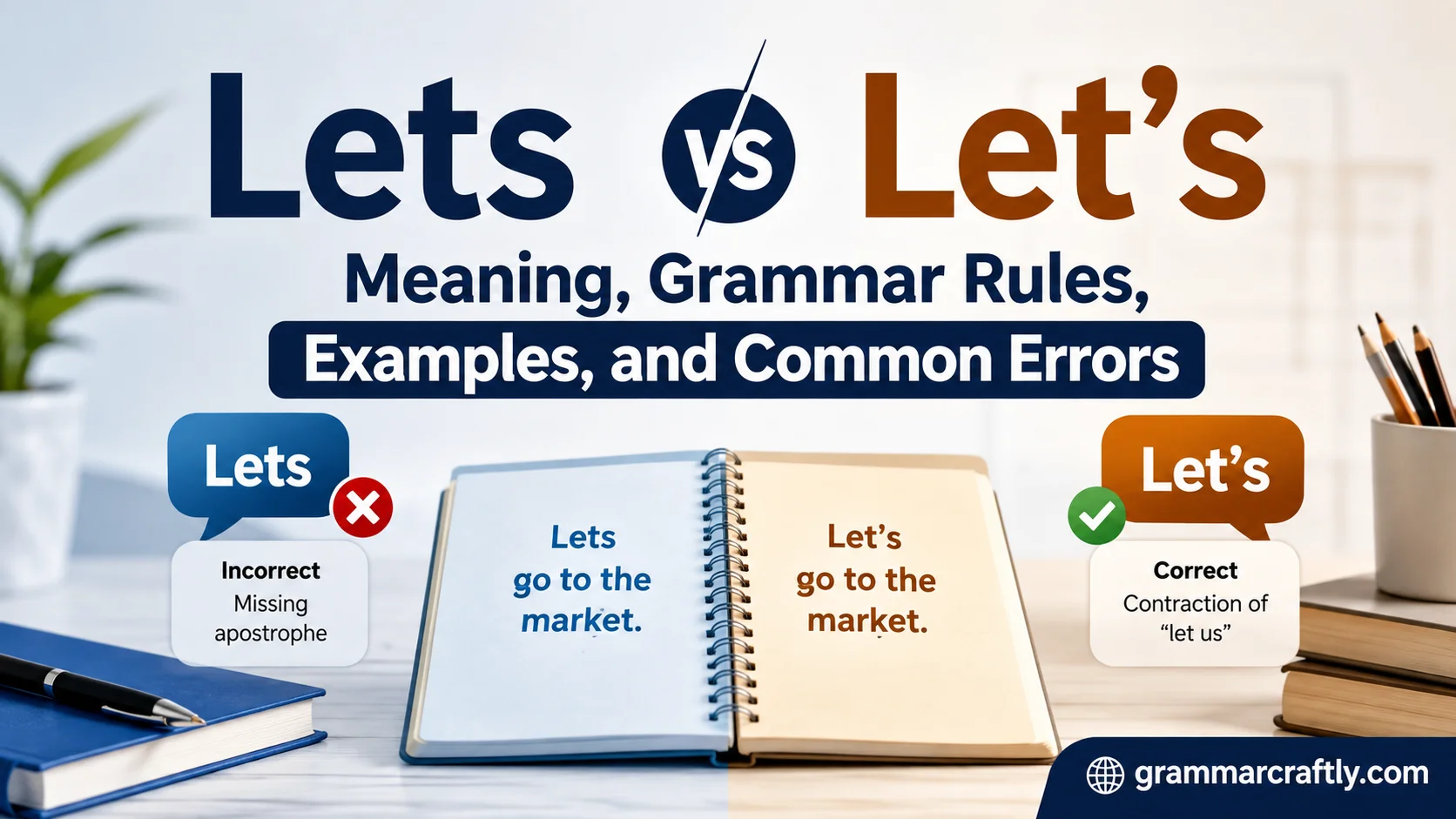
Lets vs Let’s: Meaning, Grammar Rules, Examples, and Common Errors explains how one single apostrophe changes meaning in English grammar clearly.
If you have ever paused or wondered about lets vs let’s, you have experienced a common problem. At first glance, both words appear identical, yet a significant change in meaning comes from one apostrophe. Let’s is a contraction of let us, while lets means to allow, permit, give permission, allow us, or permit us in the right context. This small punctuation mark is essential in grammar, grammar rules, English, and the English language because the difference affects every message. Over the years, I have noticed students, professionals, bloggers, and native English speakers make the same mix, leading to confusion, common errors, common mistakes, and other mistakes that make writing and speaking seem unpolished.
The best way to remember the rules is to focus on the form and its uses. Let’s is an indirect expression a speaker uses to make suggestions and invite others to go together. In contrast, lets describes abilities, ability, permissions, possibilities, or actions that allow someone to do something. A famous instance comes from T.S. Eliot in The Love Song of J. Alfred Prufrock, using the phrase “Let us go then, you and I”, while the uncontracted form also appears as the two-word phrase “Let’s go then, you and I.” The same comparison helps you understand the different purposes of each word and makes the language feel much less confusing.
Understanding Apostrophes in English Grammar
Before diving into the difference between lets vs let’s, it helps to understand why apostrophes matter.
An apostrophe serves two main purposes in English:
- Showing possession
- Forming contractions
For example:
WordMeaningJohn’sBelonging to JohnDon’tDo notIt’sIt isLet’sLet us
The apostrophe in let’s indicates that letters have been omitted from the phrase let us.
Without the apostrophe, the word becomes lets, which functions as a verb.
This simple punctuation mark completely changes the meaning and grammatical role of the word.
What Is Lets?
The word lets is the third-person singular form of the verb let.
The verb let means:
- To allow
- To permit
- To enable
- To give permission
When used with singular subjects such as he, she, or it, the verb becomes lets.
Examples of Lets
- She lets her children play outside.
- The teacher lets students ask questions.
- He lets his dog sleep on the couch.
- The software lets users edit documents online.
In each sentence, lets means allows or permits.
Lets as a Verb
Consider these examples:
SubjectVerb FormILetYouLetWeLetTheyLetHeLetsSheLetsItLets
Notice that only third-person singular subjects use lets.
Synonyms for Lets
Depending on context, lets may mean:
- Allows
- Permits
- Enables
- Grants
- Authorizes
Example:
- The app lets users customize settings.
- The app enables users to customize settings.
The meaning remains essentially the same.
What Is Let’s?
The word let’s is a contraction of let us.
It is commonly used to make suggestions, invitations, requests, or proposals.
Examples of Let’s
- Let’s go to the park.
- Let’s start the meeting.
- Let’s order pizza tonight.
- Let’s solve this problem together.
If you expand the contraction, the sentence still makes sense:
- Let us go to the park.
- Let us start the meeting.
Because let’s means let us, it always requires an apostrophe.
Why Let’s Is More Common
In modern English, people rarely say “let us” in casual conversation.
Instead, they prefer:
- Let’s go.
- Let’s begin.
- Let’s celebrate.
The contraction sounds more natural and conversational.
Lets vs Let’s: Key Differences Explained
The easiest way to understand lets vs let’s is through a direct comparison.
FeatureLetsLet’sPart of SpeechVerbContractionMeaningAllows or permitsLet usApostropheNoYesUsageThird-person singular verbSuggestion or invitationExampleShe lets me borrow books.Let’s borrow some books.
Quick Summary
Lets = Allows
Let’s = Let us
Remembering this distinction will eliminate most mistakes instantly.
Grammar Rule Behind Let’s (Let Us)
The grammar behind let’s is straightforward.
The contraction combines two words:
Let + Us = Let’s
English frequently creates contractions to make speech and writing flow more naturally.
Examples include:
Full FormContractionDo notDon’tCannotCan’tWe areWe’reIt isIt’sLet usLet’s
When you see an apostrophe, ask yourself whether it replaces missing letters.
In let’s, the apostrophe replaces the letter u from us.
When to Use Lets Correctly
Use lets whenever you’re talking about someone or something allowing another person to do something.
Common Situations
Permission
- My father lets me drive his truck.
Access
- The key lets you enter the building.
Opportunity
- This scholarship lets students study abroad.
Technology
- The platform lets businesses manage customer data.
Real-World Examples
Technology companies often use lets in marketing.
Examples:
- Google Docs lets teams collaborate in real time.
- Spotify lets users create custom playlists.
- Netflix lets viewers download content offline.
In all these examples, lets means allows.
When to Use Let’s Correctly
Use let’s when inviting, suggesting, encouraging, or proposing an action involving yourself and others.
Common Situations
Making Suggestions
- Let’s watch a movie.
Encouraging Someone
- Let’s keep going.
Starting Activities
- Let’s begin the lesson.
Planning Together
- Let’s discuss our options.
Everyday Conversation Examples
You hear let’s constantly in spoken English:
- Let’s eat.
- Let’s leave now.
- Let’s try again.
- Let’s celebrate.
Because it means let us, the speaker includes themselves in the action.
Examples in Questions, Commands, and Requests
Understanding context helps you choose the correct form.
Questions
- Let’s see what happens next.
- Let’s find out the answer.
Commands
- Let’s move quickly.
- Let’s focus on the task.
Requests
- Let’s work together.
- Let’s solve this issue calmly.
Notice that lets rarely appears in these situations.
That’s because suggestions and invitations require let’s.
Lets vs Let’s in Business Writing
Professional communication demands accuracy.
A misplaced apostrophe can make emails appear careless.
Correct Examples
- Let’s schedule a meeting next week.
- Let’s review the proposal together.
Also Correct
- The software lets managers track performance.
- The system lets employees update records.
Incorrect Examples
❌ Lets schedule a meeting.
✅ Let’s schedule a meeting.
❌ The software let’s users upload files.
✅ The software lets users upload files.
These mistakes appear surprisingly often in workplace communication.
Read More: What’s the Catch? Meaning, Origin, Examples, and When to Use It
Lets vs Let’s in Academic Writing
Students frequently confuse these terms in essays and assignments.
Academic Example Using Lets
- The experiment lets researchers observe behavioral patterns.
Academic Example Using Let’s
While less common in formal writing:
- Let’s examine the evidence more closely.
Professors generally prefer avoiding conversational contractions in highly formal academic papers. However, contractions may appear in presentations, lectures, or educational materials.
Lets vs Let’s in Text Messages and Online Chats
Texting has increased apostrophe-related errors.
People often type quickly and skip punctuation.
Examples:
Common Mistakes
❌ Lets go!
❌ Lets meet at 8.
Correct Versions
✅ Let’s go!
✅ Let’s meet at 8.
Although casual messaging is more forgiving, correct grammar still improves clarity.
Common Errors and How to Avoid Them
Many writers make the same mistakes repeatedly.
Error: Using Lets Instead of Let’s
Incorrect:
- Lets get started.
Correct:
- Let’s get started.
Error: Using Let’s Instead of Lets
Incorrect:
- The app let’s users save files.
Correct:
- The app lets users save files.
Error: Ignoring Context
Ask yourself:
Does the word mean “allows”?
If yes, use lets.
Does the word mean “let us”?
If yes, use let’s.
This simple test works nearly every time.
Quick Memory Tricks for Lets vs Let’s
Memory tricks can help you avoid confusion permanently.
The Expansion Test
Replace the word with let us.
Example:
- Let’s go home.
Expanded:
- Let us go home.
The sentence works.
Therefore, let’s is correct.
The Allows Test
Replace the word with allows.
Example:
- The software lets users edit photos.
Expanded:
- The software allows users to edit photos.
The sentence works.
Therefore, lets is correct.
Apostrophe Reminder
Think of the apostrophe as a missing-letter sign.
Whenever you can replace the word with let us, use the apostrophe.
Practice Exercises With Answers
Try these exercises.
Question 1
___ go to the beach.
Answer:
✅ Let’s go to the beach.
Question 2
The application ___ customers track orders.
Answer:
✅ The application lets customers track orders.
Question 3
___ review the report together.
Answer:
✅ Let’s review the report together.
Question 4
She ___ her brother borrow the car.
Answer:
✅ She lets her brother borrow the car.
Question 5
___ see what happens.
Answer:
✅ Let’s see what happens.
Case Study: A Real Editing Example
Imagine a company sends this email:
Lets discuss the project tomorrow. Our software let’s users create reports automatically.
The email contains two mistakes.
Corrected version:
Let’s discuss the project tomorrow. Our software lets users create reports automatically.
The corrected version looks more professional and trustworthy.
Small grammar improvements often create a stronger impression.
Frequently Confused Words Related to Let’s
Many apostrophe mistakes follow similar patterns.
Its vs It’s
WordMeaningItsPossessive formIt’sIt is
Example:
- It’s raining.
- The dog wagged its tail.
Your vs You’re
WordMeaningYourPossessionYou’reYou are
Example:
- You’re welcome.
- Your phone is ringing.
Whose vs Who’s
WordMeaningWhosePossessiveWho’sWho is
Example:
- Who’s calling?
- Whose bag is this?
Were vs We’re
WordMeaningWerePast tense verbWe’reWe are
Example:
- We’re ready.
- They were happy.
Learning these distinctions makes grammar much easier overall.
Expert Writing Tips to Avoid Apostrophe Errors
Professional editors often use several strategies.
Slow Down During Proofreading
Most apostrophe mistakes happen during fast typing.
Read Sentences Aloud
Hearing the sentence often reveals mistakes immediately.
Use Grammar Tools
Helpful tools include:
- Grammarly
- ProWritingAid
- Microsoft Editor
- LanguageTool
Learn Common Patterns
The more contractions you understand, the fewer mistakes you’ll make.
Focus on Meaning
Don’t rely solely on appearance.
Instead, ask what the word actually means in context.
Why Native Speakers Still Confuse Lets and Let’s
Surprisingly, native speakers make this mistake regularly.
Why?
Several reasons contribute:
- Fast typing
- Autocorrect issues
- Missing apostrophes on mobile devices
- Lack of proofreading
- Similar pronunciation
Because both words sound identical when spoken, many people don’t notice the difference until they see the written form.
This makes lets vs let’s one of the most common punctuation mistakes in modern English.
Cheat Sheet: Lets vs Let’s
Keep this quick-reference guide handy.
If the Word Means…UseAllowsLetsPermitsLetsEnablesLetsLet UsLet’sSuggestionLet’sInvitationLet’sEncouragementLet’s
Examples
Lets
- He lets me borrow his laptop.
- The platform lets users upload videos.
Let’s
- Let’s go hiking.
- Let’s celebrate the achievement.
FAQs:
Is lets or let’s correct?
Both are correct, but they have different meanings. Let’s means let us, while lets means allows or permits.
Why is there an apostrophe in let’s?
The apostrophe shows that let’s is a contraction of let us. It replaces the missing letter in us.
Can I use lets to make a suggestion?
No. To make a suggestion or invitation, always use let’s, such as “Let’s start the meeting.”
How can I remember the difference between lets and let’s?
A simple trick is to expand let’s into let us. If the sentence still makes sense, let’s is the correct choice. If it means allows or permits, use lets.
Are lets and let’s common grammar mistakes?
Yes. They are among the most common punctuation and grammar mistakes because they look almost identical. Checking whether you mean let us or allows can help you choose the correct form every time.
Conclusion:
Understanding lets and let’s becomes much easier once you know the simple grammar rule behind them. Let’s is a contraction of let us and is used to make suggestions or invitations, while lets is a verb that means to allow or permit. Although the difference is only one apostrophe, using the correct form improves your writing and helps you communicate more clearly. Whether you’re writing school assignments, business emails, or everyday messages, remembering this small rule will help you avoid common mistakes and write with greater confidence.