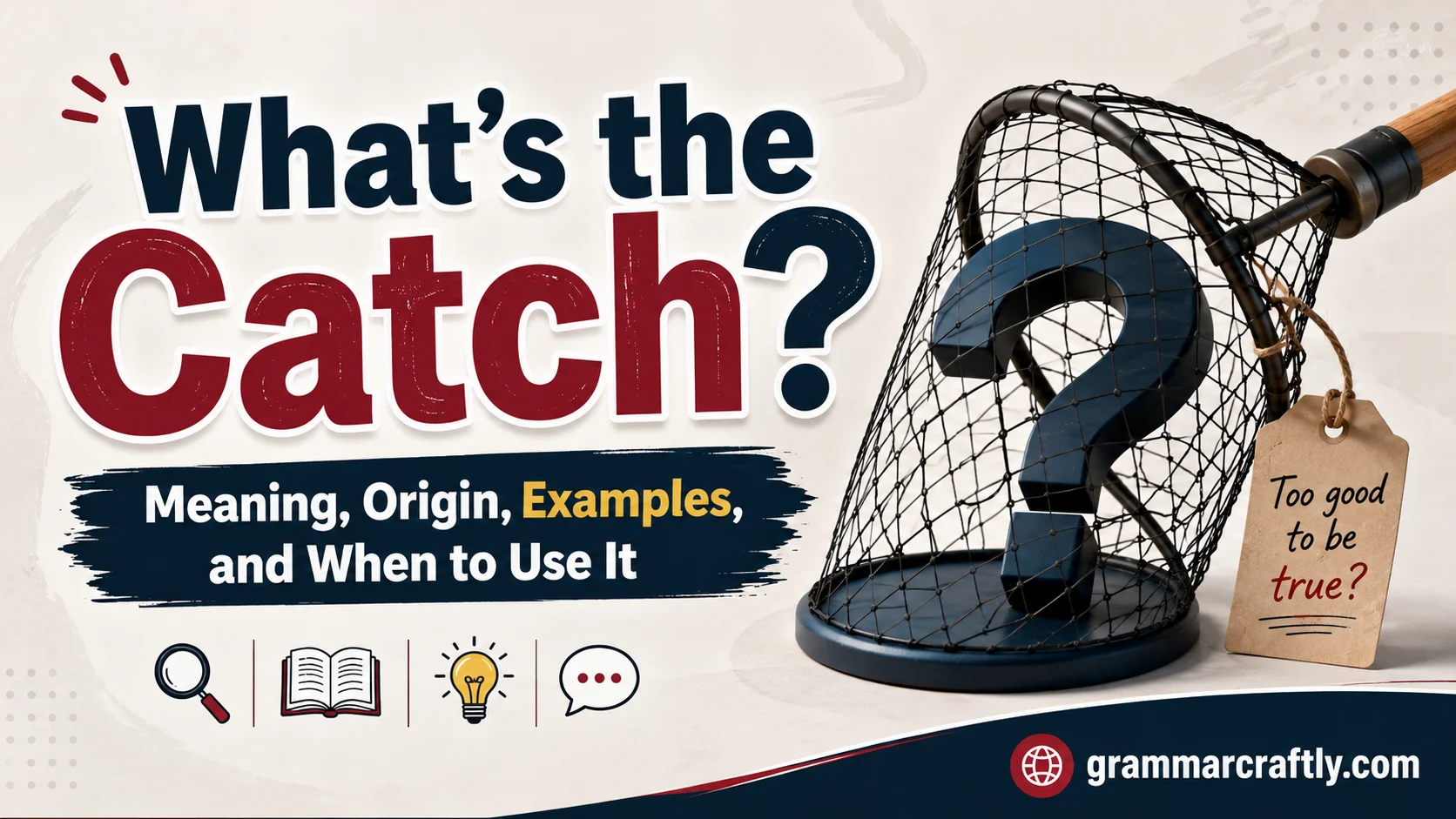
Explore What’s the Catch? Meaning, Origin, Examples, and When to Use It to understand why this phrase reveals hidden issues behind tempting offers.
When an offer seems too good to be true, your first reaction may involve curiosity and doubt. This phrase appears in everyday conversations when a deal looks free, amazing, or surprisingly valuable but still feels uncertain. The idiom asks about a possible hidden condition, hidden problem, hidden cost, or hidden trap behind a situation. From my experience, knowing the context of this expression builds real understanding because the word catch often points toward something unexpected. For example, if a store is giving away free ice cream, or a stranger offers a hundred dollar bill, you may question whether the money is stolen, how to repay it, or what condition applies.
The simple retort “What’s the Catch?” reflects awareness and caution because people naturally question offers that sound perfect. The phrase came into use in the 1800s, especially during the 1850s, and is historically linked with P. T. Barnum, a flamboyant American showman connected with hucksterism and skirting the truth. Understanding its origin, meaning, and real examples helps you recognize why this expression remains useful in business, law, advertising, and casual everyday life.
What Does “What’s the Catch?” Mean?
The phrase “What’s the catch?” is used when someone believes that an offer, opportunity, or situation appears unusually favorable and may contain a hidden disadvantage, condition, or drawback.
Simple Definition
What’s the catch?
What hidden problem, cost, obligation, or disadvantage exists behind this seemingly attractive offer?
People often ask this question when something appears better than expected.
Examples
- “They’re offering unlimited internet for only $10 a month. What’s the catch?”
- “The company wants to double my salary. What’s the catch?”
- “You got free concert tickets? What’s the catch?”
In each example, the speaker suspects there might be information they haven’t yet discovered.
Why the Phrase Matters
The phrase reflects human caution. It encourages people to look beyond surface appearances and investigate details before making decisions.
As the old saying goes:
“If something sounds too good to be true, it probably is.”
This idea closely relates to the meaning behind “What’s the catch?”
Why People Instinctively Ask “What’s the Catch?”
Humans are naturally cautious creatures.
Throughout history, survival often depended on identifying hidden dangers before they became problems. That instinct still exists today, even when dealing with business offers, advertisements, and social situations.
The Psychology of Skepticism
Psychologists have found that people tend to evaluate both rewards and risks before making decisions.
When something appears unusually beneficial, our brains automatically ask:
- Is this real?
- What am I missing?
- Are there hidden conditions?
- Could this backfire later?
This mental process helps reduce uncertainty.
Risk vs. Reward
People constantly balance potential benefits against possible risks.
RewardPotential CatchFree productHidden subscriptionHigh salaryExcessive workloadCheap vacationAdditional feesDiscounted serviceLong-term contractGift from strangerHidden expectation
The question “What’s the catch?” helps people identify risks before committing.
Cognitive Biases at Work
Several psychological principles influence this behavior:
Loss Aversion
Research shows people generally fear losses more than they value equivalent gains.
Losing $100 often feels worse than gaining $100 feels good.
As a result, people become cautious when presented with attractive opportunities.
Confirmation Bias
If someone has been misled before, they may expect similar situations in the future.
This causes them to ask:
“What’s the catch?”
even when no catch exists.
The Origin and History of “What’s the Catch?”
Although the exact origin remains uncertain, the phrase developed from the word “catch,” which has been used in English for centuries.
Historically, a catch referred to:
- A hidden difficulty
- A concealed condition
- A trick
- An unexpected obstacle
Early Usage
During the 19th century, English speakers commonly used expressions such as:
- “There’s a catch.”
- “There must be a catch somewhere.”
Over time, people began shortening the expression into the question:
“What’s the catch?”
Evolution of the Phrase
The phrase became especially popular during the 20th century as advertising expanded.
Consumers frequently encountered:
- Promotional offers
- Sweepstakes
- Discounts
- Limited-time deals
Many of these offers included fine print.
As a result, skepticism became common.
The phrase spread into everyday conversation and remains widely used today.
Modern Relevance
Today, people ask “What’s the catch?” about:
- Online subscriptions
- Cryptocurrency investments
- Social media giveaways
- AI tools
- Business partnerships
- Employment offers
The phrase remains just as relevant in the digital age as it was decades ago.
When to Use “What’s the Catch?” in Everyday Conversation
Understanding when to use the phrase helps improve communication.
Business Situations
Suppose a vendor offers a service at half the market price.
You might ask:
“What’s the catch?”
This signals that you’d like more information before agreeing.
Job Offers
Imagine receiving an offer with:
- A large salary increase
- Excellent benefits
- Flexible hours
Naturally, you may wonder:
“What’s the catch?”
Perhaps the role requires frequent travel or long working hours.
Online Promotions
Many internet users ask this question when encountering:
- Free software
- Bonus rewards
- Exclusive memberships
- Cashback programs
It’s a practical way to investigate details.
Personal Relationships
The phrase also appears in social situations.
Example:
“You’ve offered to help me move all weekend for free. What’s the catch?”
Here, the speaker suspects a hidden favor may eventually be requested.
Real-Life Examples of “What’s the Catch?”
Let’s examine situations where people commonly use the phrase.
Example: The Free Trial
A streaming platform advertises:
“Enjoy 30 days free!”
Many users immediately wonder:
“What’s the catch?”
The answer might be:
- Automatic billing afterward
- Credit card requirement
- Limited cancellation period
Example: The Dream Job
A company offers:
- Remote work
- Huge salary
- Unlimited vacation
Candidates often investigate further.
Possible catches:
- High-pressure culture
- Unrealistic expectations
- Performance-based termination
Example: Cheap Flights
Airlines frequently advertise extremely low fares.
However:
Advertised PriceHidden Costs$49 FlightBaggage fees$99 VacationResort fees$20 TicketService charges
This is precisely why consumers ask:
“What’s the catch?”
Example: Social Media Giveaways
Influencers frequently promote contests.
Participants may wonder:
- Is it legitimate?
- Is personal information required?
- Are there hidden marketing purposes?
The phrase helps encourage caution.
Is “What’s the Catch?” Always Negative?
Not necessarily.
Many people assume the phrase expresses distrust.
In reality, it often reflects healthy critical thinking.
Positive Skepticism
Healthy skepticism helps people:
- Avoid scams
- Prevent financial mistakes
- Make informed decisions
- Protect personal information
Excessive Skepticism
However, too much suspicion can create problems.
People may:
- Miss opportunities
- Reject genuine kindness
- Ignore valuable investments
- Damage relationships
Finding Balance
Smart decision-making requires balance.
Ask questions.
Review details.
But remain open-minded.
Not every opportunity contains a hidden trap.
Healthy Skepticism vs. Cynicism
Understanding this distinction is important.
Healthy Skepticism
Healthy skepticism means:
- Asking questions
- Seeking evidence
- Reviewing facts
- Remaining open to answers
Cynicism
Cynicism means:
- Assuming bad intentions
- Distrusting everyone
- Rejecting opportunities automatically
Comparison Table
Healthy SkepticismCynicismInvestigates factsAssumes deceptionOpen-mindedClosed-mindedSeeks clarityExpects failureRationalEmotional
The goal isn’t to become cynical.
It’s to become informed.
Read More: End Run Meaning: Complete Guide With Examples, Strategy?
Similar Expressions and Their Meanings
English contains several phrases similar to “What’s the catch?”
Too Good to Be True
Meaning:
Something appears unrealistically beneficial.
Example:
“A luxury car for $500? That’s too good to be true.”
What’s the Downside?
Focuses on disadvantages.
Example:
“The investment looks promising. What’s the downside?”
Where’s the Catch?
Almost identical meaning.
Example:
“This deal seems amazing. Where’s the catch?”
Strings Attached
Suggests hidden obligations.
Example:
“Nothing comes without strings attached.”
Hidden Agenda
Suggests concealed motives.
Example:
“Why is he helping? Is there a hidden agenda?”
Comparison Table
ExpressionMeaningWhat’s the catch?Hidden disadvantageToo good to be trueUnrealistically positiveStrings attachedHidden obligationHidden agendaSecret motiveWhat’s the downside?Potential drawback
Common Mistakes People Make When Using the Phrase
Although simple, the phrase can sometimes be misused.
Assuming Every Offer Is Suspicious
Not every attractive opportunity contains a catch.
Many companies genuinely offer:
- Introductory discounts
- Scholarships
- Promotions
- Customer rewards
Using It in Formal Writing
The phrase is conversational.
Formal alternatives include:
- What are the terms?
- Are there any conditions?
- What obligations apply?
Sounding Accusatory
Tone matters.
Instead of sounding suspicious, use a curious tone.
For example:
“This sounds fantastic. What’s the catch?”
sounds friendlier than:
“Okay, what’s the catch?”
How Businesses Use the Phrase in Marketing
Interestingly, marketers often use the phrase themselves.
Reverse Psychology
Many advertisements say:
- “No catch.”
- “No hidden fees.”
- “No strings attached.”
This directly addresses consumer skepticism.
Why It Works
Consumers already wonder:
“What’s the catch?”
By answering the question immediately, companies reduce uncertainty.
Examples
Modern businesses often emphasize:
- Transparent pricing
- No contracts
- Free cancellation
- No hidden charges
These messages help build trust.
Case Study: When There Really Was a Catch
The Subscription Trap
A software company advertised:
“Free forever.”
Thousands signed up.
However, users later discovered:
- Essential features required upgrades
- Storage limits were extremely small
- Customer support required payment
Technically, the service was free.
Practically, most users needed the paid version.
The catch existed in the details.
Lesson
Always examine:
- Terms and conditions
- Pricing structures
- Usage limits
- Renewal policies
Case Study: When There Was No Catch
The Customer Acquisition Strategy
A startup offered:
- Free shipping
- Free returns
- Significant discounts
Many customers assumed there must be a catch.
There wasn’t.
The company simply wanted rapid growth.
The strategy succeeded because:
- Customer lifetime value exceeded acquisition costs
- Word-of-mouth marketing increased sales
- Repeat customers generated profit
Lesson
Sometimes an offer is genuinely beneficial.
The key is understanding the business model.
How to Evaluate Any Offer Like a Pro
Instead of automatically asking “What’s the catch?”, use a structured approach.
Ask These Questions
Who Benefits?
Every transaction benefits someone.
Identify all parties involved.
What Are the Conditions?
Read:
- Contracts
- Terms
- Fine print
- Cancellation policies
Are There Hidden Costs?
Look for:
- Service fees
- Renewal charges
- Processing costs
- Maintenance expenses
Is It Sustainable?
Ask:
How can they afford this offer?
The answer often reveals important details.
A Practical Checklist Before Saying Yes
Use this checklist whenever an opportunity seems unusually attractive.
Opportunity Evaluation Checklist
- □ Read all terms and conditions
- □ Verify company reputation
- □ Search for reviews
- □ Understand cancellation rules
- □ Identify hidden fees
- □ Compare alternatives
- □ Ask questions
- □ Confirm deadlines
- □ Review refund policies
- □ Trust evidence, not hype
Following these steps dramatically reduces risk.
“What’s the Catch?” in Movies, TV Shows, and Pop Culture
The phrase appears frequently in entertainment.
Writers use it because audiences naturally understand its meaning.
Common Story Patterns
A character receives:
- Unexpected wealth
- Extraordinary powers
- A mysterious gift
- An irresistible opportunity
Then someone asks:
“What’s the catch?”
This instantly creates tension.
Why It Works
Stories thrive on uncertainty.
The phrase signals that consequences may exist beneath the surface.
It’s a simple yet powerful storytelling device.
FAQs:
1. What does “What’s the Catch?” mean?
“What’s the Catch?” means asking about a hidden problem, condition, cost, or disadvantage behind an offer that appears unusually good. People use this phrase when they suspect that something may not be as simple or perfect as it first appears.
2. Where did the phrase “What’s the Catch?” come from?
The phrase “What’s the Catch?” became common in the 1800s and is especially connected with the 1850s. It is often associated with P. T. Barnum, a famous American showman linked with promotional tricks and exaggerated claims.
3. When should you use “What’s the Catch?”
You can use “What’s the Catch?” when an offer, deal, opportunity, or promise seems too good to be true. It is useful in casual conversations, business discussions, advertising situations, and everyday decisions where you want to understand hidden details.
4. Is asking “What’s the Catch?” always negative or distrustful?
No, asking “What’s the Catch?” does not always show distrust. It can simply show awareness, curiosity, and smart judgment. The phrase helps people evaluate situations carefully before making decisions.
5. What are some examples of using “What’s the Catch?”
You might say “What’s the Catch?” when someone offers a free service, an unbelievable discount, a generous job opportunity, or a valuable gift without explaining any conditions. The phrase helps you ask what requirements or limitations may exist.
Conclusion:
“What’s the Catch?” is a powerful everyday expression that helps people question situations that seem surprisingly favorable. From free offers and unexpected gifts to business deals and promises, the phrase encourages awareness and careful thinking. Its history, connected with the 1800s and P. T. Barnum’s era, shows how language reflects human concerns about trust, honesty, and hidden conditions. Understanding the meaning, origin, examples, and proper usage of “What’s the Catch?” allows you to communicate more clearly and make smarter decisions in real-life situations.