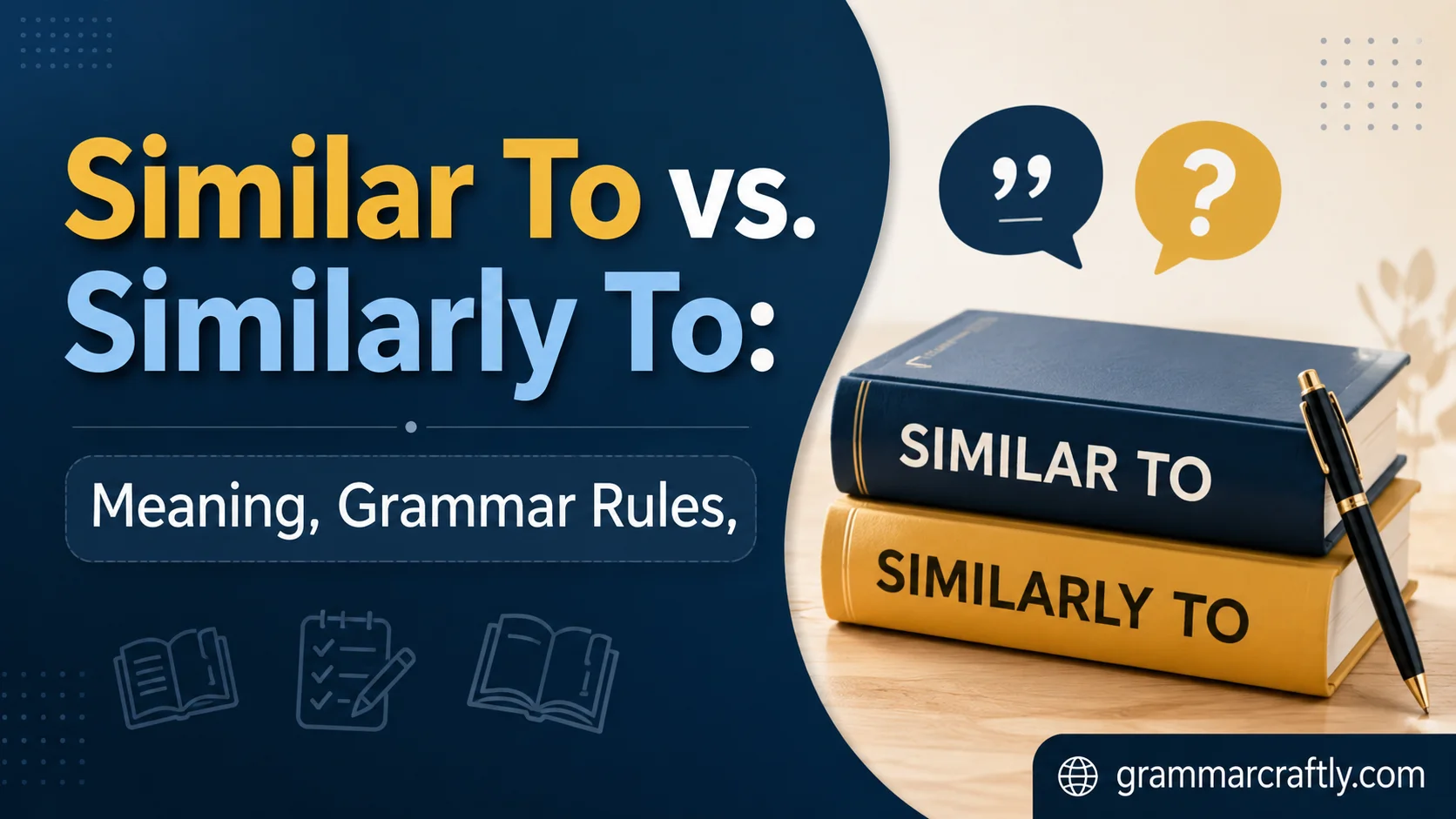
Similar To vs. Similarly To: Meaning, Grammar Rules, becomes clearer when you see how each phrase works in context and compare its grammar role.
At first glance, this grammar topic may seem simple, but my years of editing essays, blog posts, formal documents, online articles, emails, and published writing have shown me how one small word choice can create big consequences. A common comparison mistake appears when writers switch between similar to and similarly to. These forms have different meanings and different grammar roles. From a grammatical point of view, similar is an adjective that functions as a clean comparison, while similarly is an adverb that signals a subtle connection. This difference is an important point because a small slip can reduce writing clarity and make a sentence sound less natural. In my experience, writers often reach for the longer phrase, thinking it sounds more formal, but that instinct sometimes fails. A practical guide I developed through years of work shows that when comparing nouns, similar to is almost always the correct choice. While reviewing drafts, I often fix awkward sentences by trimming unnecessary words so the result doesn’t feel stiff or overcorrected. Understanding how to use them immediately improves clarity and structure. Once you understand the context, your writing becomes sharper, more confident, professional, and free from avoidable errors.
The distinction can still confuse learners, including native speakers, because both phrases relate to different sentence structures and serve various purposes. Knowing when to use each one instantly improves writing and makes sentences sound more natural. Similar to normally describes objects, ideas, or other items by showing a comparison or similarities, whereas similarly can describe actions and connections between situations. Real-life examples from an essay, blog, or post can help you avoid mistakes, communicate ideas clearly and confidently, and select the right form without stumbling, figuring out meanings, or grappling with nuance. Clear definitions, practical tips, and simple explanations make the usage easier to recognize in conversations and professional writing. For example, “This design is similar to another design” makes a direct comparison because the phrase connects something kindred to another thing. By contrast, “She responded similarly” focuses on an action, indicating a correlation with another action. Thus, similar to points toward a direct comparison, while similarly helps express how one action or situation relates to another. These distinctions strengthen your English grammar, stronger English skills, and confidence while helping you compare objects, ideas, and actions correctly instead of creating confusing sentence structures.
“Let’s dive in”
What Does “Similar To” Mean?
Similar to is a phrase used to show that two things share qualities, features, characteristics, or appearances.
The word similar works as an adjective, and to introduces the thing being compared.
The basic structure is:
Subject + be + similar to + comparison
Examples:
- This phone is similar to the previous model.
- Her personality is similar to her sister’s.
- The new policy is similar to the one introduced last year.
In each example, the phrase identifies a relationship between two things. It does not say they are exactly the same. Instead, it shows that they have noticeable similarities.
Think of similar to as a “comparison bridge.” It connects one thing with another by showing shared traits.
For example:
A bicycle is similar to a motorcycle because both have two wheels and help people travel.
However, they are not identical. A bicycle uses human power while a motorcycle uses an engine.
That difference matters.
The Grammar Structure of “Similar To”
The phrase similar to usually follows linking verbs such as:
- is
- are
- was
- were
- seems
- looks
- appears
- becomes
Common sentence pattern:
| Structure | Example |
| Subject + is similar to + noun | This painting is similar to that one. |
| Subject + seems similar to + noun | The design seems similar to the original. |
| Subject + looks similar to + noun | The logo looks similar to the old version. |
Examples in Different Contexts
Everyday conversation:
- Your jacket is similar to mine.
- This restaurant’s menu is similar to the one downtown.
Professional writing:
- The company’s strategy is similar to its competitors’ approaches.
- The two research methods are similar to each other.
Academic writing:
- The results are similar to previous studies.
- This theory is similar to earlier scientific models.
What Does “Similarly” Mean?
Unlike similar to, the word similarly is an adverb.
An adverb describes an action, condition, or relationship. It explains that something happens in a comparable way.
Examples:
- The two students studied similarly.
- The first experiment failed. Similarly, the second experiment produced unexpected results.
- Both companies responded similarly to customer complaints.
Here, similarly does not describe a physical object. Instead, it compares actions, behaviors, outcomes, or ideas.
A useful way to remember it:
Similar = describes things.
Similarly = describes actions or situations.
Compare these examples:
Similar to:
The two houses are similar to each other.
This tells us the houses have matching features.
Similarly:
The two houses were built similarly.
This tells us the building process was done in a comparable way.
The focus changes.
The Grammar Structure of “Similarly”
The word similarly often appears in three positions:
At the Beginning of a Sentence
This is one of the most common uses.
Examples:
- The first study showed positive results. Similarly, the second study supported the same conclusion.
- The company improved its customer service. Similarly, it upgraded its online platform.
Here, similarly acts as a transition word that connects two related ideas.
In the Middle of a Sentence
Examples:
- The two machines operate similarly under normal conditions.
- The children reacted similarly during the experiment.
In these examples, similarly modifies the action.
At the End of a Sentence
Examples:
- Both teams performed similarly.
- The two systems function similarly.
This placement is less common but still correct.
Similar To vs. Similarly To: The Key Difference
The biggest difference between similar to vs. similarly to comes down to what you are comparing.
| Feature | Similar To | Similarly |
| Grammar role | Adjective phrase | Adverb |
| Describes | Things, people, ideas | Actions, behaviors, results |
| Main purpose | Shows resemblance | Shows comparable manner |
| Frequency | Very common | Very common |
| Example | Her voice is similar to her mother’s. | She sings similarly to her mother. |
Look at the difference:
Sentence 1:
This painting is similar to the original.
Meaning:
The paintings share visual features.
Sentence 2:
The artist painted similarly to the original artist.
Meaning:
The artists used a comparable style or method.
The first sentence compares objects.
The second sentence compares actions.
Is “Similarly To” Grammatically Correct?
This is where many writers become confused.
The phrase similarly to is not always wrong. It can be grammatically acceptable when similarly functions as an adverb and to introduces the comparison.
Examples:
- The machine operates similarly to the older version.
- She reacted similarly to her brother.
- The new software works similarly to the previous system.
These sentences are understandable and grammatically possible.
However, many native speakers prefer simpler alternatives depending on the situation.
For example:
Instead of:
The new system works similarly to the old system.
You could write:
The new system works like the old system.
or:
The new system works in a similar way to the old system.
Both sound more natural in everyday communication.
Why Does “Similarly To” Sound Unusual?
The reason is that English often prefers shorter and smoother structures.
The word similarly already carries the idea of comparison. Adding to can sometimes feel unnecessary.
Compare:
Natural:
The two employees responded similarly.
Also correct:
The two employees responded similarly to each other.
More common alternative:
The two employees responded in the same way.
The phrase is not always a grammar mistake. It is simply less common in many situations.
Similar vs. Similarly: Understanding the Real Difference
Many mistakes happen because writers confuse similar and similarly.
The difference comes from grammar:
- Similar = adjective
- Similarly = adverb
An adjective describes a noun.
An adverb describes a verb, adjective, or another adverb.
Compare These Examples
Similar
Their opinions are similar.
The word similar describes the opinions.
Similarly
They think similarly.
The word similarly describes how they think.
Another example:
Similar:
The two products have similar features.
Meaning:
The products share characteristics.
Similarly:
The two products perform similarly.
Meaning:
The products behave in a comparable way.
Read More: In Development vs. Under Development:
Easy Memory Trick for Similar To vs. Similarly To
Here is a simple trick:
If you compare a thing, use “similar to.”
If you compare an action, use “similarly.”
Ask yourself:
“Am I describing what something is like?”
Use:
Similar to
Example:
- This book is similar to that one.
“Am I describing how something happens?”
Use:
Similarly
Example:
- The two authors write similarly.
This quick test solves most confusion.
Common Mistakes When Using Similar To and Similarly To
Even though similar to vs. similarly to seems like a small grammar issue, many writers make mistakes because these phrases overlap in meaning. The confusion usually happens when people focus only on the idea of comparison and ignore the grammatical role each word plays.
A sentence can still be understandable while sounding unnatural. Choosing the right phrase helps your writing sound smoother and more precise.
Let’s look at the most common mistakes and how to fix them.
Using “Similarly To” When You Mean “Similar To”
One of the most frequent mistakes is using similarly to when you are describing a person, object, or idea.
Incorrect:
This new laptop is similarly to the previous model.
Why is this wrong?
The sentence describes the laptop itself. You need an adjective phrase, not an adverb.
Correct:
This new laptop is similar to the previous model.
Here, similar describes the laptop’s features.
Other examples:
❌ The movie is similarly to the book.
✅ The movie is similar to the book.
❌ Her writing style is similarly to mine.
✅ Her writing style is similar to mine.
Using “Similar To” When Comparing Actions
Another common error happens when writers use similar to to describe how someone does something.
Incorrect:
The two athletes trained similar to each other.
The word trained is an action, so the sentence needs an adverb.
Correct:
The two athletes trained similarly.
or:
The two athletes trained in a way similar to each other.
The difference may seem small, but it changes the focus.
Compare:
The two athletes are similar to each other.
This describes the athletes.
The two athletes trained similarly.
This describes their training methods.
Confusing “Similar” With “Same”
Many people use similar and same as if they mean the same thing. They do not.
Similar means things share qualities but are not identical.
Same means things are identical or exactly alike.
Compare these examples:
My phone is similar to yours.
This means both phones may have the same brand, design, or features.
My phone is the same as yours.
This means both phones are identical.
A useful comparison:
| Word | Meaning | Example |
| Similar | Almost alike but different | These shoes are similar to mine. |
| Same | Exactly alike | These shoes are the same as mine. |
Think of siblings.
Two brothers may look similar, but they are not the same person.
Similar To vs. Like: Which One Should You Use?
Many learners also confuse similar to with like because both expressions compare things.
Although they often communicate a similar idea, they have slightly different uses.
Similar To
Similar to sounds more formal and emphasizes shared characteristics.
Examples:
- This design is similar to the original.
- Her approach is similar to her manager’s.
Like
Like is more common in everyday speech and usually creates a direct comparison.
Examples:
- This tastes like chocolate.
- He runs like a professional athlete.
Compare:
This painting is similar to Van Gogh’s work.
This suggests the painting shares qualities with Van Gogh’s style.
This painting looks like Van Gogh’s work.
This suggests the painting reminds you of Van Gogh’s work.
Both can work, but the feeling changes.
Similar To vs. Alike vs. Same: Understanding the Differences
English has several ways to express comparison. Choosing the right word depends on how strong the similarity is.
| Expression | Meaning | Example |
| Similar to | Shares some qualities | Her voice is similar to her mother’s. |
| Alike | Very similar | The twins look alike. |
| Same as | Identical | This answer is the same as mine. |
Similar To
Use similar to when two things share characteristics.
Example:
This restaurant is similar to the one we visited last week.
The restaurants may have similar food, atmosphere, or service.
Alike
Use alike when two things have many similarities.
Examples:
- The two paintings look alike.
- The twins think alike.
Notice that alike usually appears after the verb.
Correct:
The two designs are alike.
Incorrect:
The two alike designs are beautiful.
Same As
Use same as when two things match completely.
Examples:
- My answer is the same as yours.
- This model is the same as last year’s version.
Similar To and Similarly To in Formal Writing
Understanding similar to vs. similarly to becomes especially important in academic and professional writing.
In formal writing, precision matters. A small grammar choice can affect how clearly your ideas connect.
Using “Similar To” in Academic Writing
Researchers often use similar to when comparing findings, theories, or concepts.
Examples:
The results were similar to previous studies.
This theory is similar to the model proposed by earlier researchers.
The phrase helps writers establish relationships between ideas.
Using “Similarly” as a Transition Word
In essays and reports, similarly works as a transition that introduces a related point.
Example:
The first study examined environmental factors. Similarly, the second study focused on external influences.
Here, similarly connects two ideas.
It tells readers:
“Something comparable happened in the next example.”
Using “Similarly To” in Professional Writing
While similarly to can be correct, writers often choose alternatives because they sound smoother.
Example:
Less natural:
The company responded similarly to its competitors.
Better alternatives:
The company responded in a similar way to its competitors.
or:
The company responded like its competitors.
However, context matters.
This sentence is perfectly acceptable:
The updated software functions similarly to the previous version.
In technical writing, this structure appears often because it clearly compares performance.
How Native Speakers Use These Expressions
Native speakers usually choose these phrases based on instinct, but there are patterns you can follow.
When Describing Objects or Ideas
They usually choose:
Similar to
Examples:
- Your idea is similar to mine.
- This recipe is similar to the traditional version.
- The new building looks similar to the old one.
When Describing Actions
They usually choose:
Similarly
Examples:
- Both players performed similarly.
- The two machines operate similarly.
- The students reacted similarly.
When Explaining Comparable Methods
They may choose:
Similarly to or a longer phrase.
Examples:
- The engine works similarly to the previous model.
- The system operates in a way similar to the older design.
Real-Life Examples of Similar To and Similarly To
Understanding grammar becomes easier when you see how these phrases appear in real situations.
Workplace Communication
Imagine two employees use the same approach to solve a problem.
You might say:
Sarah’s management style is similar to James’s.
You are comparing their styles.
You could also say:
Sarah manages projects similarly to James.
You are comparing their methods.
Technology
Technology companies often compare products.
Example:
The new smartphone is similar to the previous version.
This means the phones share features.
Another example:
The new application performs similarly to the older software.
This means the applications behave in a comparable way.
Education
Teachers often compare learning methods.
Example:
Online learning is similar to traditional classroom learning in some ways.
This compares two systems.
Example:
Students studying online and in classrooms often learn similarly.
This compares learning patterns.
Everyday Conversations
People use these phrases constantly.
Examples:
- Your dog looks similar to mine.
- You and your brother laugh similarly.
- This movie feels similar to the one we watched yesterday.
- The two restaurants serve food similarly.
Small grammar choices make everyday communication clearer.
Similar To vs. Similarly To: Quick Comparison Chart
| Question | Best Choice |
| Are you describing a person, object, or idea? | Similar to |
| Are you describing an action or behavior? | Similarly |
| Are you comparing a method? | Similarly or similarly to |
| Are you writing casually? | Like or similarly may sound more natural |
| Are you making a direct comparison? | Similar to |
A Simple Test to Choose the Correct Phrase
When you are unsure, try replacing the phrase.
Ask:
Can I replace it with “almost the same as”?
If yes, use:
Similar to
Example:
This painting is almost the same as that painting.
Therefore:
This painting is similar to that painting.
Can I replace it with “in the same way”?
If yes, use:
Similarly
Example:
They responded in the same way.
Therefore:
They responded similarly.
This quick test works in most situations.
FAQs:
Is “similar to” grammatically correct?
Yes. Similar to is the standard and natural phrase used to compare one person, object, idea, or thing with another. For example, “This phone is similar to my old phone.”
Is “similarly to” correct English?
Similarly to can be grammatically possible in certain structures, but it isn’t normally used as a direct replacement for similar to. Similarly is usually an adverb that describes an action or situation.
What is the difference between “similar to” and “similarly”?
Similar to directly compares things, while similarly shows that an action, situation, or quality occurs in a comparable way. For example, “Her dress is similar to mine” compares two dresses, while “She responded similarly” compares responses.
Is “similar to” followed by a noun?
Yes. Similar to is commonly followed by a noun or noun phrase. For example, “This method is similar to the previous method.”
How can I remember when to use “similar to”?
Use similar to when you are directly comparing things. Use similarly when you are describing an action or situation that happens in a comparable way. This simple distinction can help you avoid common grammar mistakes.
Conclusion:
Similar to and similarly may look and sound closely related, but they serve different grammatical purposes. Use similar to for direct comparisons between people, objects, ideas, or things, and use similarly when describing comparable actions or situations. Once you understand this difference, your writing becomes clearer, more natural, and more confident.