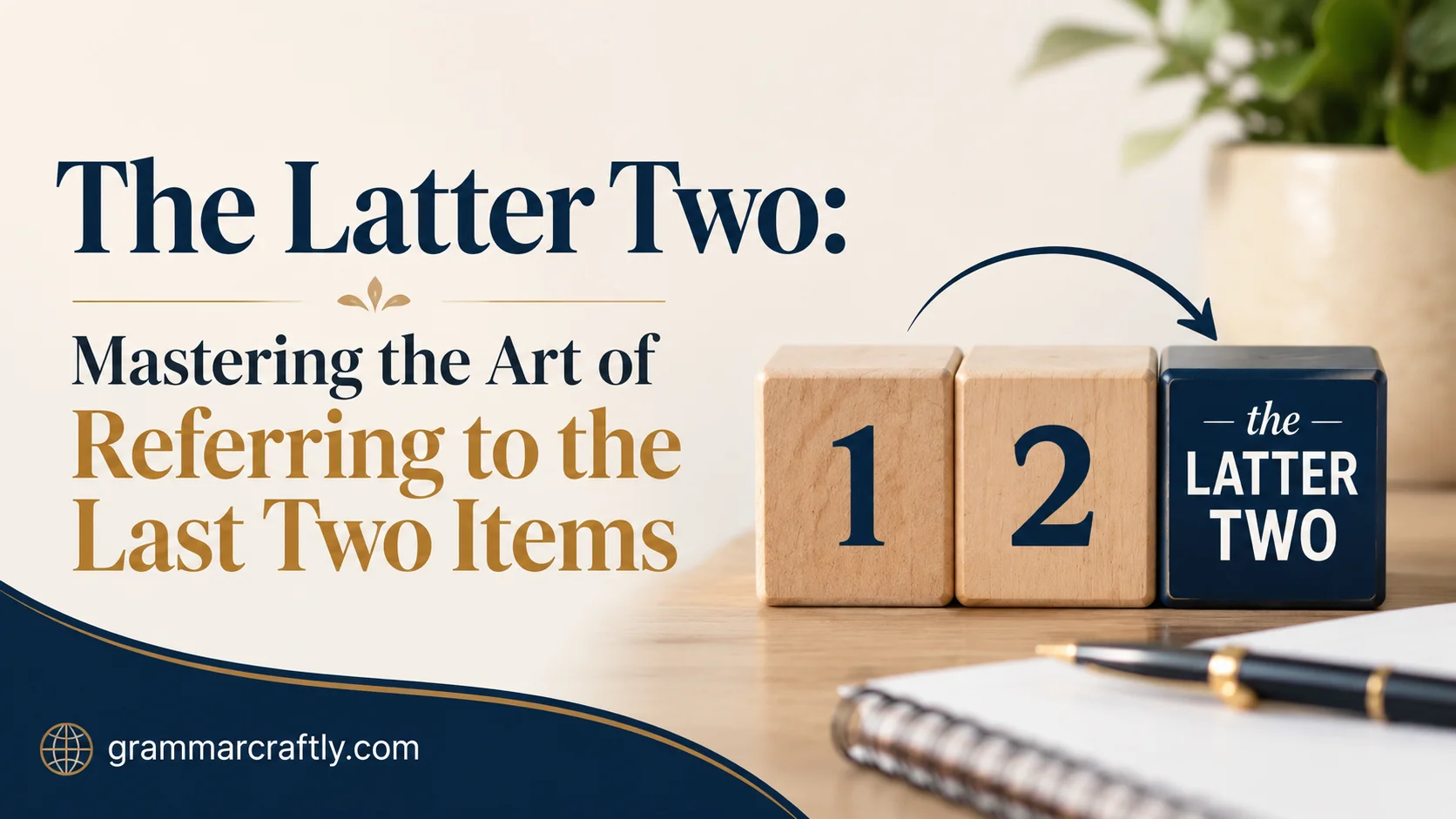
The Latter Two: Mastering the Art of Referring to the Last Two Items helps learners use former and latter clearly in lists and context usage.
The idea of former, latter, first, second, and last appears in groups of two or several items in a list, where a phrase becomes more formal and polished for better clarity and context. Based on usage guides and definitions, the correct sense of referring depends on sentence structure and proper usage, especially for English learners and writers who often pause to find the correct way of identifying positions in communication. This phrase improves clarity in context, supports sentence structure, and follows proper usage rules in English, helping English learners, writers, and editors reduce confusion in items, lists, and groups where meaning depends on order. It strengthens understanding, comprehension, and accuracy in both written English and spoken English, while connecting sense, referring, definitions, and language rules for better communication.
In real use, it directly points to the second item and third item in a three-item example like apples, bananas, and oranges, helping readers avoid misinterpretation. From experience, learners often pause, but once they understand, their semantics, interpretation, and expression improve. This builds confidence, improves readability, and supports better guidance, instruction, and learning through examples, practical examples, and teaching in spoken English and written English. Regular practice reduces confusion in list confusion, especially when name items directly are replaced with clearer reference words. It highlights difference, sequence, pair, and grouping of people, animals, and things, improving logic and communication skill. This ensures concise and unambiguous writing, avoids repetition in long lists, and supports mastery of sentence formation, nuances, and instructional material for everyday language in speaking and writing, even in real conversation with flexible usage and possibility greater than two situations.
Former vs Latter Meaning in Simple English
Let’s strip everything down to the core idea.
- Former means the first item in a pair
- Latter means the second item in a pair
That’s it. Two choices. One rule.
Think of it like picking between tea and coffee.
- Tea = former
- Coffee = latter
If someone says, “I like tea and coffee, but I prefer the latter,” you now know they mean coffee.
A quick mental image
Imagine a line:
First → Former
Second → Latter
Your brain should always map it in that direction.
Why “Former vs Latter” Confuses So Many Writers
Here’s the real problem. People don’t struggle because the rule is hard. They struggle because language doesn’t always stay clean and structured.
Three main reasons cause confusion:
Too many items in a sentence
When a sentence lists three or more things, writers still try to use former and latter. That breaks the rule.
Example:
I considered apples, oranges, and bananas, but I chose the latter.
Which one? It becomes unclear.
Memory overload
Readers don’t always hold the full list in their head. By the time they reach “latter,” they’ve forgotten the options.
Overuse in formal writing
Academic and business writing often pushes writers to sound “precise,” which ironically leads to unclear phrasing.
The Two-Item Rule You Must Never Break
Here’s the golden rule:
Use former and latter only when you have exactly two items.
No exceptions in modern clear writing.
Correct usage examples
- I had coffee and tea, but I chose the former.
- Between reading and watching TV, I prefer the latter.
Incorrect usage examples
- I had coffee, tea, and juice, but I chose the latter ❌
- She bought a phone, laptop, and tablet. The former was expensive ❌
The moment you go beyond two items, stop using these words.
Former vs Latter in Real Life Communication
Grammar rules only matter if they work in real life. Let’s see how this plays out.
Workplace example
We can schedule the meeting on Monday or Friday. The latter works better.
Clear. Fast. No confusion.
Everyday conversation
Do you want pizza or burgers? I’ll take the latter.
Natural. Easy.
Academic writing example
The study compared short-term memory and long-term memory. The latter showed stronger retention over time.
Works well because only two items exist.
Why “The Latter Two” Is Grammatically Problematic
You might have seen phrases like:
the latter two options
It sounds official. It even appears in casual writing. But here’s the truth:
It breaks the logic of the word.
Why it doesn’t work
“Latter” already refers to the second item in a two-item set. Once you say “two,” you expand the set beyond the rule.
That creates ambiguity. Readers pause and reinterpret.
Better alternatives
Instead of:
- the latter two options
Use:
- the last two options
- the final two choices
- option two and three (if listed)
Former vs Latter Compared to Modern Writing Standards
Modern style guides push for clarity over tradition.
Here’s how major writing standards treat these terms:
| Style Guide | View on “Former/Latter” |
| AP Style | Acceptable but often discouraged in long lists |
| Chicago Manual of Style | Acceptable but recommends clarity first |
| Modern journalism | Often avoids both in favor of direct naming |
| UX writing standards | Strongly discourages both |
Why clarity wins today
Readers skim more than they read. Online content competes for attention. That means unclear references lose value fast.
The Cognitive Load Problem Behind Former vs Latter
Here’s something most grammar guides skip.
Your brain only holds a small amount of information at once. When you read a sentence with multiple items, you already spend mental energy tracking them.
Now add “former” or “latter” at the end.
Your brain has to:
- Recall the list
- Identify position
- Map meaning
- Confirm interpretation
That’s too much friction.
Simple takeaway
If your reader has to think twice, your sentence failed.
Better Alternatives to Former vs Latter
You don’t need to rely on these terms at all. English gives you cleaner options.
Direct naming (best option)
Instead of:
I like coffee and tea, but I prefer the latter.
Write:
I like coffee and tea, but I prefer tea.
Numbered clarity
I had two options:
- Coffee
- Tea
I chose option 2.
Repetition (very clear in writing)
I considered coffee and tea. I chose tea.
Simple substitution table
| Instead of | Use |
| former | first option / first item |
| latter | second option / second item |
Case Study: How Clarity Improves Professional Writing
Let’s look at a real editing scenario.
Original sentence (unclear)
The company tested email marketing and social media ads. The latter performed better in engagement but the former produced more conversions.
Problem
The sentence forces readers to track meaning mentally. It slows comprehension.
Improved version
The company tested email marketing and social media ads. Social media ads performed better in engagement but email marketing produced more conversions.
Result
- Faster reading
- Zero ambiguity
- Better retention
This is why modern editors often remove “former/latter” entirely.
Common Mistakes Writers Make with Former vs Latter
Here are the errors that show up most often:
Using it with more than two items
This is the most frequent mistake.
Placing it too far from the original list
Readers forget the reference point.
Mixing it with unclear sentence structure
If the sentence already feels complex, adding these terms worsens clarity.
Overusing it in formal writing
Writers sometimes think it sounds smarter. It doesn’t. It just adds friction.
Memory Tricks That Actually Work
Let’s make this stick without effort.
Trick 1: The order rule
First = former
Last = latter
Trick 2: Alphabet hint
F comes before L
So former comes before latter
Trick 3: Story method
Imagine two friends:
- Frank (former) goes first
- Leo (latter) goes second
The story helps your brain lock it in.
Mini Practice Section: Fix the Sentence
Try these before checking the answers.
Sentence 1
I enjoy reading and writing but I prefer the latter.
Corrected
I enjoy reading and writing but I prefer writing.
Sentence 2
Between dogs and cats I choose the former.
Corrected
Between dogs and cats I choose dogs.
Sentence 3
The study analyzed laptops, tablets, and smartphones but the latter showed the highest usage.
Corrected
The study analyzed laptops, tablets, and smartphones but smartphones showed the highest usage.
Former vs Latter in Digital Communication
Online writing demands speed and clarity.
Where these terms still appear
- Academic essays
- Legal writing
- Formal reports
Where they usually fail
- Blog content
- UX writing
- Marketing copy
- Social media posts
Why digital platforms avoid them
Readers scan content in seconds. Anything that slows understanding reduces engagement.
Read More: Delicious or Dilicious – Which is Correct?
Simple Decision Framework for Writers
Before using former or latter, ask:
- Do I only have two items?
- Will my reader instantly remember both items?
- Can I just repeat the word instead?
If you hesitate even once, rewrite the sentence.
Quick Comparison Table: Old vs Modern Writing
| Traditional Style | Modern Style |
| I prefer the latter | I prefer tea |
| The former was better | The first option was better |
| The latter two options | The last two options |
| He chose the former | He chose the first option |
Modern writing almost always wins on clarity.
Expert Insight: Why Simplicity Wins in Grammar
Language evolves toward ease of understanding. Not complexity.
As linguist Steven Pinker explains in The Sense of Style:
“Good writing is about making ideas easy to understand.”
That principle directly applies here. “Former” and “latter” often slow readers down. Simpler language speeds them up.
Final Takeaway
The debate around former vs latter looks complicated on the surface. It really isn’t.
Once you remember the core rule—two items only—you already avoid most mistakes. The real skill comes from knowing when not to use them at all.
Clear writing always beats clever wording. Every time.
If you want your writing to feel modern, readable, and sharp, replace confusion with direct language. Your readers will thank you without saying a word.